© 1999-2024 by Joseph L. Monzo
Around 1900, Vienna was paradoxically both
the strongest bastion of musical conservatism and simultaneously
(along with Paris) the birthplace of the most radical new ideas
in Western music.
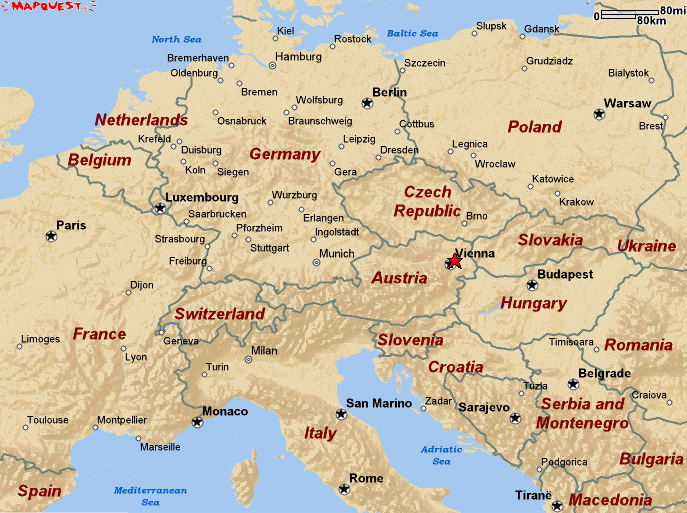
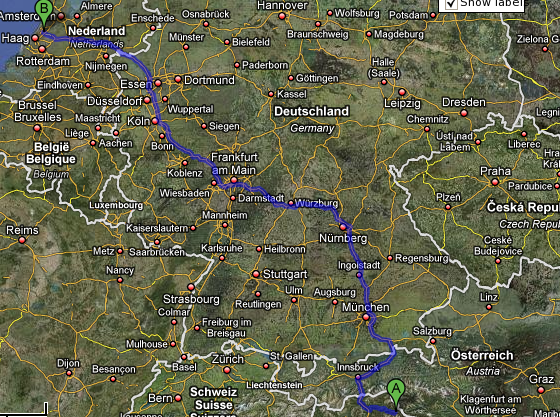
map of central Europe in 2005. The red star designates Vienna, Austria
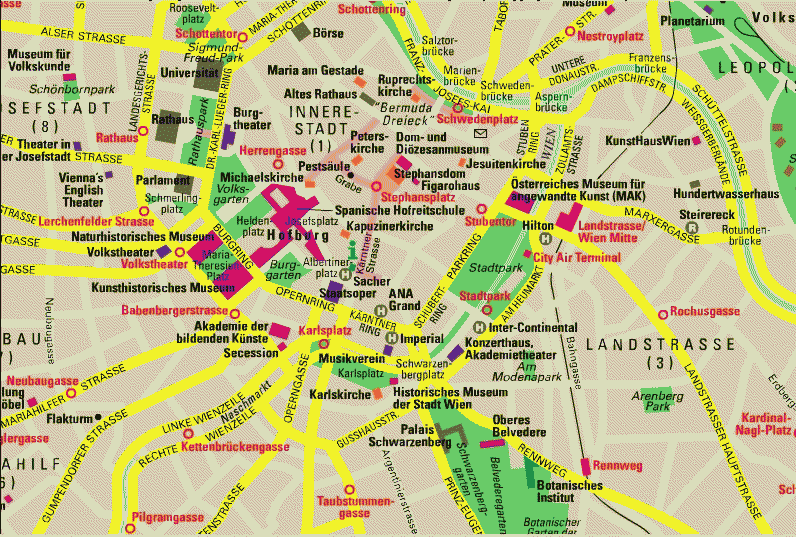
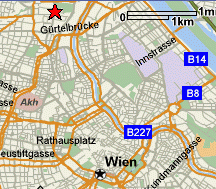
central Vienna in 1999
At that time, with only a few exceptions,
Europe, and places colonized by European
countries, were the only cultural areas whose music
was characterized by the use of
harmony.
A clearly-defined system had been established whereby
one particular note was felt to be the central,
primary note over all the others, and a piece would
be said to be "in the key of" that note. This type
of music is referred to as "tonal".
After several centuries (c. 1500-1900) of this, a few bold composers began writing music which did not give a single note primacy. The two earliest significant examples were Charles Ives, in America (notably, his Unanswered Question, composed originally in 1906), and Arnold Schoenberg, in Vienna. I find it interesting that Schoenberg and Ives were born within about a month of each other.
The first truly atonal pieces were Schoenberg's 2nd Quartet 4th movement, 3 Piano Pieces, and song-cycle Book of the Hanging Gardens, all written in 1908. Ives's work could really be characterized more as 'polytonal', while Schoenberg preferred the term 'pantonal' for the pieces he composed which disregarded traditional ideas about tonality.
It was Schoenberg's belated but extreme admiration for Mahler's work and ideals, not to mention Mahler's selfless support, that encouraged Schoenberg to be true to himself, stick to his radical inspirations, and not be swayed by criticism; he also learned from Mahler the importance of a polyphonic mode of composition, something that stayed with Schoenberg the rest of his life.
Apparently Schoenberg's student Webern was the one who really stimulated Schoenberg into giving full rein to his most progressive tendencies and into finally abandoning traditional concepts of tonality. From what I've been able to deduce, the pivotal period, when all this really began to emerge, was the summer of 1905 (which is when Mahler wrote the piece that opens with this page).
Here is a detailed chronology, centered mainly around Mahler's life,
with several decades of background sketched in, and the years after
World War I as an epilog. The "century" in the title refers roughly
to the period 1803-1908 (Beethoven's Eroica to Schoenberg's
first atonal pieces), and the entire period covered in detail,
from the French Revolution to World War 1, corresponds surprisingly
closely to the "long 19th century" defined by historian Eric Hobsbawm.
Most of the events take place during the
reigns of Napoleon and the
Habsburg Emperors. This work is not strictly limited to
descriptions of musical life in Vienna -- because of the important role
it played in the arts during the Romantic period, I inevitably had to include
many of the events that occurred in Paris. In particular, Liszt had
little association with Vienna but was too important to leave out.
I've used the present tense in
an attempt to convey the sense of excitement surrounding these events.
This webpage also documents, more completely than any other source I know of, something which really surprised me as I learned more and more about it... the interest in Viennese musical circles in my other favorite musical subject (besides Mahler and Schoenberg): microtonality.
While the facts presented here have been taken from a very wide variety of sources (many of them still remaining to be cited, those which are have been listed at the bottom of this page), there is much original speculative material of mine sprinkled throughout the documentable chronology. Some examples:
* The likelihood that Mahler intended meantone tuning to be used for his symphonies, at least partly, based on the possibility of his familiarity with the teachings of Josef Petzval on 31-edo during Mahler's stay at the University of Vienna, and on his later remarks to Schoenberg lamenting that "European music, in giving up Meantone tuning, had suffered a great loss".
* Mahler's possible re-use of material from his abandoned opera project Rübezahl in his Symphonic Poem [1st Symphony], and the likelihood that his original conception of the piece was as a 4-movement work without the 'Blumine' movement, and that adding 'Blumine' was an afterthought over which he changed his mind back and forth several times.
* The influence the success of Strauss's early Symphony in F minor had on Mahler just before the latter completed his Symphonic Poem [1st Symphony].
* The possibility that what later became the base layer of Mahler's 1893 "Hamburg" manuscript of Titan [1st Symphony], was originally written out in 1891 as a Stichvorlage ['engraver's model'] of what he was still calling a Symphonic Poem, now with the title From the Life of a Lonely One, in hopes of getting it published by Schott, and that in this form it was again a 4-movement work that did not include the 'Blumine' movement.
* The influence Brahms had on Mahler at several various times as their personal friendship deepened. This relates to some of Mahler's important early compositional decisions (concerning Mahler's 1st and 2nd Symphonies) as well as his habit of secluding himself in the country during the summer to compose.
* The influence Tanaka's pseudo-just-intonation (really 53-edo) "Enharmonium" may have had on Bruckner's harmonic experiments in his 9th Symphony.
* The possibility that Hanslick's death in August 1904 may have been the catalyst for Mahler to end his 6th Symphonic as a tragedy - the only one of his symphonies which does so.
* The "program" of Mahler's 7th, influenced by Mahler's fascination with the program of Strauss's Sinfonia Domestica.
* The influence Schoenberg had on Mahler before the latter composed the 3rd, 5th, and 1st movements (in that order) of his 7th Symphony during the summer of 1905, and the influence this Mahler piece in turn had on Schoenberg when he wrote his Kammersymphonie the following spring and summer.
* The influence Webern had on Schoenberg in the fall of 1905 when the latter was composing his 1st Quartet and Webern brought his single-movement String Quartet to Schoenberg for his composition lessons.
* The possibility that Mahler's comment about "being too old to have the ears for Schoenberg's music" and the argument that the two of them had about klangfarbenmelodie, were connected to Mahler's possible loss of high-frequency hearing from his listening to large orchestras every day.
* The possibility that the opening of Das Lied von der Erde was Mahler's rendering in music of the horrible wheezing he heard as his 5-year-old daughter Maria lay dying after her tracheotomy (as documented in Alma's book).
* The possible influence Scott Joplin may have had on Mahler while they both lived in New York 1907-1911 (reflected in a motive and harmonic progression very typical of a Joplin ragtime near the end of Mahler's 10th Symphony, and possibly also in the irregular meters of the 2nd movement of the same symphony).
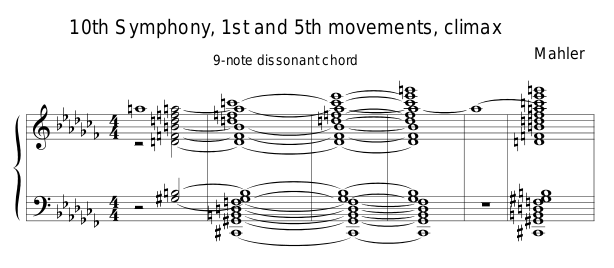
* The possibility that the sonic inspiration for the dissonant 9-note chord (the infamous "nonachord") at the climax of the first and last movements of Mahler's 10th Symphony may have been the sound of the orchestra tuning-up before a performance, because of the long-held "A" and the seemingly random dissonance of the chords, and because of the way the chord first builds up in sections, then after another held "A", the whole orchestra plays the dissonance.
* The possibility that Schönberg knew of Mahler's association since childhood of the popular Viennese tune "Ach, du lieber Augustin" with tragedy, because of Schoenberg's use of this tune in his 2nd Quartet, written as Schoenberg was dealing with his marital crisis.
* The experimentation with microtones by Schoenberg and Webern in 1909 leading to the development of sprechstimme ['speech-voice'] the following year.
* The influence of Möllendorf on Hába and Wycschnegradsky to adopt the use of quarter-tones.
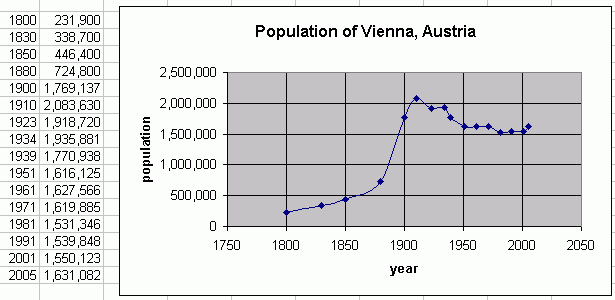
population of Vienna, 1800-2005
1781
On March 13, in Bath [England], 42-year-old astronomer William Herschel, who is also a composer and proficient musician -- and whose musical studies led him to his interest in mathematics, astronomy, and telescope-building -- discovers the 7th planet, Uranus. This momentous event marks the first planet discovered with the telescope (i.e., not visible to the naked eye), and hence the first planet not known to the ancients.
|
Aerial view of Esterháza Palace
|
20 years into his 29-year residence and employment at Esterháza [now in Fertöd, Hungary], the 126-room palace built in 1760 by the Esterházy family, 49-year-old Franz Joseph Haydn composes:
|
In March, 25-year-old composer Wolfgang Amadeus Mozart, who had been a famous child prodigy, is dismissed from his position at the court in his native Salzburg [Austria], and moves to Vienna to live as a freelance composer. In this year Mozart composes:
1782
50-year-old Haydn composes:
26-year-old Mozart composes his opera Die Entführung aus dem Serail ['the abduction from the Seraglio'], in Singspiel style (i.e., containing only set pieces, with spoken dialog between them, and no recitative), produced on 16 July at the Burgtheater in Vienna. Previously, only imitations or translations of foreign works have been successful at this theater, and this opera fulfills the Emperor's longtime wish to produce a successful German opera. It also establishes Mozart's reputation in his new hometown.
Other major works by Mozart this year:
1783
27-year-old Mozart composes the following pieces (among others) this year in Vienna (with the exception of the 36th Symphony, composed in Linz, Austria):
During the summer, in Bonn [Germany], capital of the Electorate of Cologne (one of numerous small states of the Holy Roman Empire), 12-year-old Ludwig van Beethoven, a promising young Court musician, composes the second of his acknowledged works: 3 piano sonatas (the "Electoral Sonatas", WoO 47) dedicated to the Elector of Cologne, Maximilian Friedrich, and these are published in October. In the fall, Beethoven goes with his mother on a trip to Rotterdam [Netherlands], and for his performance in a concert is paid more than any of the other participating artists, 63 florins (equivalent in 2007 buying power to about US$2,000).
1784
Sometime this year, Haydn and Mozart meet and establish a good friendship, each of them admiring the other's compositions, and occassionally play together in a string quartet for informal gatherings.
52-year-old Haydn composes:
28-year-old Mozart composes 6 piano concertos this year, and a few other important works:
1785
53-year-old Haydn composes:
29-year-old Mozart composes 3 piano concertos this year, among other works:
1786
54-year-old Haydn composes:
30-year-old Wolfgang Amadeus Mozart composes his opera Le nozze di Figaro ['the marriage of Figaro'], K.492 and premières it in Vienna on 1 May. In addition he composes the following other works:
Mozart also gives harmony and counterpoint lessons to young English composer Thomas Atwood. Atwood's notebooks survive, and show that Mozart taught that there should be two different sizes of semitone, with the sharps lower in pitch than the flats, indicating a form of meantone tuning. Mozart's father had taught this in his own violin method, and wrote a letter to his son citing Tosi as an authority on tuning, leading to the conclusion that the variety of meantone which Mozart had in mind was approximately 55-edo or 1/6-comma.
On 14 December, Iwan Müller (also spelled Mueller) is born in Reval [now Tallinn, Estonia]. He will go on to make great improvements to the "classical" clarinet.
1787
55-year-old Haydn composes:
Due primarily to constant warfare, the French government has been spending more than its annual revenue, principally by borrowing. The royal government proposes a series of major reforms to raise taxes and reduce expenses, which meet with great resistance from many French people across a variety of social classes. There is a demand for greater representation in government.
In late March, in Bonn, 16-year-old Beethoven goes to Vienna [Austria] to study with famous 31-year-old Mozart. But Beethoven has to cut his trip short to return home in April because of his mother's failing health. His mother dies from tuberculosis on 17 July at age 40, and on 25 November his 1-year-old baby sister also dies, leaving only Ludwig and his younger brothers Johann and Carl. Beethoven's father slips deeper into alcoholism, and Ludwig as the eldest surviving child eventually has to take on the responsibility of caring for the family. Beethoven will remain in Bonn for 5 more years, and during this time the French Revolution occurs, inspiring Beethoven to uphold the ideals of "liberty, fraternity, equality" for the rest of his life.
Important compositions completed this year by Mozart include:
Mozart gives the première of Don Giovanni in Prague on 29 October.
55-year-old Joseph Haydn composes his Symphony No. 89 in F-major.
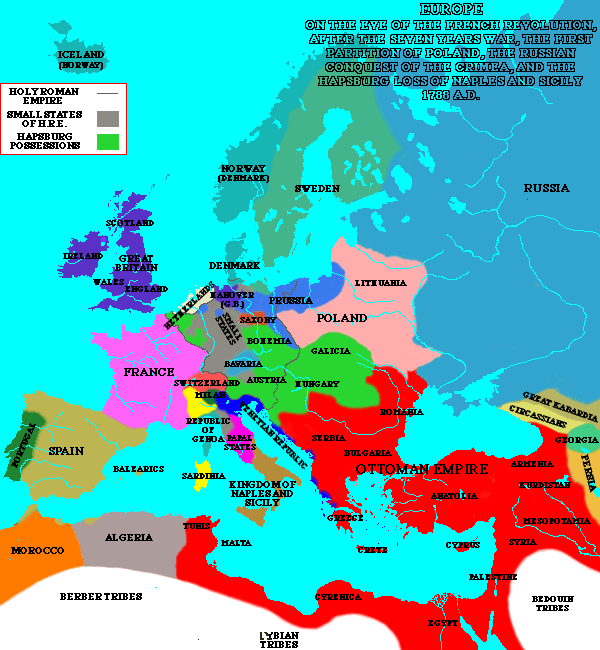
Europe in 1788
1788
56-year-old Joseph Haydn composes:
During the summer, 32-year-old Mozart composes his great last 3 symphonies,
among other works:
1789
In Paris [France] in May, the Estates-General (a body of advisors to the King)
meets for the first time since 1614 to decide how to manage the French government's
fiscal responsibility. The differences between deputies of the
nobles and commoners grow deeper, and leading deputies from the Third Estate
decide that they have to seize power. On 17 June 1789, they declare
that they alone represent the "nation", calling themselves the "National Assembly",
and thus beginning the French Revolution. On July 14, a mob of citizens takes over
the Bastille (a fortress serving as a prison holding those
who displease king Louis XVI), turning the Revolution into a popular uprising.
On August 26, the National Assembly publishes the
Declaration of the Rights of Man, declaring that all men are free and equal.
33-year-old Mozart composes:
57-year-old Joseph Haydn composes his 92nd Symphony in G-major,
the "Oxford".
On 20 November, 18-year-old Beethoven obtains a legal order by which
his father's salary is continued despite the father's inability
(due to his alcoholism) to carry out his job responsibilities, and
half of his father's salary is paid directly to Beethoven to enable him
to support the family, in addition to Beethoven's
own income from his job as a violist in the court orchestra.
He becomes familiar with three of Mozart's operas performed at court in this period.
1790
At the Burgtheater in Vienna on 26 January, the day before his 34th birthday, Mozart
premières his opera Cosi fan tutte ['thus do all (women)'
or 'women are like that'], which had been suggested to him by
Emperor Joseph II. Mozart's other important works this year include:
Holy Roman Emperor Joseph II, ruler of Austria (and brother of Marie Antoinette),
dies on 20 February at age 48, and is succeeded by his 42-year-old brother Leopold II.
Leopold secures peace negotiations and quiets the revolutions in Netherlands
and Hungary, and tries to prevent war with France.
In Paris on 12 July, the National Assembly passes the Civil Constitution of the Clergy,
which reorganizes the Catholic Church in France. This measure
makes the clergy elective and makes them salaried employees
of the revolutionary government, thus cancelling royal and
papal powers to appoint clergy. The roughly 15 percent of French land
formerly owned by the church becomes "national property,"
which the assembly starts selling off to pay its debts. One result of
this law is the formulation of an illegal underground Church loyal to the Pope,
alongside the official Church controlled by the government. This situation
will last until 1801.
On 28 September, Prince Nicklaus Esterházy dies. His son
and heir Anton is not interested in retaining the Esterháza
palace because of its remoteness, and thus 58-year-old Haydn's employment ends.
But Haydn has become the most popular composer in England, and he accepts
a lucrative offer from impressario Johann Peter Salomon to visit England
and conduct new symphonies there. Haydn leaves Vienna on 15 December,
and passing thru Bonn, meets Beethoven just after his 20th birthday.
Crossing the English Channel by boat, Haydn sees the sea for the first time.
1791
In Paris in June, the French National Assembly finally drafts a new constitution,
greatly limiting king Louis XVI's power. Louis has tried to
go along with the revolution and has remained popular, but
now he and his supporters turn against revolutionary factions.
Louis attempts to flee France, is arrested and returned to Paris,
and accepts the new consitution. In September new elections
are held for a Legislative Assembly.
In the Carribean, a slave revolt begins on August 22 in the French
colony of Saint Domingue [today Haiti], leading to a civil war which
will eventually establish the new Republic of Haiti.
59-year-old Haydn composes the first four of his 12 "London" symphonies:
35-year-old Mozart composes:
La Clemenza di Tito is Mozart's last opera, composed to satisfy
a commission he receives in July for an opera seria
to celebrate the coronation of Leopold II as King of Bohemia.
On 30 September at the Theater-an-der-Wien outside Vienna,
Mozart premières Die Zauberflöte,
and it is a huge success.
Mozart is unable to complete his last composition,
his Requiem [mass for the dead], K.626,
as he becomes ill and dies suddenly in Vienna on December 5 at the age of 35,
and is buried in an unmarked communal grave. Contrary to
popular belief, this was not a mass grave, nor was he a pauper
at his death -- his difficulties with money stemmed from his
habit of spending his fortune lavishly.
1792
Leopold II of Austria dies on 1 March at age 44,
and is succeeded by his 23-year-old son Francis II.
Attempting to stop the slave revolt in Saint Domingue [now Haiti],
in March, the Legislative Assembly of France grants
civil and political rights to free men of color in the French colonies.
The other European powers and the United States are shocked by this decision.
6,000 French soldiers are also dispatched to the island,
with Léger-Félicité Sonthonax in charge.
On April 20, France declares war on Austria, which lasts until 1797.
With Prussia as Austria's ally, this is the War of the First Coalition,
and France soon occupies the land up to the Rhine, including Bonn.
From now until 1815 France is involved in a nearly continuous
series of wars, a period sometimes called the "Great French War".
In France itself, revolutionary reforms prove to be largely unpopular,
and a counter-revolution begins almost immediately. King Louis XVI
is deposed by a mob on August 10, the new consitution is invalidated,
and the Legislative Assembly dissolved. A National Convention
is convened beginning on September 20 to draft a new consitution ruling
France as a republic, to form a new ruling assembly, and to
decide the fate of the king, who is stripped of his title
and sentenced to death. "Year I" of the new French Republican Calendar
begins on September 22.
60-year-old Haydn composes the fifth and sixth of his 12 "London" symphonies:
and then returns to Vienna.
In Bonn, 21-year-old Beethoven completes the score of a concerto
which will eventually become known as his
Piano Concerto No. 2, op.19 in Bb-major.
With Bonn temporarily occupied by France and the war raging,
on 2 November, Beethoven leaves Bonn again and
returns to Vienna, planning to study with Haydn.
About a month after his arrival in Vienna, Beethoven's father dies
in Bonn on 18 December.
Beethoven embarks upon a period of study of counterpoint and violin,
and establishes a reputation as a piano virtuoso and improviser
in the salons of the nobility, often playing the preludes and fugues
of J. S. Bach's Well-Tempered Clavier.
Gioacchino Antonio Rossini is born in Pesaro, Italy on 29 February.
His father is the town trumpeter and his mother is a singer.
1793
In Paris during the winter and spring there are food riots
and mass hunger. In January, "Citizen Capet" (formerly king Louis XVI)
is beheaded at the guillotine. Supporters of the Revolution view
it as liberation, while detractors see it as stupid and cruel.
Spain and Portugal join Prussia in the coalition against France in January.
On February 1 France declares war on Great Britain and the Dutch Republic.
In Haiti, this has the effect of the white planatation owners joining
with Britain to fight French rule. Spain, who controls the other side of the island
of Hispaniola, joins with Britain against France, invades Saint Domingue,
and is joined by the revolting slaves. To prevent military disaster,
a French commissioner frees the slaves in his jurisdiction
On April 6 the National Convention, having until now been preoccupied
with war, creates the Committee of Public Safety, headed by
Maximilien Robespierre, to deal with the problems inside France.
Until the middle of 1794, the Revolutionary ideals are twisted into
the paranoid "Reign of Terror" (led by Robespierre), as anyone suspected of
being counterrevolutionary is sent to the guillotine.
On August 29 in the French colony of Saint Domingue [now Haiti], Sonthonax
proclaims the freedom of the slaves in the north province.
In September and October, emancipation is extended to the whole colony.
61-year-old Haydn composes the seventh of his 12 "London" symphonies:
the 99th Symphony in Eb-major.
In Vienna 22-year-old Beethoven rewrites the score, previously composed before
he left Bonn, of a concerto which will eventually become known as his
2nd Piano Concerto, op.19 in Bb-major.
Beethoven is also inspired to set Schiller's 'Ode to Joy' to music
-- a project which will occupy his mind on-and-off for 30 years
before finally being realized in his 9th Symphony.
1794
On February 4, the French National Convention ratifies Sonthonax's
emancipation of all slaves in Saint Domingue [today Haiti],
and applies it to all French colonies, marking it as a momentous event.
22-year-old Beethoven finishes his lessons with
62-year-old Haydn, who leaves for his second trip to London.
Haydn composes the 8th, 9th, and 10th of his 12 "London" symphonies:
With Haydn gone from Vienna, the Elector of Bonn
expects 23-year-old Beethoven to return home. Beethoven
instead chooses to remain in Vienna, continuing the instruction in
counterpoint with Johann Georg Albrechtsberger and other teachers.
His stipend from the Elector has expired, but many Viennese noblemen,
among them Prince Joseph Franz Lobkowicz, Prince Karl Lichnowsky,
and Baron Gottfried van Swieten, already recognize his talent and
offer him financial support. For Beethoven, Albrechtsberger proves to be a better
teacher than Haydn. Some time this year or earlier
Beethoven completes his String Trio, op.3.
On June 26, in the Battle of Fleurus, French forces under Jourdan
defeat an Austrian army under Saxe-Cobourg a decisive battle, and France
occupies the Rhineland. The French use of the reconnaissance balloon
l'Entreprenant ['The Enterprise'] marks the first military use
of an aircraft that has a decisive influence on the outcome of the battle.
In Paris, on July 27 (9 Thermidor Year II, in the French Republican Calendar),
a reaction against Robespierre and his allies results in a
concerted and organized attack from other members of the Committee of Public Safety.
The next day Robespierre is tried and executed,
ending the Reign of Terror and paving the way for the rise of Napoleon.
1795
63-year-old Haydn composes the last two of his 12 "London" symphonies,
which are his last two symphonies:
At the end of March, 24-year-old Beethoven bursts onto the scene,
making his public debut as composer and performer, performing his
2nd Piano Concerto, op.19 in Bb-major. His 3 Piano Trios, op.1
are his first published work, selling for 1 ducat per copy, of which
241 are printed, and at least 125 are sold. After paying his fee to the publisher
of 1 gulden per copy, his profit (in 2007 buying power) is approximately
US$100 per copy, earning a total somewhere between $13,000 and $24,000.
Beethoven works on his next concerto, the one eventually known
as 1st Piano Concerto, op.15 in C-major, and also completes
his first published sets of piano sonatas:
Also around this time, Beethoven composes two "Easy Sonatas",
probably for his students, which he does not intend to publish,
but which his brother Caspar Carl later will publish. At that time
they are named the Sonatas, op.49 and today are known as
the 19th and 20th Sonatas.
Haydn returns to Vienna from his second trip to England, and is now
widely recognized as a celebrity. He moves into a large house in the
Vienna suburb of Windmühle. Prince Anton Esterházy had died,
and his successor Nikolaus II wishes to revive the musical activity
at court with Haydn leading it. Haydn accepts on a part-time basis and spends
the summers with the Esterházys at Eisenstadt. During these
years he composes 6 masses for them.
In France there is a royalist uprising which is put
down by the army under Napoleon's direction. A new constitution
is adopted on October 5 which creates the Directory.
1796
25-year-old Beethoven undertakes a concert tour of Germany,
performing in Prague, Dresden, Leipzig and Berlin.
While in Berlin he composes his Cello Sonatas, op.5
for King Frederick William II of Prussia, who played the cello.
He also first begins to realize that he is
slowly losing his formerly very acute sense of hearing.
In October, 64-year-old Haydn begins composing his oratorio
The Creation (in English).
1797
Franz Schubert is born in Vienna on January 31.
26-year-old Beethoven is engaged for most of the year in
composition of his 3 Piano Sonatas, op.10.
In this year he publishes several of his early works:
Around this time a new dance craze sweeps Europe: the waltz.
It is strikingly different from the former predominant 3-beat dance,
the Minuet -- the tempo is livelier; the partners hold each other in a close embrace,
which many detractors find scandalous; and they glide across the floor
hardly lifting their feet. Other than its long reign as the new king of dances
in popular music, the main effect of this shift on concert music is that
the 3rd movement of the sonata and symphony, which Haydn had established as a Minuet,
becomes much faster in Beethoven's hands -- not really a waltz, but rather
a new creation which he labels "scherzo".
The Treaty of Campo Formio, between France and Austria, is signed on October 17.
It marks the collapse of the "First Coalition", the victorious conclusion to Napoleon's
campaigns in Italy and the end of the first phase of the Napoleonic Wars.
The treaty passes a number of Austrian territories into French hands,
including the Austrian Netherlands (Belgium) and certain islands in the
Mediterranean and Corfu and other Venetian islands in the Adriatic.
Venice and its territories (Venetia) are divided between
the two states: Venice, Istria and Dalmatia are turned over to Austria.
Austria recognizes the Cisalpine Republic and the newly-created Ligurian Republic
(formed of Genovese territories) as independent powers.
The borders of France are extended up to the Rhine, the Nette, and the Roer.
Free French navigation is guaranteed on the Rhine, the Meuse, and the Moselle.
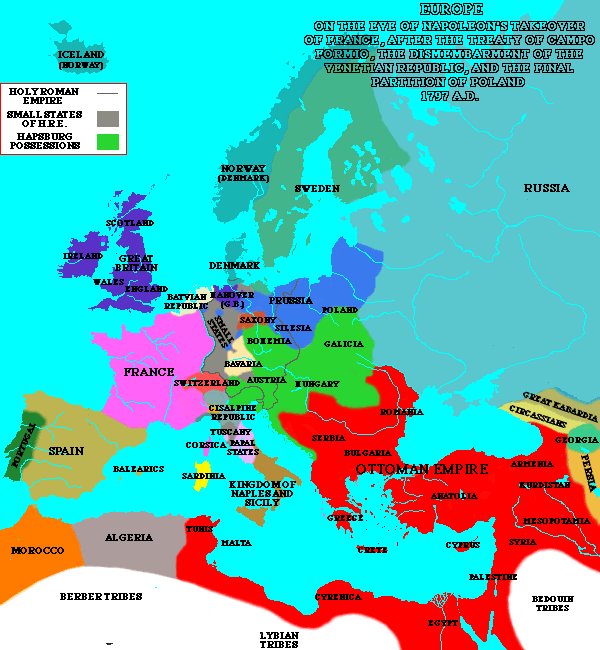
Europe in 1797
1798
In April, 66-year-old Haydn completes his oratorio
The Creation (in English), considered by many
to be his greatest masterpiece. It was immediately so successful
that it inspired Haydn to begin composition of another large
oratorio, The Seasons.
27-year-old Beethoven completes:
and has them published in July. By this time he has probably
also completed his 8th Piano Sonata, op.13 ("Pathetique").
During the summer he begins
sketching his 3rd Piano Concerto, op.37 in C-minor.
Then he embarks on the composition of his first set of string quartets,
the 6 quartets, op.18, working on them to the exclusion
of almost anything else until the end of 1799.
At some point during this year, Beethoven also stops sketching
his compositions on loose sheets of manuscript paper, instead
starting the habit, which will last the rest of his lifetime,
of writing down his musical ideas in large bound sketchbooks,
which he keeps at home. In addition, he carries smaller books
of music paper on his long walks, jotting down ideas which are
then transferred to the larger workbooks.
Napoleon and France occupy Egypt until 1803, which has the
lasting result of an extensive European interest in Africa.
1799
28-year-old Beethoven composes:
The "Pathetique" marks many innovations in both structure and style,
and is considered today to be the first really mature work by Beethoven.
In the Scherzo (2nd movement) of the 9th Sonata, at the first cadence
Beethoven uses what is essentially what later became known as the
"Hendrix Chord", 168 years before Jimi Hendrix did it.
He also begins work on his 1st Symphony.
Returning from his campaign in Egypt, Napoleon leads the army
in an overthrow of the Directory on November 9, and establishes
the Consulate, installing himself as ruler of France.
1800
29-year-old Beethoven composes:
In the spring, Beethoven travels to Hungary to
perform in Budapest, and to visit the Brunsvik estate.
On April 2, at the Burgtheater in Vienna, Beethoven holds
the first concert for his own benefit, and the program concludes
with the première of his 1st Symphony.
While Beethoven's piano sonatas have by now become
quite adventurous, his first symphony still shows the
strong influence of Haydn and Mozart.
In London, James Wood patents a means of boring woodwind-instrument
holes with a brass ring lining them. Putting a light coat of oil
on the inside of the bare brass keys ensures a tight seal, but the
metal-to-metal contact makes a loud noise.
1801
In Cornwall (England), 30-year-old inventor Richard Trevithick builds a
full-size steam road locomotive near the present day Fore Street at Camborne,
the first verified demonstration of a steam-powered vehicle.
On February 9, France and Austria sign a peace treaty, and during the
rest of the year Napoleon negotiates peace with the Papacy, ending the
shism between the official French Church and the underground Church,
and also with Britain and the Ottoman Empire.
68-year-old Haydn completes his oratorio The Seasons.
30-year-old Beethoven composes four piano sonatas: the
The op.27 sonatas again display bold innovations. Beethoven also takes on Ferdinand Ries and Carl Czerny as students.
Beethoven's hearing begins to deteriorate markedly. He suffers a severe form of tinnitus, a "roar" in his ears that makes it hard for him to appreciate music.
In France, 49-year-old Joseph Marie Jacquard exhibits his newly invented improved loom. Its final form will be revealed a few years later.
1802
Approaching age 70 and feeling the effects of old age, and sometimes in poor health, Haydn completes his last major work, the Harmoniemesse, the last of his 6 masses composed for the Esterházys.
31-year-old Beethoven's deafness has progressed to the point where,
on October 6, he writes the Heiligenstadt Testament
to his brothers Carl and Johann, to be opened and read after
his death, in which he says
Beethoven completes his:
but Beethoven resolves to write "a new kind of music" -- a desire which explodes into fruition with his next symphony. |
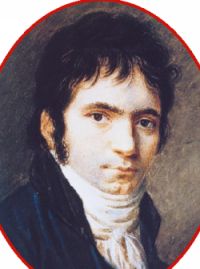
Beethoven |
1803
Oberdöbling, outside Vienna
|
In Vienna, during 2 weeks in March,
32-year-old Beethoven composes his oratorio
Christus am Oelberge ['Christ on the Mount of Olives']
and premières it on April 5,
and also premières his 9th Violin Sonata ("Kreutzer"), op.47
on May 17. Beethoven begins teaching piano and composition to
Archduke Rudolf (youngest son of Emperor Leopold II), a relationship
which will last nearly all of Beethoven's life, until 1824.
Many operas of Etienne-Nicolas Méhul and Luigi Cherubini are performed in Vienna during 1802 and 1803. This post-revolutionary French music exerts a profound influence on Beethoven. He spends the summer in Oberdöbling and begins his 3rd Symphony, in E-flat, which he calls the 'Bonaparte Symphony' (later renamed 'Eroica' ['heroic']). The monumental 1st movement is inspired by his admiration of Napoleon, whose wars seem to Beethoven to be a liberation from old-fashioned tyranny, and the symphony is dedicated to him. |
By the end of the year Haydn's condition has deteriorated to the point where he is no longer able to compose He complains that musical ideas constantly continue to come to him, but he is unable to organize them into proper works.
1804
On January 1, Dessalines officially declares the independence of the former French colony of Saint Domingue, renaming it "Haiti" after the indigenous Arawak name. This major loss is a decisive blow to France and its colonial empire.
In Wales on February 21, a steam locomotive built by 32-year-old Richard Trevethick carries 10 tons of iron, 5 wagons and 70 men a distance of 9.75 miles (16 km) in 4 hours and 5 minutes, an average speed of nearly 5 mph (8.0 km/h). This is the first demonstration of a practical steam railway.
Beethoven completes his Bonaparte Symphony [Eroica] by the spring.
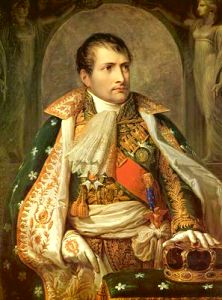
Napoleon |
34-year-old Napoleon crowns himself Emperor of France on May 18.
In accord with his feelings, Beethoven composes a monumental funeral march for the 2nd movement of his Bonaparte Symphony, and submits the work for publication in August. When the symphony is finally published, it is listed as a "Sinfonia Eroica, composta e festeggiare il Sovvenire di un grand Uomo" ['Heroic symphony, composed to celebrate the memory of a great man'], op.55." Note Beethoven's conspicuous use of Italian in that dedication instead of French, probably intended as an affront to Napoleon. |
|
When Napoleon actually carries out his coronation as Emperor in December, a disgusted Beethoven angrily yells:
and he scratches the name "Bonaparte" off of the dedication on the title page of his new symphony so violently that he creates a hole in the paper. |

Eroica Symphony manuscript - title page |
Motivated by the grandeur of his new conceptions, and by his rage at Napoleon, Beethoven also begins the sketches for a symphony in C-minor (which will eventually become his 5th Symphony), and his only opera Leonore [now known as "Fidelio"], and he composes:
1805
After being summoned to Paris and seeing the automated loom which had been invented in 1745 by Jacques de Vaucanson, 53-year-old Jacquard will make further improvements on his own design. The Jacquard Loom uses strings of punched cards to allow the loom to automatically weave the pattern on the cards. This idea will later inspire Charles Babbage to invent his Difference Engine and Analytical Engine, and will ultimately lead to the "stored program" concept used on modern computers.
Beethoven's 'Eroica' Symphony is premièred in Vienna on April 7. The symphony's length and highly dramatic style stun the audience, an mark a boldly innovative approach to concert music, being the first large-scale work of 'absolute' music (i.e., no text or programmatic story-line) to incorporate dramatic narrative, using purely musical means.
In the spring, Beethoven is in love with Josephine Brunsvik, who is now a widow. However, she refuses his proposal of marriage, and within a short time Beethoven's feelings towards her cool off.
On November 13, Napoleon's armies invade and occupy Vienna.
Napoleon appoints 44-year-old Luigi Cherubini as music director in Vienna, a post which will last about a year. During this time Cherubini conducts several of his own compositions in Vienna. As a composer, Beethoven considers Cherubini to be his greatest contemporary.
34-year-old Beethoven interrupts work on his C-minor symphony (the 5th) and composes:
Then Beethoven gets back to work on his C-minor symphony.
On December 26, the Treaty of Pressburg is
signed between France (Napoleon) and Austria (Holy Roman Emperor Francis II).
Austria loses much territory to France: Italy and Bavaria are ceded;
certain Austrian holdings in Germany are given to French allies - the King of Bavaria,
the King of Württemberg and the Elector of Baden; and
Istria, Dalmatia and the Bay of Kotor
are handed over to France as the "Illyrian provinces".
The treaty marks the effective end of the Holy Roman Empire.
Francis II declares himself Emperor Franz I of Austria, thus creating
the modern Austrian Empire.
1806
In January the French troops leave Vienna.
After just over 1000 years of existence, the Holy Roman Empire officially comes to an end, as Napoleon reorganizes it into the "Confederation of the Rhine", a loose confederation of over 30 relatively independent German states.
During the rest of the year, a triumphant Napoleon conquers Naples, Holland, Prussia, and Warsaw, leaving members of his family in charge of each new territory.
35-year-old Beethoven again interrupts composition of his C-minor symphony (the 5th), to revise his opera Fidelio, replacing the "Leonore Overture No. 2" with the "Leonore Overture No. 3", and produces the new version on March 29, but it is again withdrawn quickly.
On May 25, Beethoven's brother Carl becomes the first of the three brothers to marry, to Johanna Reiss. On September 4, their son Karl is born -- this nephew Karl will eventually be the source of a tragic destructive force in Beethoven's later life.
Beethoven uncharacteristically spends the summer in the city, staying in Vienna rather than going to the country as he usually would. He composes his Violin Concerto, op.61, in D-major, which is premièred on December 23, then again resumes work on the C-minor symphony.
Woodwind instrument maker Iwan Müller invents key-pads glued to the insides of the keys, the metal clarinet ligature with screws to tie the reed to the mouthpiece, and the thumb-rest to help hold up the clarinet and oboe.
14-year-old Rossini enters the Bologna Acadamy.
1807
36-year-old Beethoven once again interrupts (for the third time) composition of his Symphony in C-minor (the 5th) to compose:
Then Beethoven resumes his final work on the C-minor symphony, now numbered as the 5th.
1808
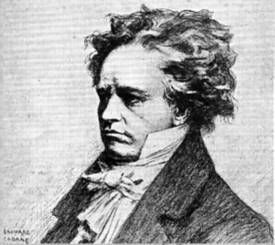
Beethoven |
In Vienna, 37-year-old Beethoven Beethoven finally completes his 5th Symphony, op.67, in C-minor (whose sketches go back to 1804), a work which introduces several formal and orchestral innovations subservient to its dramatic narrative. While finishing the last movements of the 5th, Beethoven also composes his 6th Symphony, op.68, in F-major, the "Pastoral", the first work for the concert-hall of important musical quality which has a programmatic story-line behind it. In the spring, Beethoven also writes down a theme in the "Pastoral" sketch-book which he later uses as the main section for his piano piece now known as Für Elise. |
Beethoven moves in with Countess Erdödy, but it is unclear today if this was a love relationship or just a very good friendship. He composes the 5th ("Ghost") and 6th Piano Trios of op. 70 while living with her. Beethoven also composes the Fantasia op. 80 ("Choral Fantasy"), which will serve as a sort of rough draft for the last movement of his 9th Symphony 15 years later.
On 22 December, in a massive concert lasting over four hours, Beethoven premières both his 5th and 6th Symphonies (but with their numbering reversed on this concert) along with the "Choral Fantasy" and several other works.
Goethe writes Part 1 of Faust.
Fredrick Nolan receives British patent 3183 on November 26 for his invention of the brille, a key-ring for woodwind instruments which simultaneously depresses a key-with-pad which closes a hole at some distance from the fingered key-ring. The brille will later become the basis of the innovative flute redesign by Theobald Boehm (see below, 1830), and will then be used on all other new woodwind key-systems.
1809
On January 7, Beethoven agrees to become Kapellmeister in Kassel. His friends create an alternative contract to try to keep him in Vienna. He begins work on the 5th Piano Concerto, the Emperor. On February 26, Prince Lobkowitz, Prince Kinsky, and 22-year-old Archduke Rudolph agree to pay Beethoven an annuity of 4000 florins per year for life, the only condition being that he stays in Vienna. Beethoven agrees, and abandons his plans to go to Kassel. The Archduke is the youngest brother of Emperor Franz, and it is primarily Beethoven's friendship with Rudolph which enables him to meet many people who belong to the highest echelon of Viennese society.
Jakob Ludwig Felix Mendelssohn Bartholdy is born in Hamburg on February 3, into a well-to-do Jewish family involved in banking.
Realizing that Napoleon will not be content to have the Austrian Empire in the midst of his own European empire, Austria acts on the offensive and declares war on France on April 9. In May, Napoleon's armies bombard Vienna, which surrenders and becomes a French city.
During the seige of Vienna, Beethoven composes his 26th Piano Sonata, op.81a, in Eb-major, the "Les Adieux" or "Lebewohl", as a farewell present for his patron the Archduke Rudolph, who is forced to leave Vienna along with the rest of the royal family as the French army advances. Beethoven promises not to write the final movement, Das Wiedersehen ['the Welcome Home'] until the Archduke returns to Vienna, which he does the following year.
From September to November, Beethoven composes his 10th String Quartet, op.74, the "Harp".
On May 31, Franz Joseph Haydn dies at his home in Vienna at age 77.
1810
In April Beethoven composes:
and begins composing the Archduke Trio. E. T. A. Hoffman calls Beethoven one of the three great "Romantic" composers, and his 5th Symphony "one of the most important works of the age".
Fryderyk Chopin is born in Poland, in the town of Zelazowa Wola (near Sochaczew, Masovia region, part of the Duchy of Warsaw), probably on March 1 (his baptismal certificate lists February 22, a week earlier, but this is probably an error), to a Polish mother and French father.
Robert Schumann is born on June 8 in Zwickau, Saxony.
In October, the Chopin family moves to Warsaw.
Carl Baermann is born on 24 October in Munich. He will go on to become an important clarinet teacher, and with Ottensteiner, design an improved key-system for the Müller-system clarinet.
1811
On March 15, Austria's currency is devalued to 20% of its former value.
The devaluation of Austrian currency drastically reduces the income which Beethoven receives under his annuity. He completes the 7th Piano Trio, op.97, in Bb-major, the "Archduke", this spring, and begins his 7th Symphony. Now almost completely deaf, Beethoven's failed attempt to perform his Piano Concerto No. 5 ("Emperor") ends his career as a performer.
Franz Liszt is born October 22 at Doborján [now Raiding, Austria], a village near Sopron, Hungary, in the Austrian Empire.
1812
During the French occupation of Austria, and most likely a result of Napoleon's cultural policies, the Vienna Gesellschaft der Musikfreunde ['Society of Friends of Music'], generally known as the Musikverein ['music association'], is created, to provide the city with a concert society, music school (Conservatory), and music library.
41-year-old Beethoven composes his:
and also writes the famous letter to his "Immortal Beloved". In November Prince Kinsky, one of Beethoven's 3 patrons, is thrown from his horse and dies. Archduke Rudolph increases his share in Beethoven's annuity to cover the loss. Around this time, Beethoven is generally regarded as the greatest of all living composers.
Sketches of Beethoven's 7th Symphony show that he was already contemplating the "Symphony in D-minor" (the 9th) to follow the 7th, but he embarked immediately on the 8th, and sketches for that work now show the D-minor to follow the 8th. So he originally envisioned the 7th and 9th together as a pair, and then after starting on the 8th, all three together as a set. A letter he wrote at this time also bears this out. In the following years Beethoven makes drafts of the Scherzo of the 9th. [Nohl 1860, p 137]
The Mendelssohn family converts to Lutheranism and moves to Berlin when Felix is 3 years old.

Müller-system 13-key clarinet |
Iwan Müller invents his "13-key clarinet", which is a major improvement to the woodwind family of instruments and remains the basis of clarinet key-systems in Germany and Austria today (the "Albert" or "simple" system clarinet of the later 1800s, and the modern Oehler system, are both evolutions of Müller's). |
1813
Richard Wagner is born on May 22 in Leipzig.
Giuseppe Verdi is born.
16-year-old Schubert, whose father is a teacher and who expects his son to follow in his footsteps, has lost all interest in academic studies, and is writing many substantial compositions. In October, he composes his 1st Symphony, in D-major.
| In Venice, 21-year-old Gioachino Rossini has the first of his many operatic successes with the production of Tancredi, an opera seria, and L'Italiana in Algeri ['the Italian in Algiers'], an opera buffa. This signals a shift in the public's taste away from the heavier style of Beethoven. |
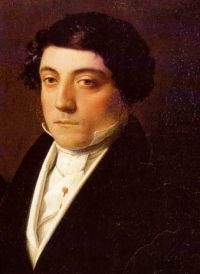
Rossini |
Georg Büchner is born in Goddelau (Hesse, Germany) on October 17. Büchner will go on to write the play that inspires Berg's opera Wozzeck a century later.
After a long and difficult seige, Napoleon enters an evacuated Moscow with his army hungry and freezing. The allied European countries defeat him, and Vienna is again under Austrian rule.
Maelzel, inventor of the metronome, convinces 42-year-old Beethoven to write a symphony commemorating Napoleon's defeat, for a mechanical instrument he invented which could play all the different parts. After re-arranging it for a regular orchestra, with real guns and cannon in the percussion parts, Wellington's Victory, op.91 (the "Battle Symphony") is wildly popular, and will be Beethoven's most financially successful piece during his lifetime.
One of Beethoven's two remaining patrons, Prince Lobkowitz, goes bankrupt and flees Vienna, leaving Archduke Rudolph as Beethoven's only remaining benefactor. Rudolph again increases his payment to cover the financial loss of Lobkowitz. In gratitude for Rudolph's generosity, Beethoven dedicates far more compositions to him than to anyone else, including some of his most important works (4th Piano Concerto, 5th Piano Concerto (Emperor), 26th Piano Sonata (Les Adieux) op.81a, 29th Piano Sonata (Hammerklavier) op.106, 32nd Piano Sonata op.111, Violin Sonata op.96, Archduke Piano Trio (named for Rudolph), Missa Solemnis, Grosse Fuge).
For the next several years, there is a sudden decline in the number of significant works Beethoven produces, prompted most likely by his bitterness over the public's neglect of his more important work while they favored Rossini and his own 'throwaway trash' (Wellington's Victory), and also by the time and energy he will spend as guardian and teacher of his reluctant nephew Karl a few years later (see 1815).
1814
On April 6, Napoleon abdicates the throne. He is allowed to remain "Emperor" of his tiny principality on the island of Elba.
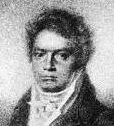
Beethoven | 43-year-old Beethoven again rewrites Fidelio, and the production on May 23 is finally a success. He also composes his 27th Piano Sonata, op.90, in E-minor. |
22-year-old Rossini is engaged as music-director for both opera houses in Naples.
In Vienna, around his 18th birthday, Schubert composes his 2nd Symphony in Bb, D.125, between December 10 and the following March 24.
1815
On 9 February, Georg Ottensteiner is born in Füssen. He will go on to become an instrument maker, and together with Baermann will design an improved key-system for the M¨ller-system clarinet.
On March 1, Napoleon escapes from Elba, returns to Paris, and regains control of France for the "Hundred Days". Napoleon's final defeat occurs at the Battle of Waterloo on June 18. This time he is imprisoned on the remote island of St Helena (in the south Atlantic, about midway between Brazil and Africa), where he remains until his death in 1821.
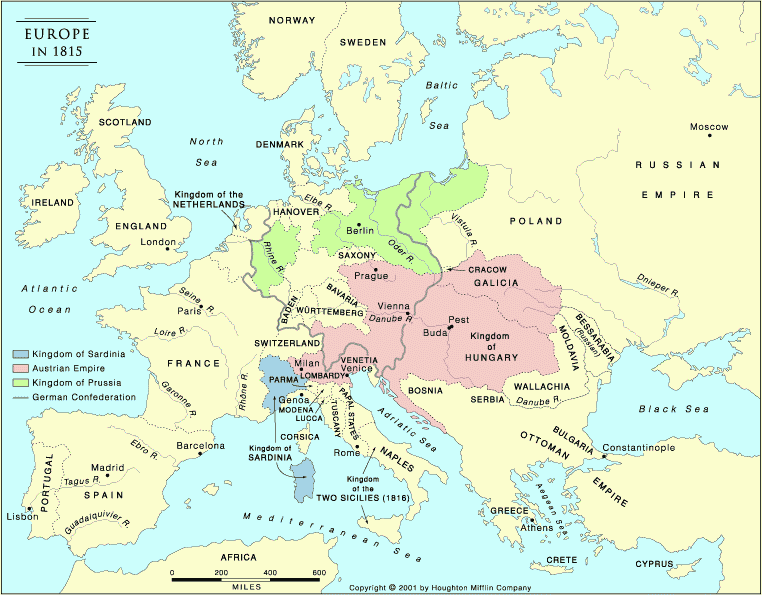
Europe in 1815, after Napoleon's final defeat.
The end of the Napoleonic Wars in 1815 mark the breakup of the
Spanish empire in the New World. Between 1815 and 1822 the new republics
of Argentina, Chile, and Venezuela are born, seeking and expecting
recognition by the United States, and many Americans endorse that idea.
But President James Monroe and his secretary of state, John Quincy Adams,
are wary of risking war for nations whose survival is unsure.
Their point of view is that the United States should just let Spain
and her rebellious colonies fight it out.
Great Britain is torn between monarchical principle and a desire for
new markets, because South America at this time is a much larger market
for English goods than the United States.
When Russia and France propose that England join in helping Spain
regain her New World colonies, Britain vetoes the idea.
The Austrian province of Venetia is combined with its western neighbor into the Kingdom of Lombardy-Venetia, until 1859. Austria regains control of Dalmatia as the Kingdom of Illyria.
With Klemens von Metternich in control as foreign minister, the Austrian Empire enters the Vormärz period of censorship and a police state, until 1848.
In Vienna, 18-year-old Schubert composes his 3rd Symphony, in D, D.200, between May 24 and July 19.
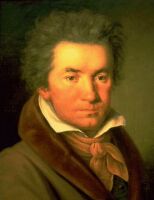
Beethoven | On November 15, Beethoven's brother Carl dies of tuberculosis. Beethoven is appointed co-guardian of his nephew Karl, along with the boy's mother Johanna. Beethoven begins a long legal battle to gain full custody of Karl. |
1816
Eugène Albert is born on 26 April in Belgium. He will go on to design his own improved key-system for the Müller-system clarinet.
In Vienna, Schubert composes his 4th Symphony (the "Tragic") , in C-minor, D.417, completing it by April 27.
In Naples, 24-year-old Rossini composes and produces his most popular opera, The Barber of Seville.
55-year-old Cherubini composes his Requiem in C-minor to commemorate the anniversary of the execution of France's King Louis XVI. It is a big success and is much admired by Beethoven.
In September and October, 19-year-old Schubert composes his 5th Symphony, in B-flat, D. 485.
45-year-old Beethoven composes his:
and also begins sketching the 1st movement of his 9th Symphony. [Nohl 1860, p 137]
Beethoven's patron Prince Lobkowitz dies on December 15, leaving only Archduke Rudolph to support Beethoven's annuity.
1817
46-year-old Beethoven begins sketching his 9th Symphony.
7-year-old Fryderyk Chopin composes and publishes two polonaises, in G minor and B-flat major, and is recognized in Warsaw as a Mozart-like prodigy.
6-year-old Franz Liszt begins taking piano lessons.
Around his 21st birthday, from August until the following February, Schubert composes his 6th Symphony, in C-major, D.589
1818
|
47-year-old Beethoven receives a gift of a Broadwood piano
from London; its increased dynamic range and extended keyboard
inspire Beethoven to begin composing his monumental
"Hammerklavier Sonata".
Beethoven also begins working on the equally large-scale Mass in D "Missa Solemnis". |
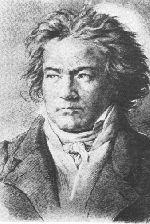
Beethoven |
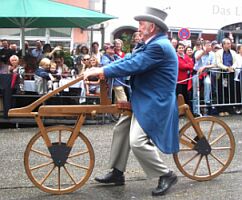
Replica of Drais's original "running machine", ridden by a man in period costume. |
In December, Baron Karl von Drais files a patent application
in Baden, Germany, for his 2-wheeled "running machine", the
direct forerunner and inspiration for the later bicycle.
Having been discouraged in his attempts at creating a
mechanized human-powered 4-wheel carriage, Drais decides
that the 2-wheeled vehicle should be propelled by the "natural"
method of walking or running.
Named the "draisene" in English and "draisienne" in French, honoring his name, it is also known as the "velocipede" (from the Latin for "fast foot"), and the "hobby horse". |
1819

Johnson-type hobby horse | In England, Denis Johnson creates an improved version of the draisine and patents it under the name "pedestrian curricle". There is a brief craze for the new invention all over Europe and in America during the summer of 1819, but it fades quickly into oblivion after that, resurfacing with pedals attached only in 1863. |
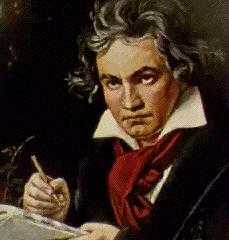
Beethoven |
Beethoven, 48, finishes the 29th Piano Sonata, op.106, in Bb-major, the "Hammerklavier", in March, and continues work on Missa Solemnis and the 9th Symphony. |
Francesco Ezechiele Ermenegildo Cavaliere Suppe-Demelli born April 18 in Spalato, Dalmatia [now Split, Croatia], of Belgian ancestry. He later goes by the name of Franz von Suppé.
1820
Beethoven, 49, composes his 30th Piano Sonata, op.109, in E-major, and continues to work on his Missa Solemnis.
23-year-old Schubert, who has very little money and is able to survive only thanks to the support of his friends, begins treating them rudely and inconsiderately. In December he composes his 12th Quartet, in C-minor, D. 703, nicknamed "Quartettsatz" because it contains only a single movement.
1821
12-year-old Mendelssohn begins composing a set of 12 Symphonies for Strings over the next 2 years.
In August, 24-year-old Schubert composes a full sketch of his Symphony [No. 7] in E (numbered D. 729 after the catalog of his works by his biographer Deutsch), but never orchestrates it.
On August 31, Hermann Helmholtz is born in Potsdam, Germany.
Beethoven, 50, finishes his 31st Piano Sonata, op.110, in Ab-major, on Christmas Day, meanwhile continuing to work on his Missa Solemnis.
1822
Early in the year, 51-year-old Beethoven mentions in a letter that he is working on a string quartet (eventually op. 127), the first new one since the "Serioso" of 1810. But during most of this year, Beethoven composes his 32nd Piano Sonata, op.111, in C-minor -- his last, containing the notorious "boogie-woogie variation", and continues to work on his Missa Solemnis.
During February and March, Carl Maria von Weber visits Vienna for a production of his opera Der Freischütz, and Schubert meets him.
Joachim Raff is born on May 27 in the town of Lachen, on lake Zürich in Switzerland.
30-year-old Rossini comes to Vienna and visits Beethoven.
Antonio Salieri, Mozart's old rival, hears 11-year-old Liszt play at a private house and is astonished. Salieri offers Liszt free lessons in composition. Prince Nicholas Esterházy, the employer of Liszt's father, gives the family leave to stay in Vienna. Liszt at this time also studies piano under Beethoven's pupil Carl Czerny, but Liszt's father takes him away from Czerny after only eighteen months. For four years Liszt tours and gives concerts to amazed audiences, including princes and kings.
30-year-old Charles Babbage, in a paper to the Royal Astronomical Society on 14 June entitled "Note on the application of machinery to the computation of astronomical and mathematical tables", proposes the use of an automatic, mechanical calculator designed to tabulate polynomial functions, his "Difference Engine", an important precursor of the modern digital computer. This machine uses the decimal number system and is powered by cranking a handle.
Beethoven composes Die Weihe des Hauses ['the consecration of the house'] Overture in September.
This year marks a turning point (for the worse) for 25-year-old Schubert: his career had been starting to develop nicely, but now he begins to live hedonistically and has serious financial trouble. He is diagnosed with syphilis late in the year, and as a result the remaining 6 years of his life will be filled with illnesses. However, it is also from around this time that his music becomes imbued with a strong emotional intensity. In October, he composes his "Unfinished" Symphony in B-minor, D. 759, usually listed as the 8th, and considered by many to be his masterpiece.
In November, Prince Galitzin commissions Beethoven to compose some string quartets, which will turn out to be his last set of great compositions.
The Kingdom of Illyria is dissolved, and Dalmatia becomes a province directly under the administration of the Austrian Empire.
1823
After 5 years of work on it, 52-year-old Beethoven finishes his grandiose Mass in D-major, op.123, the "Missa Solemnis" ['solemn mass'], in February.
Later this year Beethoven also finishes his monumental 9th Symphony, op.125, in D-minor, the "Choral", on which he has also been working actively for several years, and passively for decades. The final movement sets the words of Schiller's 'Ode to Joy':
Beethoven's 9th Symphony is considered by legions of music-lovers ever since then to be the supreme achievement by a composer, and will become a huge inspiration to, among others, Bruckner and Mahler.
While finishing the 9th Symphony, Beethoven sketches a draft of the Quartet in A-minor op. 132, then resumes work on the Quartet in E-flat op. 127.
13-year-old Chopin begins schooling at the Warsaw Lyceum, where his father is a professor, and also begins getting informal instruction in music theory, figured bass, and composition from composer Józef Elsner.
This is a significant year politically as it marks the real emergence of America as a world power. With France, Spain, and the "Holy Alliance" (Russia, Prussia, Austria) wishing to retain their power in the western hemisphere, and Britain hoping to join with America against them, in James Monroe's message to Congress on December 2, 1823, (today called the Monroe Doctrine, but really the work of John Quincy Adams), the United States informs the European powers that the American continents are no longer open to European colonization, and that any effort to extend European political influence into the New World would be considered by the United States "as dangerous to our peace and safety", effectively separating America and Europe from interfering in each other's politics.
1824
27-year-old Schubert composes his 14th Quartet, in D-minor, D. 810, "Der Tod und das Mädchen" ['death and the maiden'] in March.
Bedrich Smetana is born on 2 March in Litomyšl in Bohemia, then part of the Austrian Empire.
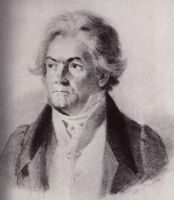
Beethoven |
53-year-old Beethoven premières his 9th Symphony
in Vienna on May 7. Schubert is there. The symphony
is received enthusiastically by that audience, but the
repeat performance on May 23 is poorly attended.
Just after the performances of the 9th Symphony, Beethoven begins his 12th Quartet, op.127, in Eb-major, the first of his great final series of string quartets. Its composition will occupy him for the rest of the year. |
32-year-old Rossini moves to Paris and composes his final opera, Guillaume Tell ['William Tell'] (whose overture remains famous more than a century later as the theme song for "The Lone Ranger" TV show). At the height of his career, the young Rossini then inexplicably stops composing, never to write another opera, and only composing again much later in his long life.
13-year-old Liszt composes his only opera, Don Sanche, produced the following year.
15-year-old Mendelssohn composes his 1st Symphony, in C-minor, op.11, his first symphony for full orchestra.
Anton Bruckner is born in Ansfelden, near Linz, in Upper Austria, in September.
Johann Christian Woyzeck sentenced to be beheaded in Leipzig for the slaying of his mistress. Before his execution, Woyzeck is assessed by Hofrat Dr. Clarus to determine whether he could be considered responsible for his actions. Clarus determines that Woyzeck is "of sound mind and that any abberations were due to his physical constitution and moral degeneration". This becomes the basis for Georg Büchner's play Woyzeck 12 years later.
38-year-old Carl Almenraeder, assisted by physicist G. Weber, makes major changes in the positioning of the holes on the bassoon. His design is later (1874) updated by Heckel, to become the standard modern bassoon.
1825
In February, 54-year-old Beethoven completes his 12th Quartet, op.127, in Eb-major. He immediately begins work on the second of his final series of quartets, now known as the 15th Quartet, op.132, in A-minor, and also sketches ideas for the 13th Quartet, op.130, in Bb-major. Interrupted by a serious illness in April, Beethoven depicts the illness and his recovery in the long slow movement of the A-minor quartet, and finishes composing the quartet in July. (The A-minor quartet was published later, so both the quartet and opus numberings reflect dates of publication, and not of composition.)
16-year-old Mendelssohn composes his String Octet in E-flat Major, op.20, the first work which really shows his genius.
|
Probably inspired by the epic size of Beethoven's 9th Symphony,
from June to September 28-year-old Schubert composes his "Great" Symphony in C-major,
which today is variously numbered 7, 8, or 9, depending on how one considers
the status of his "Unfinished Symphony" and a hypothetical "lost" one to which
his cataloger Deutsch gave a number; the "Great" is generally known as Schubert's
9th.
Deutsch believed this "Great" Symphony to be composed in 1828, so he gave the number D. 944 to it, and numbered the hypothetical "lost" one of 1825-26 (which he called the Gmunden-Gastein Symphony) as D. 849 -- in fact, the "lost" one possibly never existed, and both Deutsch numbers may actually refer to the "Great" C-major Symphony. The "Great" Symphony is dedicated to the Vienna Philharmonic in hopes of a performance; they pay Schubert a 100 florin honorarium and read thru it in a rehearsal, but then it is not performed publicly and is not rediscovered until 11 years after his death. |
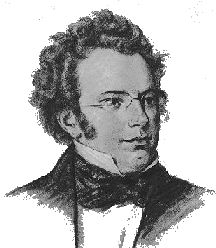
Schubert |
Between August and November, Beethoven, 54, composes his 13th Quartet, op.130, in Bb-major, with the huge Grosse Fuge as its finale. This fulfills his commission from Prince Galitzin for 3 quartets, but Beethoven evidently feels an inner need to keep composing string quartets, and soon begins his 14th Quartet, op.131, in C-sharp-minor.
Johann Strauss, Jr. (the 'Waltz King') is born in Vienna on October 25.
1826
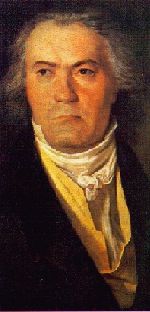
Beethoven |
In the early part of the year 55-year-old Beethoven composes
his 14th Quartet, op.131, in C-sharp-minor,
completing it in July. He himself considers it to be his greatest piece.
On March 21, the 13th Quartet, op.130, in B-flat major is premièred with its original final movement, the piece now known independently as the Grosse Fuge, op.133, which meets with incomprehension from the audience. In July, Beethoven's nephew Karl buys two pistols and shoots himself in the head in an attempt to commit suicide. The first shot misses and the second one grazes his temple, but he lives. Beethoven takes this as the final proof of his inability to act as a father to Karl, and probably never recovers from his emotional upset. Beethoven allows his publisher to convince him to publish the Grosse Fuge as an independent piece, and to write a new finale for the 13th Quartet. The publisher hires an arranger to make a version of the Grosse Fuge for piano 4-hands, but Beethoven is so displeased with the result that he makes his own version in August. He also begins work on the 16th Quartet, op.135, in F-major, his last. |
17-year-old Mendelssohn composes his Ein Sommernachstraum ['a mid-summer night's dream'] Overture in E major, op.21, completing it on August 6. The work is written as a stand-alone "concert overture" intending to depict the action of the entirety of Shakespeare's play. (Years later Mendelssohn will compose incidental music for the whole play, using this overture as the opening number.)
Liszt's father dies, leaving the 15-year-old to take care of the family. He settles in Paris and teaches piano lessons.
In September, 16-year-old Chopin begins formal study of music theory, figured bass, and composition with Józef Elsner at the Warsaw Conservatory.
In October, Beethoven finishes the much smaller and lighter 16th Quartet, op.135, in F-major, his last completed work. At the end of the year he composes his very last piece, a new and much shorter and simpler finale for the 13th Quartet, and publishes its original huge final movment as an independent composition, the Grosse Fuge, op.133.
In December, Beethoven goes to his brother Johann's house, taking Karl along to live there. By the end of the month, the brothers have a falling out, and so Beethoven goes back to Vienna with Karl. Beethoven contracts a chill on the ride back to Vienna which will lead to his final illness.
1827
|
Beethoven's condition continues to worsen during the early
months of 1827, and he is confined to
bed with pneumonia and dropsy (which is now called
edema,
localized primarily in Beethoven's abdomen and chest).
On March 26, Beethoven dies in Vienna at age 56. |
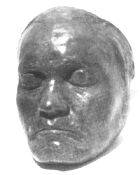
Beethoven's death-mask |
Vienna in 1827
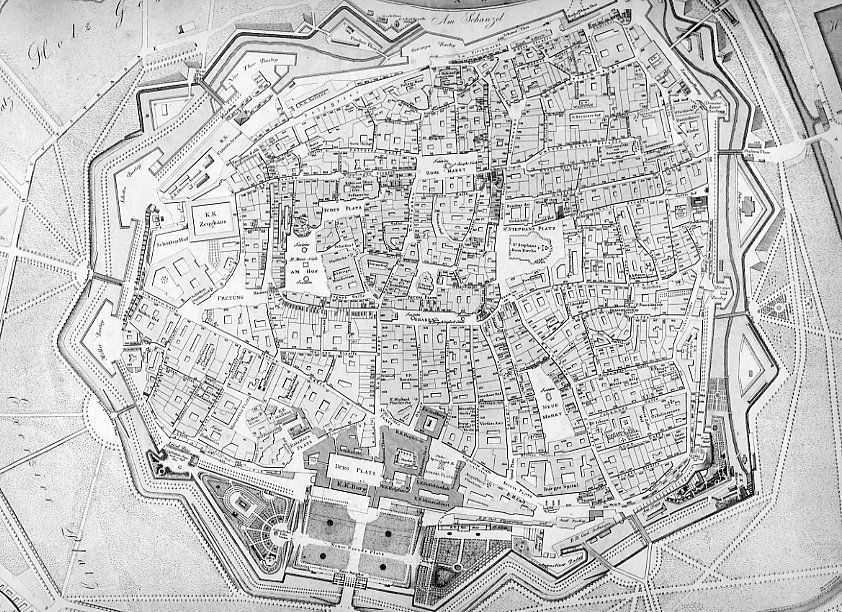
By the time of Beethoven's death, Vienna still had not yet expanded beyond its medieval walls.
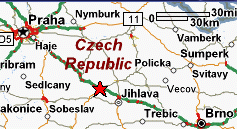
map of the area between Prague and Brno -- the red star designates Kalischt | Bernhard Mahler is born in the village of Kalischt (near the town of Humpolec), in the province of Bohemia close to the border with Moravia, in the Austrian Empire (now Kalište, Czech Republic). |
In Paris, 16-year-old Liszt falls in love with one of his female students,
but her father stops the relationship. Liszt suffers such a
severe nervous breakdown that there are rumors of his death,
and he doesn't touch the piano for a year.
1828
19-year-old Mendelssohn composes his Meeresstille und glückliche Fahrt ['calm sea and prosperous voyage'] Overture in D major, op.27.
In March 31-year-old Schubert makes extensive revisions to his "Great" C-major Symphony (D. 849/944) in hopes of getting it performed. He writes this date on the manuscript, thus leading to the confusion over its date of composition, as detailed above (see 1825).
In September Schubert completes a series of masterworks: his String Quintet in C-major, and his last 3 Piano Sonatas (the 19th in C-minor, D. 958, 20th in A, D. 959, and 21st in B-flat, D. 960), and also sketches a Symphony [No. 10] in D-major, D.936a.
After these last compositions, the syphilis from which Schubert has been suffering causes his health to decline rapidly. Needing medical attention, he moves in with his brother Ferdinand in Neue Wieden (a new suburb being built outside Vienna), and he dies there on November 19. He has never acheived any real recognition as a composer, and he will be totally forgotten until his last symphony is shown by his brother to Robert Schumann in 1839, and subsequently premièred by Mendelssohn.
1829
Early in the year, 20-year-old Mendelssohn directs a performance of Bach's St. Matthew Passion at the Berlin Singakademie, beginning the modern cultivation of Bach's music. Mendelssohn then takes a 2-year tour around Europe, which will inspire several major works: the "Italian" and "Scottish" Symphonies, and his Les Hébrides ['Fingal's Cave'] Overture. During this year he visits England and Scotland.
19-year-old Chopin sees a performance by Paganini (on the violin), whose virtuosity leaves a lasting impression. Chopin also falls in love with singing student Konstancja Gladkowska, which inspires him to put the melody of the human voice into his piano compositions. Chopin visits Vienna for the first time, gives two piano performances and receives mixed reviews, many favourable but some others criticizing his "small tone".
16-year-old Richard Wagner writes his first compositions.
1830
Hans Guido Freiherr von Bülow is born in Dresden on January 8.
21-year-old Mendelssohn completes his Symphony No. 5, in D-minor "Reformation", op.107 (his second symphony in order of composition, published posthumously, hence, the out-of-sequence numbering and large opus-number), in honor of the 300th anniversary of the Protestant Reformation initiated by Martin Luther. The symphony concludes with Luther's chorale "A Mighty Fortress is Our God" from the Augsburg Confession. Mendelssohn travels to Italy this year.
|
In Paris, 27-year-old Hector Berlioz completes his
Symphonie Fantastique en cinq parties: Episode de la vie d'un Artiste
['fantastic symphony in 5 parts: episode in the life of an artist']
early in the year, making use of material from earlier
pieces he had composed,
and premières it on December 5 at the Paris Conservatoire.
The Symphonie Fantastique is widely hailed by progressives as an important new musical work, and widely condemned by conservatives as being an assemblage of cacophonous sounds unworthy of being referred to as 'music'. Upon examining the score, Rossini is alleged to have quipped: "What a good thing that young man has never taken up music! He would certainly be very bad at it." 19-year-old Liszt meets Berlioz the day before the première of the Fantastique and loves it when he hears it. |
Berlioz |
Carl Goldmark born on May 18 in Keszthely, Hungary.
The street fighting during the July Revolution in Paris suddenly rouses Liszt as if from a coma, and he goes back to playing the piano. He begins making a transcription of the Symphonie Fantastique for solo piano. Liszt also begins composing his 1st Piano Concerto, in E-flat-major, which he will not finish until 1839.
In England on September 15, the Liverpool and Manchester Railway opens, the first modern steam-powered railway, carrying both goods and passengers by trains running on a schedule.
In November, 20-year-old Chopin leaves Poland and goes to Vienna again, intending to travel on to Italy. He performs his two Piano Concertos (No. 1 in E-minor and No. 2 in F-minor) and stays in Vienna until the following summer, and because of hostilities never goes to Italy. During his stay in Vienna, the Russo-Polish war breaks out ("November Uprising") and ultimately Russia occupies Poland. While in Vienna he becomes quite well known as composer and performer, and his subsequent compositions suddenly become much more dramatic and passionate. By this time he has composed some of his Etudes, op.10.
Advances made in the hand-forging of metals in Paris and Brussels over the last decade will now make these two cities the centers of the woodwind manufacturing industry.
36-year-old instrument maker Theobald Boehm invents posts for woodwind instrument keys, and uses them with Nolan's brille key-ring idea (see above, 1808).
Backed by Russian diplomacy, ethnically homogenous Serbia becomes an autonomous province within the Ottoman Empire.
1831
On March 9, Liszt hears the brilliant violinist Paganini at the Paris Opera House and vows to be the Paganini of the piano. He practices up to 14 hours a day.
James Clerk Maxwell is born on June 13 in Edinburgh, Scotland (UK). He will go on to become a mathematician and one of the most important physicists, his work laying the foundation for the field of electrical engineering, as well as leading to the development of special relativity and quantum mechanics.
In August, Chopin leaves Vienna and goes to Paris, which will be his home-base for the rest of his life. He chooses to live there as an exile, and thus is never able to return to Poland. He becomes friends with Liszt, Berlioz, and Mendelssohn.
18-year-old Wagner attends Leipzig University.
1832
19-year-old Wagner composes and performs his Symphony in C-major.
21-year-old Liszt meets Paganini and Chopin, whose talents inspire him further. The three become close friends.
23-year-old Mendelssohn completes his overture in B-minor Les Hébrides ['the Hebrides'], known in English usually as 'Fingal's Cave', op.26, inspired by his trip to Scotland.
38-year-old woodwind instrument maker Theobald Boehm invents the long-axle key, and applies it to both regular keys and Nolan's brille key-ring idea (see above, 1808) in his new flute, enabling him to place the holes at their acoustically-most-preferable position regardless of where the fingers lie. The long-axle and brille are concepts which are used by all subsequent woodwind manufacturers in their new key-system designs.

Boehm's 1832 flute, the first woodwind with brille rings
1833
Johannes Brahms is born on May 7 in a Hamburg slum, of German background.
His father is an aspiring professional musician.
24-year-old Mendelssohn completes his
Symphony No. 4, in A-major "Italian", op.90
(his third symphony in order of composition,
posthumous publication results in out-of-sequence numbering),
inspired by his 1829-1831 tour of Europe.
Mendelssohn is unsatisfied with the work and composes alternate
versions of the 2nd, 3rd, and 4th movements -- but later it becomes
one of his most popular pieces.
Wagner becomes chorus master at the Würzburg theatre and writes the
libretto and music of his 1st opera, Die Feen,
which he does not produce. Wagner also composes his 2nd opera,
Das Liebesverbot.
22-year-old Liszt finishes his piano transcription of Berlioz's
Symphonie Fantastique and uses it for the rest of his career
in his dazzling piano recitals. Liszt also
meets 28-year-old married Comtesse Marie d'Agoult
(Marie Catherine Sophie de Flavigny, known under her pen-name as "Daniel Stern")
at Chopin's house and falls in love.
1834
24-year-old Schumann founds the Neue Zeitschrift für Musik
['new magazine for music']; it will become the leading European
journal for progressive composers.
21-year-old Büchner founds the secret Society of Human Rights,
and writes a political pamphlet, The Hessian Courier,
despising the aristocrats and attempting to incite the peasantry
into rebellion.
12-year-old Joachim Raff shows great natural talent as a
pianist, violinist and organist, and performs at
the Sunday concerts in the nearby spa of Nuolen.
1835
The esteemed French music-theorist and musicologist
F. J. Fétis publishes a
scathing review of Berlioz's Symphonie Fantastique. Schumann,
intrigued by the varying opinions he's read of the work, obtains
Liszt's piano transcription of it and studies it, publishes
a German translation of Fétis's review, then his own
detailed analysis, mostly praising the piece.
On March 2, Emperor Franz I of Austria dies, and Metternich
(who is really running the Austrian Empire by now) installs
mentally handicapped Ferdinand I as Emperor. This leaves
Metternich essentially in charge of Austrian foreign policy
until the revolution of 1848.
A warrant is issued for the arrest of 22-year-old Büchner because
of his political activities. He flees to France, then Switzerland,
returns to the study of science, and begins writing plays to support
himself; some time within the next two years he writes Woyzeck,
which is left somewhat unfinished.
30-year-old Comtesse Marie d'Agoult leaves her husband,
and she and 24-year-old Liszt elope and travel to Switzerland,
settling in Geneva and causing a scandal in Paris.
They eventually have 3 children, and Marie's money enables
Liszt to devote time to composition.
He composes several several pieces which are intended to
portray his impressions of Switzerland, which end up in
Années de Pélerinage - Premi`re Année: Suisse
['years of pilgrimage - 1st year: Switzerland'].
16-year-old Suppé's father dies in January, and
in September he moves with his mother to Vienna. His father had opposed his
desire to be a musician, so now he is free to follow his vocation.
26-year-old Mendelssohn is appointed conductor of the Leipzig Gewandhaus Orchestra.
Wilhelm Jahn is born in Hof, Moravia (then part of the Austrian Empire,
now in the Czech Republic).
In Brussels, 21-year-old woodwind instrument maker
Antoine Joseph Sax (known as Adolphe Sax)
perfects the bass clarinet.
1836
23-year-old Wagner becomes an opera conductor with a small company
which produces his 2nd opera, Das Liebesverbot,
then goes bankrupt. He marries the singer Minna Planer
and moves to Königsberg, where he becomes musical director
at the theatre. But Wagner soon leaves Königsberg and takes a similar post
in Riga, where he begins his 3rd opera, Rienzi,
and conducts a lot of Beethoven.
22-year-old Büchner begins writing his play Woyzeck.
27-year-old Mendelssohn composes his Paulus ['St. Paul'], op.36,
an oratorio for choir and orchestra.
Rossini leaves Paris and returns to Italy, composing almost nothing
for the next 19 years.
1837
George Büchner
Büchner contracts typhus and dies on February 19 at
the young age of 23, leaving Woyzeck as an
unfinished
manuscript.
In March, 28-year-old Mendelssohn marries Cécile Jeanrenau,
and they have a happy marriage with 5 children.
Marie Hermann (future mother of Gustav Mahler) is born.
4-year-old Brahms is taught cello, violin, and valveless horn
by his father. He progresses well on the cello, but unaccountably
(as there is none in the house) demands to learn piano.
26-year-old Liszt continues to compose his Années de Pélerinage
while in Italy. He is also making the first versions of his piano transcriptions
of the Beethoven symphonies.
Liszt and his mistress Marie have their second child,
a daughter named Cosima, born on December 25.
In England, 45-year-old Charles Babbage publishes the first description of his Analytical Engine, the most direct ancestor of the modern digital computer.
In Paris, woodwind instrument manufacturer Louis Auguste Buffet
invents the needle spring, mounted on a metal post which is
screwed directly into the hardwood body, parallel to the rods
used in Boehm's flute key-system, and which will be used by all subsequent
woodwind manufacturers in their own key designs.
During these decades the manufacture of woodwind instruments shifts
from the ornately-carved and softer boxwood previously used, to very stable
tropical hardwoods such as grenadilla.
1838
27-year-old Liszt feels compelled to return to the concert stage to raise money
for Hungarian victims of the 1838 Danube flood. Marie argues that
he should stay home and concentrate on composing, but Liszt ignores
her and goes on tour.
1839
Schubert's brother Ferdinand shows the score of the
"Great" C-major Symphony to 29-year-old Schumann while Schumann is
staying in Vienna. Schumann immediately recognizes the
greatness of the work and sends the score to Mendelssohn,
who conducts the successful première in Leipzig.
Wagner and his wife, slipping away from creditors, sail
from Riga to London -- a trip which inspires his next opera,
Die fliegende Holländer ['the flying Dutchman'] -- and
go on to Paris. There, 26-year-old Wagner does hack-work for publishers
and theaters while composing Holländer, and
becomes friends with Meyerbeer.
Liszt hears of Thalberg's success in Paris and returns there for
a famous piano duel, to ensure his title as King of the piano.
Over the next 5 years, giving a series of spectacular recital
tours all over Europe where he performs for hours from memory,
he plays to hysterical audiences of thousands and
creates full-blown "Lisztomania". Liszt finally finishes his
1st Piano Concerto, in E-flat,
and composes his 2nd Piano Concerto, in A-minor.
Liszt at 30
"Boehm" clarinet
In September, 17-year-old Hermann von Helmholtz begins his studies at
the Royal Friedrich-Wilhelm Institute of Medicine and Surgery in Berlin.
1840
7-year-old Brahms begins piano lessons with Otto Cossel
in Hamburg, seeing
him nearly every day. Brahms quickly becomes the favored child
in the family.
Wagner and Liszt meet and become close friends.
Mendelssohn at age 30
Systeme-3 oboe (shown without reed),
Albert-system clarinet
Also in Brussels, 26-year-old Antoine Joseph (Adolphe) Sax develops his own clarinet
design based on Müller's system, but which still requires cross-fingering.
Sax also tries to produce a
clarinet which will overblow at the "octave" as in the flute and oboe
(and instead of the "12th" as on a regular cylindrical clarinet),
by replacing the regular trumpet-like mouthpiece on a type of keyed bugle called an
ophicleide
with a clarinet mouthpiece, and in the process invents the saxophone.
18-year-old Joachim Raff finishes his studies at the
Jesuit Seminary in Schwyz, with prizes in German, Latin and mathematics,
goes to Rapperswil (near his birthplace of Lachen), to
work as a teacher. Having taught himself the rudiments of music,
Raff begins to compose.
16-year-old Smetana begins high school in Prague.
1841
31-year-old Schumann marries Clara Wieck, who as a pianist was
a child prodigy. In the full flush of inspiration from his new love,
he writes his 1st ('Spring') and 4th Symphonies
(the latter will not appear until after the next two).
Antonin Dvořák is born in Nelahozeves
(a small village approximately 45 miles north of Prague,
then in the Austrian Empire, now in the Czech Republic)
on September 8.
the original saxophone
and its first variation
1842
29-year-old Wagner premières Rienzi in Dresden
and is very successful.
Johann Nepomuk Fuchs is born in Styria on May 5.
Emil Jakob Schindler is born in Vienna.
33-year-old Mendelssohn completes his
Symphony No. 3, in A-minor "Scottish", op.56
(his fifth and last symphony to be completed - posthumous
publication of earlier symphonies results in out-of-sequence numbering),
conceived during his 1829 trip to Scotland.
alto, tenor, baritone, and soprano saxophones made by Adolphe Sax
1843
Hans Richter is born on April 4 in Györ, Hungary (then part
of the Austrian Empire).
30-year-old Wagner produces Die fliegende Holländer
['the flying Dutchman'] in Dresden, but it is not as successful
as Rienzi had been the year before, despite its higher quality.
In Holländer, Wagner is beginning to move away from
the concept of opera as a series of separate "numbers".
He is also appointed joint Kapellmeister at the Dresden court.
Brahms's piano teacher Cossel takes him to Eduard Marxsen, the best
teacher in Hamburg, to discourage Brahms's parents from succumbing
to an offer to take the 10-year-old boy to America as a prodigy.
Marxsen tries to focus on the piano, but Brahms insists on learning
composition and progresses rapidly.
Liszt ends his stormy relationship with Marie d'Agoult.
system 4 oboe
Also in Paris, Conservatoire clarinet professor Hyacinthe Klosé publishes
his Celebrated Method for the Clarinet, illustrating the
superiority of fingering of the "Boehm clarinet" which he had
developed with instrument-maker Buffet.
In England, 27-year-old Ada Lovelace, in her extensive additional notes to
Sketch of the Analytical Engine, which is her translation of
Luigi. F. Menabrea's description of Charles Babbage's invention,
she includes an algorithm to calculate Bernoulli numbers on the machine.
This particular procedure was probably actually written by Babbage,
but contains an important correction by Lovelace; at any rate, her
contribution leads to her being acclaimed in the 1950s as "first computer programmer",
and 2 decades later to the programming language Ada named after her.
34-year-old Mendelssohn founds the Leipzig Conservatory.
21-year-old Joachim Raff becomes friends with the young composer and
Zürich kapellmeister Franz Abt, who encourages him to send some of
his earliest piano pieces to Mendelssohn in Leipzig.
Mendelssohn recommends them to his publisher, Breitkopf & Härtel,
who publish several of them.
1844
24-year-old Suppé premières his
incidental music to the play Ein Morgen, ein Mittag
und ein Abend in Wien ['Morning, Noon and Night in Vienna']
on February 26.
35-year-old Mendelssohn completes his
Violin Concerto, in E-minor, op.64, on which he
has been working since 1838.
Buffet also invents, this time with actual advice from Boehm himself,
the "Boehm oboe", a louder and more powerful instrument which,
in contrast to his clarinet, will never become very popular.
22-year-old Raff, bolstered by the good review of his opp.2-6
in Schumann's Neue Zeitschrift für Musik which predicts
"a future for the composer",
quits his teaching job and moves to Zürich to become a full-time composer.
He lives in poverty for the next year.
In America, Samuel Morse has been working since 1832 on his telegraph machine.
On May 24 he sends a message ("What hath God wrought") from Washington DC to
a receiver 37 miles away in Baltimore, thus beginning the modern age of
electric-powered telecommunications.
1845
Wagner, 32, completes and produces his opera Tannhäuser,
and begins composing Lohengrin. He also jots down the
first ideas for his later music-drama Die Meistersinger von Nürnberg
['the master-singers of Nuremberg'], to which he will not
return until 15 years later.
Schumann, 35, completes his Piano Concerto in A Minor.
On June 19, 23-year-old Raff, with no money, walks 75 kilometers
(46 miles, about 17 hours of walking) in the pouring rain from Zürich to Basle,
to see Franz Liszt perform. The concert is sold out, but
Liszt lets the soaking-wet Raff sit on the stage near him.
Liszt takes Raff with him on the remainder of his tour through
southern Germany and the Rhineland, with Raff making the concert arrangements.
Raff never returns to Switzerland.
26-year-old Suppé becomes Kappellmeister at the
Theater an der Wien for the next 17 years.
In Paris, Adolphe Sax and his band, populated with the whole
family of saxophones, win a competition against
the French Army Band, and the latter from then on include saxophones
in their instrumentation.
1846
Schumann, 36, composes his 2nd Symphony.
12-year-old Brahms begins earning money by playing popular tunes
all night on the piano in Hamburg whorehouses. He keeps a book on
the music-stand
and reads poetry while he plays, and his delicate girlish features
subject him to torment from the prostitutes and the sailors who are
their customers. The experience will leave profound scars on
Brahms's psyche and sexuality. To endure it he often becomes drunk,
and the alcohol and lack of sleep undermine his health.
On March 20 in Paris, Adolphe Sax is granted a patent for the family of saxophones.
When Liszt's concert tour ends, Liszt gets Raff a job in Cologne
selling pianos and music scores for Eck & Lefèbre's shop.
Raff meets Mendelssohn while there and writes music criticism
for the journal Caecilia, but despises his job, while he
continues to compose and to correspond with Liszt, who keeps
offering Raff a job as his secretary.
37-year-old Mendelssohn composes his oratoria Elijah, op.70,
for chorus and orchestra.
In Vienna, 27-year-old Suppé composes music for
Dichter und Bauer ['poet and peasant'], whose overture is
one of the most famous he wrote.
The failure of the Kraków Uprising results in the annexation
of Kraków by Austria, and its incorporation into the province
of Galicia.
On September 23 in Berlin, the 8th planet Neptune is discovered
within 1 degree of the position predicted by French astronomer
Urbain Le Verrier, who is now given credit for its discovery.
Ignaz Brüll is born on November 7 in Proßnitz, Moravia
(now Prostějov, Czech Republic).
1847
24-year-old Raff gets involved in a controversy after writing an article in the
Wiener allgemeine Musik-Zeitung ['Viennese general musical times']
making fun of Cologne music-lovers, who threaten to boycott Eck & Lefèbre's
shop where he works.
Raff quits his job and leaves Cologne in January, going on a trip
to Vienna to meet his publisher Mechetti.
On the way Raff stops in Berlin, then
Leipzig, where he meets the music publishers
Breitkopf & Härtel, Schuberth, and Bartolf Senff,
and Dresden, where he becomes friends with composer Carl Reissiger.
Originally intending to stop in Weimar, Raff instead goes straight
towards Vienna, but then upon learning of Mechetti's death, he
stops for awhile in Stuttgart to decide whether to become Mendelssohn's
student in Leipzig or Liszt's secretary in Weimar.
Thomas Edison is born in on February 11 in Milan, Ohio (USA).
Robert Fuchs is born on February 15 in Styria (Austria).
Brahms's father removes the sickly 14-year-old to a friend's farm at
Winsen-an-der-Luhe, where Brahms becomes strong and healthy again, and fills
his mind with the literary works of German Romanticism. He styles
himself 'Johannes Kreisler, Jr.', after E. T. A. Hoffmann's hero. Returning
to Hamburg, with renewed health that he will retain until his final
illness, he begins teaching piano and playing in more respectable
establishments to earn money. He holds affection for the classical musical tradition.
Princess Carolyne Sayn von Wittgenstein
Theobald Boehm patents his cylindrical flute which now has
holes which are so large that the brille rings have
been replaced by covered metal plates, known as the
plateau system, giving each pitch on the instrument
its maximum clarity and volume. This idea will later be applied
to the saxophone family and to all of the large bass
and contrabass clarinets.
After suffering a series of strokes,
Mendelssohn dies in Leipzig on November 4, at age 38.
25-year-old Joachim Raff had hoped to study with Mendelssohn, and is crushed
by disappointment at Mendelssohn's death.
Also, Raff and Liszt have a falling-out at this time.
So Raff continues to eke out a living in Stuttgart and
tries to establish himself there,
becoming friends with 18-year-old Hans von Bülow.
Raff composes a 5-act opera King Alfred, and tries
desperately to get it performed, without success.
map of central Europe -- the red star designates Weimar, Germany
Weimar thus becomes the center of avant-garde music in Europe.
For the next decade Liszt composes many radically innovative
pieces which earn him both strong admirers and violent critics.
Liszt composes his first two symphonic-poems:
The Vienna Conservatory closes (until 1851) as a result of the revolution.
On March 13, the revolutionary mobs force Metternich to resign,
and he flees to England for 3 years.
original title-page of the Communist Manifesto
35-year-old Wagner starts to formulate a project for a series of operas based
on Nibelungen sagas. He completes a libretto called
Siegfrieds Tod ['Siegfried's death'] during October and November
-- this is the core
of what will become his massive Der Ring des Niebelungen
cycle of 4 separate music-dramas, to be given on successive nights.
In December, Emperor Ferdinand I of Austria abdicates in the
face of approaching revolutionaries, and is replaced by his nephew
Franz
Joseph, who will rule until 1916 (beyond the outbreak of World War I).
1849
36-year-old Wagner, who holds an official position as
Court Conductor at Dresden, stands on a
roof and helps to direct fighters during an unsuccessful rebellion.
Fleeing an arrest warrant for his role in this on May 9,
Wagner goes first to Liszt in Wiemar, then
lives in exile outside Germany for 11 years, mainly in Zurich.
The most radical members of the German Assembly flee to Stuttgart
and set up a temporary government, but are dispersed by the Würtemberg
troops on June 18.
27-year-old Joachim Raff is implicated in the Stuttgart disturbances,
and with his debts mounting, he leaves town in secrecy.
Raff writes a letter of apology to Liszt in May, and Liszt offers
to try to stage Raff's opera King Alfred.
Liszt helps Raff secure a job with the publisher Shuberth in Hamburg,
working on arrangements of music of others. Raff's long hours of work
leave him little time to compose while in Hamburg.
Bourgeois prosperity eventually damps down the revolutionary tendencies
in Europe. Many German patriots flee to America, where they are called "the 48'ers".
The bloody
Hungarian
revolution comes to an end as rebels
are defeated and the prime minister and 13 generals are executed in
October; this event inspires 38-year-old Liszt to compose his Funerailles
[a word with the literal meaning 'funeral ceremonies' and the
figurative meaning 'death and destruction'], a new type of work
for piano which he calls a 'tone-poem'.
During the same month, on October 17 in Paris, Chopin dies of
pulmonary tuberculosis at age 39. He was a close friend of Liszt, and
this is probably another part of the inspiration for Funerailles.
Also in Paris, 50-year-old Fromental Halévy becomes one of the
earliest "modern" composers to use
quarter-tones,
in his incidental music to Prométhee Enchainé
['Prometheus bound']. Halevy's intention is to revive the ancient
Greek "enharmonic genus",
using quarter-tones between B:C
and E:F, following the Romanization of the note-names in
the enharmonic version of the Greek
"Greater Perfect System".
One of several composers being published under the pseudonym of G. W. Marks,
16-year-old Brahms earns some money by doing hack-work, composing
little salon pieces.
Living in exile in Zürich, Wagner writes an
essay called Das Kunstwerk der Zukunft ['the artwork of the future'],
in which he proclaims
that Beethoven was the last symphonist and that the symphony is dead.
He also writes the first musical sketches for the Ring, for the
drama currently titled Siegfrieds Tod [later Götterdämerung].
Systeme-5 ("thumb-plate") oboe
In Paris, Guillaume Triébert produces his Systeme 5
("thumb plate system") oboe.
In November, Liszt again invites 27-year-old Joachim Raff to Weimar,
this time formally offering him a job. Raff accepts and becomes Liszt's
copyist and secretary, staying until 1856.
Raff still lives in abject poverty, eventually
claiming to have composed parts of several Liszt pieces -- modern scholarship
casts doubt upon these claims, but Raff does indeed do a tremendous amount of work
for Liszt, playing an important role at a crucial moment in Liszt's career.
Here, Raff again comes into regular contact with Bülow, and they will
remain lifelong friends.
and begins composing the symphonic-poem numbered 8th,
Héroïde funèbre ['a hero's funeral']
(numbering reflects the order of publication, not of composition).
On November 29 in Lancaster, England [UK], John Ambrose Fleming is born.
His inventions in the early 1900s will pave the way for the development of vacuum tubes
(thermionic valves) and the "electronic revolution".
1850
Schumann, 40, moves to Düsseldorf and composes his
3rd Symphony (the 'Rhenish'), his last.
In March, the Schumanns visit Hamburg to perform, and Brahms, 17, sends
Schumann a package containing several compositions.
When the package is returned unopened, Brahms understandably
holds resentment for Schumann.
Other Liszt projects this year:
June 18 - Richard Heuberger born in Graz, Styria
[a province of Austria].
Also in Weimar under the direction of Liszt,
on August 28, is the première of Wagner's Lohengrin,
the last of his compositions which he refers to as an "opera".
20-year-old Bülow is present at the Lohengrin première,
and this experience finally makes him determined
to abandon the law career into which his parents have pushed him,
and to be a conductor. He goes to
Zürich to seek Wagner's help, and Wagner recognizes his talent
and obtains some small conducting jobs for him
in Zürich and then St. Gall.
Johann Gottfried Heinrich Bellermann is born.
Liszt decides to give another concert to raise money
for the Beethoven memorial statue. During Christmas,
he returns to Hungary for the first time in 18 years,
visiting Budapest and then his birthplace, Raiding,
where he happens to hear the music of the local Roma people
[gypsies] and begins to write the Hungarian Rhapsodies.
In Paris, Conservatoire clarinet professor Hyacinthe Klosé and
woodwind instrument maker Louis Auguste Buffet apply Boehm's flute key-system
(making extensive use of his brille concept -- see above, 1830)
to the clarinet d'après le système de M. Boehm
(also called the clarinette a anneaux mobiles ['clarinet with
moveable rings']), and present it at the Exhibition. It eventually
becomes the standard clarinet system everywhere except Germany and
countries in the German sphere of musical influence.

by Buffet/Klosé
31-year-old Mendelssohn composes his Symphony No. 2, in B-flat major
"Lobgesang" ['Hymn of Praise'], op.52 (his fourth symphony in order
of composition - posthumous publication of the intervening two result in
out-of-sequence numbering), to celebrate the 400th anniversary
of the invention of printing.
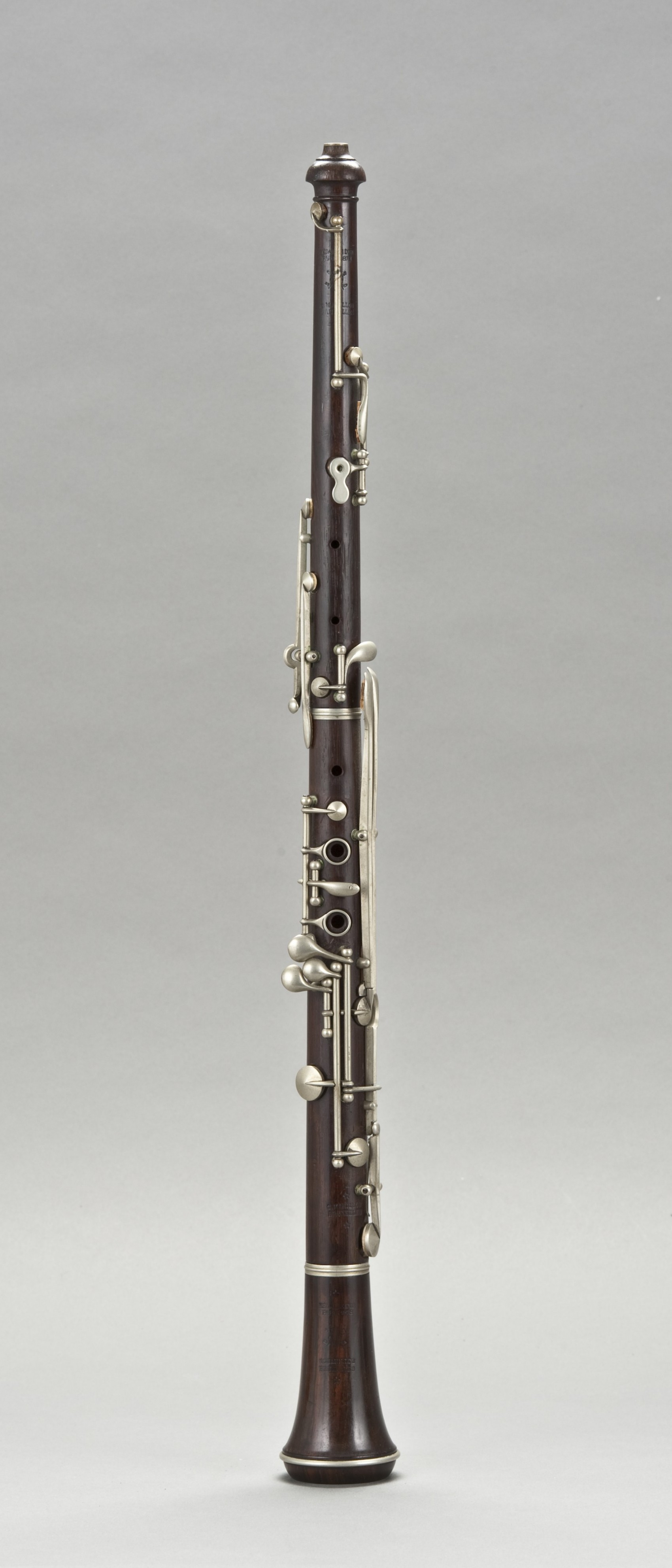
made by Mahillon in Brussels
sometime between approximately 1878 and 1900
In Paris, Guillaume Triébert produces his Systeme 3 oboe,
his first patented model and a mechanization of the old "simple system"
oboe which utilizes Boehm's brille idea (see above, 1830), placing
a set of rings over the finger-holes on the lower joint.
Its manufacture continues into the early 1900s.
After this model, Triébert's instrument manufacturing
company will evolve the key-system of the
modern oboe over the course of the next 35 years.
In Brussels, Eugène Albert develops the
"Albert clarinet" by applying Boehm's brille idea
to the standard Müller clarinet design, placing
a set of rings over the finger-holes on the lower joint
(as in Triébert's System 3 oboe).
It is a system which will remain popular into the early 1900s
and will be the favored type of clarinet with
the early jazz players in New Orleans.

a rather early model including the "patent C#" key
and the brille on the lower joint,
but without the brille on the upper joint
(shown here without the mouthpiece)
Adolphe Sax demonstrates a C bass saxophone to Berlioz,
who is amazed at its dynamic range and expressive possibilities.

Adolphe Sax moves to Paris, and within a few years creates
two entire families of saxophones (in Bb and Eb for band,
and in C and F for orchestra) which are all notated and fingered
exactly the same, regardless of register. (The four shown here in bold are
those still in common use today):
BAND ORCHESTRA
key: Bb Eb C F
highest F sopranino
E flat sopranino
C soprano
B flat soprano
F alto
E flat alto
C tenor
B flat tenor
E flat baritone
C bass
B flat bass
F contrabass
lowest E flat contrabass
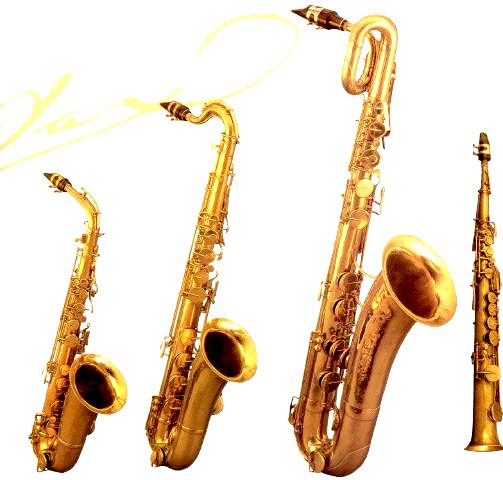
In Paris, Guillaume Triébert produces his Systeme 4 oboe
(which continues to be made into the 1920s).
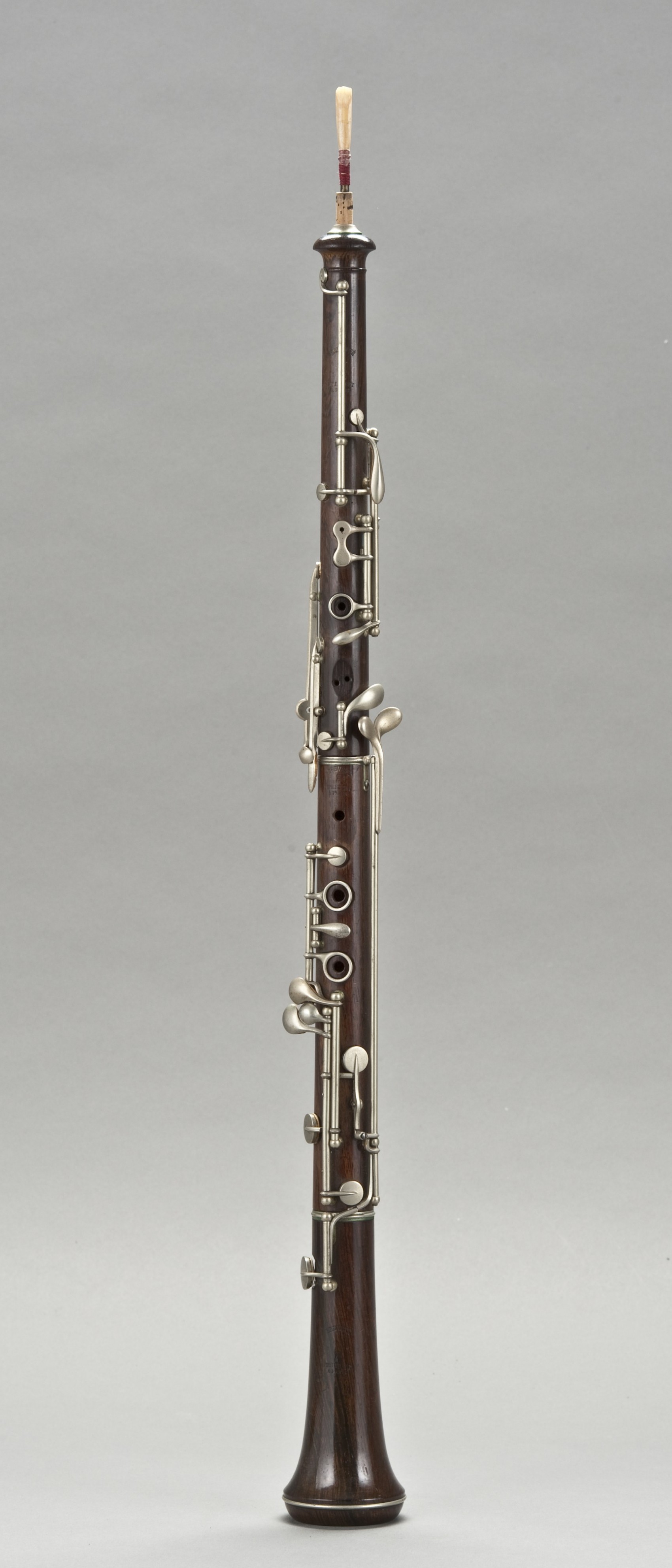
made c.1855 by Charles Triebert in Brussels
In Paris, Buffet and Klosé patent their "Boehm system" clarinet.

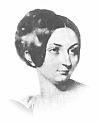
36-year-old Liszt meets Princess Carolyne Sayn-Wittgenstein in Kiev, and to
the disappointment of his many fans, Liszt retires from the concert stage in September,
to devote himself to composition.
1848
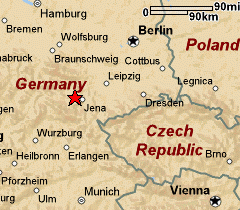
37-year-old Liszt settles in Weimar, where he will stay until 1861,
becoming Court Kapellmeister in February.
Carolyne joins him later in the year. Liszt gives up his lucrative
concert career to pursue the creation of new musical forms,
inventing the symphonic-poem and unusual piano pieces.
Marx and Engels publish the Communist Manifesto, and in
March an uprising in Paris touches off a wave of revolution in
the disunified German and Italian principalities and in the
nationalist Hungarian and Czech parts of the Austrian Empire.
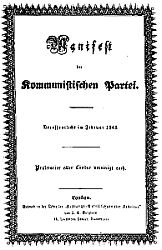
34-year-old Wagner completes Lohengrin on April 28
In September, 15-year-old Brahms gives his debut as a recital soloist.
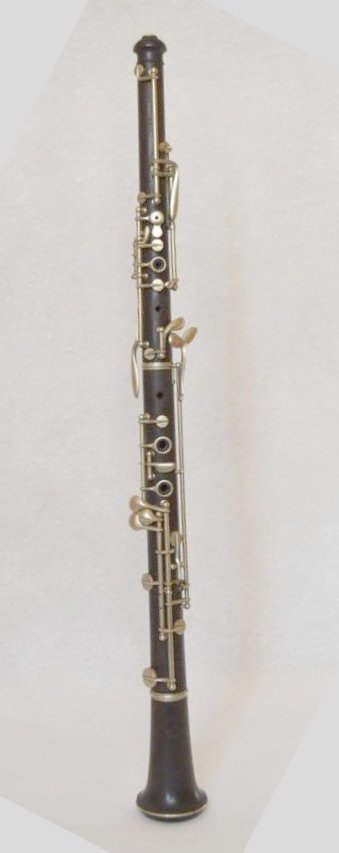
made by Triebert, with modifications by Barret
Liszt completes two symphonic-poems, which will both be revised twice
(in 1850-1 and again in 1854):
In Weimar, 39-year-old Liszt premières the first example of
a new type of work he invented, the symphonic-poem, with forms
based on literary or visual-art subjects:
Ce qu'on entend sur la montagne ['What one hears on the mountain',
the "Bergsymphonie"], which he has just subjected to its first revision.
19-year-old violin virtuoso Joseph Joachim
accepts a job as concertmaster in Liszt's orchestra.
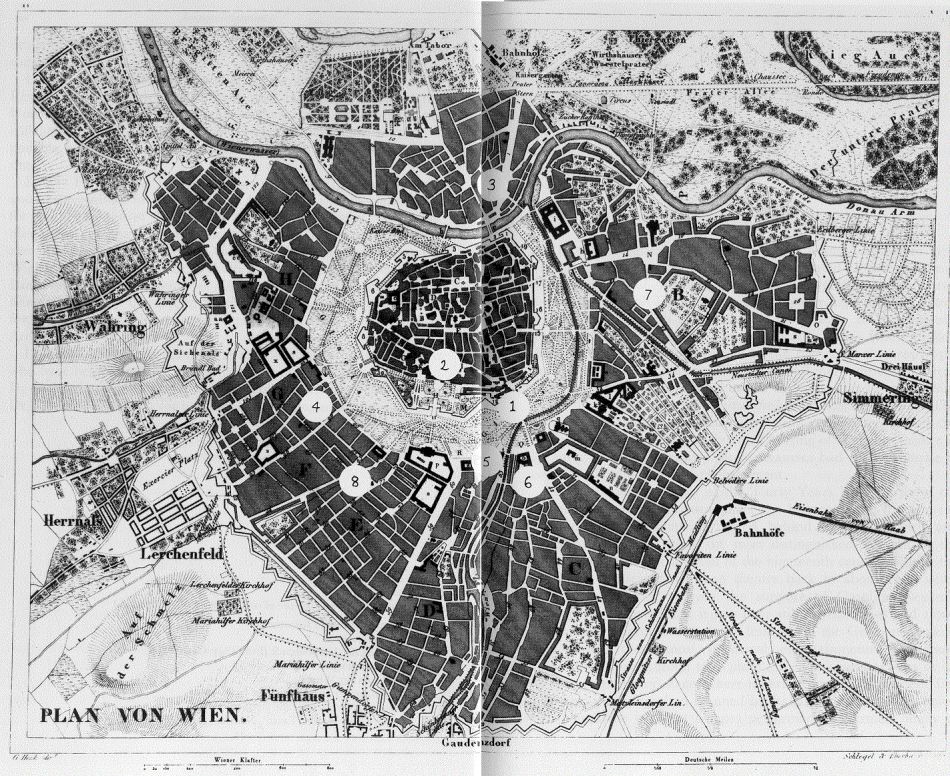
Vienna and its suburbs in 1850.
Note the small city in the center,
still surrounded by fortifications,
which a few years later will be torn down and converted into the Ringstrasse,
and the ring of suburbs lying outside the walls.
1851
On January 10, 37-year-old Wagner publishes his theories on opera in his book Oper und Drama ['opera and drama']. He is also deeply involved in his huge Der Ring des Nibelungen project, writing the prose draft for Wieland der Schmied in March and the sketch and then the poem for Der junge Siegfried ['the young Siegfried'] during May and June.
18-year-old Brahms composes the first work he will publish under his own name, the E-flat-minor Scherzo, op.4 for piano. His training and temperament cause Brahms to value the past musical achievements of Bach, Mozart, and especially Beethoven, more highly than those composers holding to the 'New German School' ideology (chiefly, Liszt and Wagner).
21-year-old Bülow goes to Weimar to study piano seriously with Liszt.
Liszt projects for this year:
Both of these will be orchestrated by Raff, and revised by 1854.
The Vienna Conservatory reopens after having shut down
in 1848 as a result of the revolution.
22-year-old violinist Josef Hellmesberger (senior)
becomes Director, a position he holds until his death in 1893.
Metternich returns to Austria, and altho he will never hold another official office, he does become a close personal advisor to Emperor Franz Josef.
In America, 7 years after the first public demonstration of the telegraph, there are 50 telegraph companies operating hundreds of offices, mostly located at railway stations. 12 small telegraph companies merge to form Western Union Company.
1852
In February, Wagner meets Otto Wesendonck, a wealthy merchant who becomes a generous patron, and his wife Mathilde. Wagner completes the poems of Die Walküre on July 1 and Das Rheingold on November 3, and works on the text of the drama now called simply Siegfried.
Probably feeling inspired by the patriotic fervor of the Revolution a few years before, 41-year-old Liszt composes the 1st thru 15th Hungarian Rhapsodies, which are based not on Magyar folk music, but on urban popular music of Hungary, whose cultural basis is Roma [gypsy].
In November, 19-year-old Brahms completes his 2nd Piano Sonata, in F-sharp-minor, op.2, the first written but second to be published.
During the end of this year and the beginning of the next, 41-year-old Liszt composes his radical and monumental Sonata in B-minor, finishing it on the following February 2. This work's main importance lies in Liszt's formal innovation: an attempt to fuse all 4 movements of the traditional sonata design into a 1-movement structure.
1853
In January, 19-year-old Brahms composes the song Liebestreu ['true love']; in March, he completes the 1st Piano Sonata, in C major, op.1 (i.e., the piece he considered worthy of publishing first), and composes the 2nd and 4th movements of the 3rd Piano Sonata, in F minor, op.5.
By now an accomplished pianist and composer, Brahms goes on a tour playing popular 'Hungarian' (really Gypsy) music with 23-year-old violinist Eduard Reményi, and in May meets Reményi's old classmate Joachim, 22, who will be a lifetime friend. When Reményi gets in trouble with the police, Joachim sends both he and Brahms to Liszt.
Liszt is very pleased while sight-reading Brahms's E-flat-minor Scherzo, then plays his own recently-completed Sonata in B-minor. When Liszt looks over to see what his young visitor thinks, he finds Brahms asleep: a premonition of the major split that will occur in 19th-century European music. Brahms claims that he was simply listening with his eyes closed...
Thru Joachim, Brahms visits Düsseldorf and befriends Robert and Clara Schumann. Schumann is dazzled by Brahms's three piano sonatas, and declares him to be the prophet of the musical future, in classically restrained opposition to the 'New German School' headed by Liszt and Wagner.
Liszt projects for this year:
23-year-old Bülow goes on a concert tour as pianist.
39-year-old Wagner completes the text for his four-night cycle Der Ring des Nibelungen, has it printed and read to friends, and he sends a copy to Liszt. During one of these readings, on October 10 in Paris, Wagner meets Liszt's 15-year-old daughter Cosima. Wagner begins composing the music of Das Rheingold, the first of the Ring music-dramas, in November.
During this year and the next, music-theorist Simon Sechter publishes the 3 volumes of his very influential Die Grundsätze der Musikalischen Komposition ['the foundations of musical composition'].
1854
Early in the year Brahms, 20, composes his first surviving chamber piece, the 1st Piano Trio in B, op.8, which he will rewrite 35 years later.
Wagner, in a letter to Liszt, expresses his first ideas about Tristan und Isolde.
In February, Schumann, 43, is finally overtaken by his mental illness (probably bipolar disorder) and jumps into the Rhine in a suicide attempt. He is rescued, and has himself committed to an asylum in Endenich, near Bonn, where he will live out the rest of his life.
21-year-old Brahms is inspired by this tragedy to write what will eventually become his 1st Piano Concerto, in D Minor.
On June 28, 41-year-old Wagner begins composing the music for Die Walküre
In Weimar, 43-year-old Liszt finally seems to have clarified his ideas
about the symphonic-poem with the completion of Festklänge,
as he now finishes the revisions of the ones he had composed since 1848
(and will not subject the future ones to such revision),
puts in order the 7 composed so far, and composes a new one
(numbers reflect publication order):
and in 2 months composes his Faust Symphony, which has a theme using a 12-tone row made of 4 successive augmented triads.
Also in Weimar, 32-year-old Raff composes a 5-movement
Grand Symphony in e minor, WoO.18.
1855
Josef Hellmesberger Jr. is born in Vienna. His father is the Director of the Vienna Conservatory.
Guido Adler is born in Moravia (now in the Czech Republic) in November.
Wagner travels to London to conduct, and then stays in Paris alone.
Rossini returns to Paris, where he remains for the rest of his life.
In Weimar, 44-year-old Liszt expands his overture to choral settings of Herder's "Der entfesselte Prometheus" ['Prometheus unbound'] into his 5th symphonic-poem: Prometheus, S.99/639, premières it on October 15.
Joachim Raff formally leaves Liszt's Neu-Weimar-Verein ['New-Weimar Society'],
eventually settling the following year in Weisbaden.
25-year-old Bülow begins teaching piano at the Stern and Marx conservatories in Berlin, organizing concerts and recitals which feature composers of the "New German School".
In Paris, the Triébert firm of instrument makers
produces both Charles Louis Triébert's revision of the Boehm oboe,
and the Barret's Systeme oboe.
1856
On March 23, Wagner finishes the score of Die Walküre.
On July 29, Schumann, who has stopped eating, dies in the asylum at age 46.
In Hamburg, 23-year-old Brahms begins sketching his 1st Symphony, which will not be completed for another 20 years.
In September, Wagner, now 43, begins composing the music to Siegfried. On December 19 he sets down the first musical sketches for Tristan und Isolde.
In Weimar, 45-year-old Liszt composes his Dante Symphony.
1857
On February 22, Heinrich Hertz is born in Hamburg, German Confederation.
In February, 43-year-old Wagner writes the essay On Liszt's symphonic-poems. In April, Wagner and Minna move into "Der Asyl", a cottage in the garden of the his patron Wesendonck's villa in Zurich, where Wagner drafts the first prose sketch for Parsifal.
In Paris, the phonautograph, a machine which transcribes sound to a visible medium, is invented by Frenchman Édouard-Léon Scott de Martinville and patented on 25 March. Its design will later be developed by Cros (1877) and Edison (1878) into the phonograph.
Wagner becomes entangled into a love affair with Mathilde von Wesendonck, his patron's wife, which inspires him to begin serious composition on Tristan und Isolde. So on August 9, Wagner, now 44, interrupts work on his Der Ring des Nibelungen after completing Act 2 of Siegfried (the third of the four music-dramas comprising the project), to begin composing Tristan.
The Vienna première of the original version of Wagner's Tannhäuser occurs on August 28.
19-year-old Cosima Liszt marries 27-year-old Hans von Bülow, and on their honeymoon in September they visit the Wagners.
From October to December, Wagner composes the Prelude to Tristan, making a bold break with the past by giving the piece a restless harmonic structure full of wandering chord progressions where dissonant chords resolve into further dissonant chords for long periods of time.
Robert Hirschfeld is born in September in Moravia.
During the winter, Wagner sets 5 love poems which Mathilde wrote to him, as the Wesendonck Lieder. 2 of these are later incorporated into Tristan.
In Weimar, 46-year-old Liszt adds an optional final chorus to his Faust Symphony and premières it on December 5. Liszt also composes his 11th symphonic-poem, Hunnenschlacht ['the battle with the Huns'], S.105/645, based on Wilhelm von Kaulbach's 1847 mural "Battle of the Huns", a depiction of a battle so fierce that ghosts of the dead soldiers were said to be seen fighting in the air afterwards.
1858
Escaping the situation in Zurich, Wagner goes to Paris in January. In April, Minna finds one of his letters to Mathilde.
Natalie Lechner is born on May 9 in the Penzing district of Vienna. She will later become an important friend of Mahler.
Hans Rott is born on August 1 in Vienna's 15th district, illegitimate son of the actor Carl Mattias Roth (later Rott) and the singer and actress Maria Rosalia Lutz.
The Vienna première of Wagner's Lohengrin occurs on August 19.
Also in August, because of his flagrant affair with Mathilde Wesendonck, Wagner is forced to separate from his wife Minna, and to leave his residence at the Wesendonck's villa; he goes to Venice and writes out the manuscript of the Wesendonck Lieder in October.
In Weimar, 47-year-old Liszt completes his 12th symphonic-poem Die Ideale ['the ideals'], S.106/646., and begins his 10th, based on Shakespeare's Hamlet. With conservatives attacking his works and those of his pupils, Liszt resigns his post as Kapellmeister at Weimar.
1859
During May and June, Sardinia (under Victor Emmanuel II) provokes Austria with the intent of engaging an alliance with France (under Napoleon III) in the effort to unify Italy, and Austria (under Franz-Josef) attacks, thus resulting in the Austro-Sardinian War, in which Austria loses the province of Lombardy and its capital Milan to France, which in turn gives it to Sardinia in exchange for Nice and Savoy.
On August 6, 46-year-old Wagner completes Tristan und Isolde. He has been running from creditors -- having left Venice for Lucerne and then Zurich -- and his new work expresses his philosophy of finding redemption from the turmoil of life in a quasi-Buddhist nirvana of death and nothingness. These ideas attract the attention of the philosopher Nietzsche. Wagner has a premonition of the difficulties Tristan will encounter, and indeed, the first two attempts at a première are eventually scrapped.
1860
Brahms and Joachim write a manifesto condemning the 'New German school' of composition headed by Liszt and Wagner. Intended to be published in a music journal with dozens of signatures, it leaks out and gets printed early in a daily newspaper with only four signatures, causing more damage than good to Brahms's reputation.
Hugo Wolf is born in Slovenj Gradec [in what is now Slovenia] on March 13. Both his parents are Slovenian, but change their name to "Wolf" and aggressively try to assimilate to the Germanic culture.
On May 4, Carl Mattias Rott's first wife dies, and he marries 1-year-old Han's mother Maria.
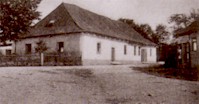
Mahler's birthplace |
Gustav Mahler is born on July 7 in the village of Kalischt in Bohemia (then part of the Austrian Empire, now Kalište, Czech Republic), the second of 14 children, most of whom will die in infancy. His ethnic background is Polish-Jewish. |
When Gustav is just a few months old, the Mahler family moves to the town of Iglau in Moravia (then Austrian Empire, now Jihlava in the Czech Republic), living at Znaimergasse 4. Iglau is a small provincial center of German culture, approximately a 5 hour train ride from Vienna, and until the 1780s had been a center of silver mining.
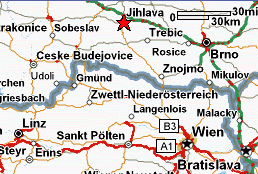
map of the area from Vienna to Iglau (Jihlava) |

The Mahler houses in Iglau |
Liszt and Carolyne attempt to marry in Rome but she has not submitted her divorce papers and so they cannot -- but they remain soul mates. Liszt settles in Rome.
41-year-old Suppé composes Das Pensionat, which is considered to be the first successful Viennese operetta, and only the first of many from Suppé.
The Vienna première of Wagner's Der fliegende Holländer ['the flying Dutchman'] occurs on November 2.
In America on November 6, Abraham Lincoln is elected the 16th President. The United States at this time has 33 states, along with other large territories between the west-coast states and the rest, which are near and east of the Mississippi River. The major tenet of Lincoln's platform has been the abolition of African-American slavery, which causes the most sharply divided opinions in the country up to this time. Most voters in the northern states agree with abolition but most in the southern states wish to preserve slavery. On December 24, South Carolina declares its secession from the United States ("the Union"). 7 other states will follow its lead in the next six weeks. These declarations are not recognized by the Union. Meanwhile, the southern states begin to form local militia armies, expecting conflict with the Union.
In Europe also on December 24, Julius Korngold is born in Brünn, Moravia (then part of the Austrian Empire, now Brno, Czech Republic). He will go on to become an influential newspaper critic, and father of a precocious composer.
1861
In America, on February 1 Texas secedes from the Union but its governor Sam Houston refuses to declare his alliegiance to the southern states which have seceded, so during the month he is replaced. On February 2, the 7 states which seceeded from the Union before February issue a Provisional Constitution, and on February 8 declare themselves' the Confederated States of America ("the Confederacy"). The local militias are quickly formed into the Confederate Army.
In Europe, starting in February, Wagner creates the framework for the libretto of Die Meistersinger von Nürnberg ['the master-singers of Nuremberg'] in Vienna and Paris. He makes heavy revisions to Tannhäuser for performance at the Paris Opèra: the "Paris version". Wagner is then allowed to re-enter Germany, except Saxony, and in November he begins to compose the overture for Die Meistersinger, which shows the influence of Tristan, but at the same time is very different from it.
In America on March 2, Texas, with its new governer, joins the Confederacy. On March 4, Lincoln is inaugurated and takes office. On April 12, the Confederate Army attacks the Union's Fort Sumter in Charleston (South Carolina) harbor and captures it. Lincoln sends the Union Army to crush the rebellion, beginning the American Civil War.
In Europe, 39-year-old Raff completes his 5-movement Symphony No. 1, in D-major "An das Vaterland" ['to the fatherland'], op.96, which will later win a prize.
On March 17, the Kingdom of Italy comes into existence, under the rule of Victor Emmanuel II, including most of mainland Italy except for Venetia-Lombardy.
Building is begun in Vienna for the new Statsoper ['state opera'] theater on the Ringstraße, designed by A. Sicard von Sicardsburg and E. van der Nüll.
In Rome, 49-year-old Liszt completes his 10th symphonic-poem Hamlet, S.104/644 -- the last one he will write until 1881.
In America, during May and June 4 more states join the Confederacy, as the Civil War escalates.
In Germany, schoolteacher Philip Reis invents a device he calls a "telephone", which can transmit musical tones, but never becomes useful for voice transmission.
1862
| 29-year-old Brahms visits Vienna for the first time, and after several extended stays, will make it his residence. |
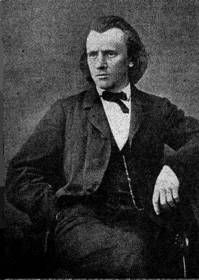
Brahms |
30-year-old Heinrich Bellermann publishes his treatise Der Contrapunct, oder Anleitung zur Stimmführung in der musikalischen Composition ['Counterpoint, or guidance for voice-leading in musical Composition'], which will become the main text used by Schoenberg when he begins his teaching career in earnest in 1904.
On May 15, in Hyogo, Japan, Shohé Tanaka is born.
49-year-old Wagner has a brief affair with actress Friederike Meyer, sister of Frau Meyer-Dustmann of the Vienna Opera. As a result of the affair, Wagner cannot get Tristan und Isolde staged at the Vienna Opera, and his wife Minna also finally leaves him for good. Wagner is also granted amnesty from Saxony. He periodically works on the libretto of Die Meistersinger.
43-year-old Suppé produces his operetta Zehn Mädchen und kein Mann ['10 maidens and no man'] in Vienna.
In Brussels [Belgium], woodwind manufacturer Eugene Albert mechanizes the Müller 13-key system clarinet by the use of Boehm's brille (see above, 1808) on the right-hand joint, creating the "Albert system", also still called by its old name of "simple system", and a clarinet system still in some use today, especially in Eastern Europe.
On September 22, Otto von Bismarck becomes chancellor of Prussia, and immediately begins a policy of uniting Germany as a Kleindeutschland ['little Germany'] under Prussian rule, as opposed to the idea of a Grossdeutschland ['large Germany'] which would include Austria.
On the same date, in America, President Lincoln gives a speech now known as the "Emancipation Proclamation", to be put into effect the following January 1, in which all Americans, including former African-American slaves, are given free citizenship. Of course the Confederate states consider this to not apply to the slaves living in those states, as the Civil War ravages on.
1863
In Austria, 39-year-old Bruckner composes his his earliest surviving symphony, at first numbered No. 1. Later he decides to leave it unnumbered, and today we know it as Symphony No. 00, "study symphony", or simply Symphony in F minor, the only one he wrote in that key.
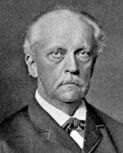
Hermann Helmholtz
The 41-year-old physicist Hermann Helmholtz, teaching at Heidelberg University,
publishes his groundbreaking study of musical acoustics,
Die Lehre von den Tonempfindungen als physiologische Grundlage für die Theorie
der Musik ['treatise on sound-perception as a physiological basis
for the theory of music', published later in English translation
with "Die Lehre von den Tonempfindungen" rendered as On the Sensations of Tone].
Helmholtz also has constructed a
24-tone harmonium tuned in just-intonation.
| |
44-year-old Suppé produces his operetta Flotte Bursche in Vienna.
Vienna's Gesellschaft der Musikfreunde ['society of friends of music'] awards the 1st Prize to 41-year-old Joachim Raff for his 1st Symphony "To the Fatherland", op.96.
Franz Schalk is born in Vienna on May 27.
Liszt's mistress Princess Carolyne Sayn-Wittgenstein is nearly mad, and so 52-year-old Liszt dissolves their relationship and retires to a Dominican monastery.
In Prague in July, 39-year-old Bedrich Smetana begins work on his opera Prodaná Nevěsta ['The Bartered Bride'], which will occupy him for the next 3 years.
|
Having seen someone ride by on a draisene (see 1818) the previous year,
Pierre Lallement moves to Paris, carries out several experiments trying
to introduce a mechanized transmission to the draisene, and during the
summer, completes the
construction of his 2-wheeled vehicle with foot-operated rotary cranks
attached to the front wheel hub: the first true bicycle.
Known at first as a "velocipede", taking over the name from the various mechanized 3- and 4-wheeled vehicles that had become popular during the 1850s, bicycles of this type, with wooden wheels covered with iron tires, would later be dubbed the "boneshaker". |

"Velocipede" pedal-crank bicycle |
1864
Richard Strauss is born in Munich on June 11, of German background.
His mother, Josephine Pschorr, is the heiress to a family of brewers,
making her independently wealthy, and his father, Franz Joseph Strauss,
plays principal horn in the Munich Court Orchestra for nearly 50 years;
thus his early childhood is relatively carefree.
45-year-old Suppé produces his operetta
Pique Dame in Vienna.
Wagner
Wagner flees creditors in Vienna, going to Stuttgart.
The eccentric 18-year-old King Ludwig II of Bavaria
loves Wagner's music and "rescues" him,
installs him in Munich, pays off all his debts, and offers Wagner total
financial support and love, which enables him to continue composing
the rest of his Ring project.
Wagner completely changes his outlook and becomes a devout Christian,
repelling Nietzsche. Cosima, pregnant with Wagner's child,
leaves Hans von Bülow and
goes with her two daughters to live in Munich with Wagner.
Wagner considers it prudent to put aside the nationalistic
Die Meistersinger so as not to offend Ludwig, and
concentrates on re-engagement with his unfinished Ring project.
In Paris, students René and Aimé Olivier and
George de la Bouglise recognize the importance and potential profitability
of Pierre Lallement's bicycle invention, and they
form a partnership with Lallement's employer, the carriage-maker
and blacksmith Pierre Michaux, to construct bicycles. Michaux's first batch
of bicycles is finished by summer.
1865
In America, for several months the Confederate Army has been facing
serious defeats, and finally surrenders on April 9, ending the
American Civil War. The Confederacy is dissolved,
and all 36 states are now once again the United States of America.
Shortly after, President Lincoln is assassinated, and dies on April 15.
On April 10, Wagner and Cosima's first child Isolde is born.
Despite the fact that Wagner stole away 35-year-old Hans von Bülow's wife Cosima,
Bülow remains devoted to Wagner's music.
On June 10, in Munich, the première of Wagner's
Tristan und Isolde finally occurs, conducted by
Bülow, and turns the musical world upside-down
with its 5 hours of evaded cadences, rampant chromaticism,
and orgasmic love-scenes.
In July, Pierre Lallement leaves Paris for America,
taking the parts for an improved version of his recent
invention, the bicycle (see 1863), with him to Brooklyn, New York.
Later in the fall, he settles in Connecticut and builds the bicycle,
later taking it on a few test rides around the New Haven area.
Also during August, the Olivier brothers and Georges de la Bouglise
(Michaux bicycle company's financial backers) take a test ride
of 500 miles [~805 km] from Paris to Avignon on bicycles of two different
designs, first with Lallement's serpentine cast-iron frames, then on wooden
prototypes of a rigid wrought-iron frame design by Aimé Olivier and
a mechanic named Gabert.
At the end of August, Wagner completes his prose draft of
the story of Parsifal.
46-year-old Suppé produces his operetta
Die schöne Galatea on September 9 in Vienna. He begins a
17-year stint as Kappellmeister at the Carltheater.
Mahler
In Iglau (Bohemia, Austrian Empire), 5-year-old
Mahler
has already displayed an extraordinary talent for
reproducing tunes and other sounds on his toy accordion, begins taking
piano lessons and makes rapid progress, and writes his first compositions.
Mahler's teachers during his youngest years are:
In one of his most famous statements, someone asks the young
Mahler what he wants to be when he grows up, and his strange
answer is: "a martyr".
18-year-old Robert Fuchs begins studies at the Vienna Conservatory,
studying composition under Felix Otto Dessoff.
Scandals force King Ludwig to banish Wagner from Munich,
and so he and Cosima and the children move to Luzern (Switzerland) on December 10.
54-year-old Liszt enters the Vatican,
joins the Franciscan order, receives the tonsure and four
Minor Orders of the Catholic Church (Porter, Lector, Exorcist and Acolyte),
and is made an abbé by Pope Pius IX.
He publishes his piano transcriptions of all 9 Beethoven symphonies.
By October, 41-year-old Smetana has completed the piano score to
his opera Prodaná Nevěsta ['The Bartered Bride'].
He then puts it aside while he composes his third opera Dalibor.
Jean Sibelius is born in Hameenlinna, Finland, on December 8,
during a period of Russian rule, and in a Swedish-speaking household.
The première is given of the newly-discovered
"Unfinished Symphony" in B-minor of Franz Schubert,
considered today by many to be his greatest work.
In America, the 13th Amendment to the United States
Constitution, abolishing slavery, has been passed by Congress,
and on December 18 is ratified by the required majority of states and becomes law.
1866
In February and March, Smetana rapidly orchestrates his second opera
Prodaná Nevěsta ['The Bartered Bride'].
It is premièred in Prague on May 30, in a 2-act format
containing spoken dialog. It is not a success, and over the following
4 years Smetana revises and extends it, and eventually turns all the
spoken dialog into recitative.
Ferruccio Dante Michelangilolo Benvenuto Busoni is born on April 1
in Empoli, Italy (near Florence). His father is a virtuoso clarinettist
and his mother (whose father is German) is a pianist. He shows
talent early and takes lessons from his parents.
Ludwig Karpath is born in April in Budapest.
In April, in America, Pierre Lallement files a patent for
his invention, the pedal bicycle. Within a year the bicycle
craze erupts in Paris, on machines exactly of Lallement's design
built by the firm of Michaux, but Lallement's patent is the
only one ever filed anywhere for this first version of the vehicle.
Meanwhile, in Paris, René Olivier makes plans to launch the
Michaux bicycle company as an impressive new industry, deciding to
produce the machines with Lallement's original serpentine cast-iron
frame design. Olivier's wealthy family disapproves of the venture, so
he cannot rely on their money, and he also uses Michaux's name
for the venture to protect his family name in case it is a failure.
During June, Austria and Saxony battle Prussia over
supremacy of the German states in the Austro-Prussian War,
ending in Austria-Saxony's defeat at the Battle of Königgrätz
in central Bohemia on July 3. The hegemony of Austria is broken,
and from now on Prussia will take the leading role in German politics.
Bismarck is generous to Austria, demanding only that Austria give up Venetia.
Austria cedes the province of Venetia to France, which in turn cedes
it to Italy.
In August, the Norddeutscher Bund ['North German Confederation']
is formed, as a military alliance of 22 states of northern Germany,
with the Kingdom of Prussia as the leading state.
8-year-old Natalie Lechner begins 6 years of study at the Vienna Conservatory.
42-year-old Smetana produces his opera
Prodaná nevěsta ['The Bartered Bride']
in Prague, in its original 2-act version.
33-year-old Brahms finishes Eine deutsches Requiem
['a German Requiem'].
von Suppé
In April in Linz [Austria], Bruckner, 41, finishes composing a symphony in C-minor which at first
is labeled as "No. 2", but when he supresses the number of the
first one in F-minor (the one we now call "00"), this one becomes known as
Symphony No. 1. He had composed two earlier versions of the middle movements
(Adagio and Scherzo) which he replaced in the completed symphony.
This version is referred to now as the "first version", because a later revision
done in Vienna is now known (incorrectly) as the "Linz version".
He also composes his Mass No. 2, in E minor.
Wagner moves to Triebschen, near Geneva [Switzerland].
In December, he rewrites the libretto of
Die Meistersinger and works seriously on the composition of its music.
1867
In February, the Ausgleich
['compromise', kiegyezés in Hungarian]
establishes the Dual Monarchy of Austria-Hungary,
signed by Franz Joseph of Austria and a
Hungarian delegation led by Ferenc Deák. The compromise follows a series
of failed constitutional reforms of the Habsburg Empire. Under the
new arrangement the Magyar dominated government of Hungary gains
near equal status to the "Austrian" government based in Vienna.
This forms a twin country united
only at the top through the King-Emperor and the common
Ministries of Foreign Affairs and of War. Each half of the country
had its own Prime Minister and parliament: in Hungary the Diet
is restored to power.
The Austrian half of the dual monarchy begins to move towards constitutionalism.
A constitutional system with a Reichsrat [parliament] is created,
and a bill of rights is enacted -- however, the parliament's effectiveness
is hampered by conflicts between parties representing different ethnic groups.
During the period from now until 1914, the Gründerzeit, Austria
becomes an industrialized country (except for the Alpine regions), with
a lot of construction, and expansion of cities and railway lines.
Austria also gives autonomy to its province of Galicia
(now part of Ukraine; capital: Lemberg, 'Lwów' in Polish,
'Lviv' in Ukranian).
Wagner and Cosima's second daughter Eva is born on February 17.
On 25 March, Arturo Toscanini is born in Parma, Italy.
The Universal Exhibition opens in Paris in May.
In May, in Paris, the newspaper Le Moniteur Universel du Soir
['the universal evening monitor'] carries the first advertisement
for the Michaux bicycle company. Within months the bicycle craze is born.
The wealthy young men who are its first proponents gather in the Bois du Boulogne
and ride to the Universal Exhibition fairgrounds, showing off their machines
to visitors from all over Europe, who in turn purchase their own and have them
shipped home.
In July, the Norddeutscher Bund ['North German Confederation']
is transformed from simply a military alliance into a federal state
with a constitution, and will be the building block
of the German Empire 4 years later.
42-year-old Johann Strauss, Jr. composes The Beautiful Blue Danube,
still the most popular waltz ever written.
48-year-old Suppé composes his operetta
Banditenstreiche ['the jolly robbers'].
20-year old Robert Fuchs gives a performance of a symphony
for his graduation from the Vienna Conservatory.
On October 24, 54-year-old Wagner completes Die Meistersinger.
1868
Bruckner
44-year-old Bruckner, who has been organist at St. Florian in Upper Austria,
moves to Vienna and becomes Court Organist and professor at the
Conservatory of the Gesellschaft der Musikfreunde [society
for the friends of music]. He composes his Mass No. 3, in F minor
('Grosse Messe').
Max von Schillings is born on April 19 in Düren (Rheinland), Germany.
Already, by the spring, only a year after their initial advertisement,
the Michaux bicycle company in Paris is having difficulties filling
their orders, and the serpentine cast-iron frame also proves to be
prone to breakage. Several other bicycle companies form, many using
the more sturdy diagonal wrought-iron frame design that had been rejected by
the Oliviers (Michaux's partners), and these companies also do a better job of meeting
demand. Realizing their mistake, the Olivier brothers draw up a charter
agreement with Michaux giving them control over all design matters,
and switch to the diagonal design, which becomes recognized as the
industry standard by the fall. The Michaux firm also develops racing
contests in Paris as a means to promote their business, which in turn
leads to the popularity of other unrelated races. In France, 1868 is
known as "the year of the velocipede".
Pierre Lallement, the inventor of the pedal bicycle, fails to
secure a manufacturer during his sojurn in America, and he returns to France
early in the year. But by the summer, bicycle mania has hit America
and several companies begin manufacture.
Still on hiatus from his Ring project,
55-year-old Wagner premières his comic music-drama Die Meistersinger
von Nürnberg ['the master-singers of Nuremberg'] on June 21 in Munich,
conducted by Bülow. Meistersinger
will be greatly admired, privately, by Brahms.
Immediately after this production, Wagner resumes work on the
score of Siegfried.
In America, Scott Joplin is born sometime during the summer
in northeastern Texas, to a couple who had been slaves until
the Civil War and Lincoln's Emancipation Proclamation.
On December 15 in Iglau (now Jihlava, Czech Republic), Mahler's
favorite sister Justine is born.
1869
Building of the Vienna Statsoper ['state opera'] theater
is complete. The architects are severly criticised,
which causes van der Nüll to commit suicide and
Sicardsburg to die of a heart attack two months later.
The opening performance on May 25 is Mozart's
Don Giovanni.
Between January 24 and September 12, Bruckner, 45, composes a Symphony in D minor, at
first called "No. 2", but then later around 1872/73 he decides that this one
is unworthy to be numbered, and we now know it
as "Die Nullte" or No. 0. He also composes
his Mass No. 1, in D minor.
In Wiesbaden, 47-year-old Raff composes his
Symphony No.3 in F "Im Walde" ['in the forest'], op.153,
which makes him famous.
Hans Pfitzner is born on April 23 in Moscow, Russia.
In America, on May 10, the "Golden Spike" is driven into the ground
at Promontory Summit, Utah, to complete the Transcontinental Railroad,
making it possible to travel by train from the Atlantic to the Pacific Oceans.
Wagner and Cosima's son Siegfried is born on June 6.
The philosopher Friedrich Nietzsche is a houseguest at the time.
58-year-old Liszt returns to Weimar.
In America, within the first year of the new bicycle industry,
3 major improvements take place:
These innovations appear simultaneously in England,
and will soon make the "Ordinary" high-wheel bicycle the
industry standard. Other experimental American improvements
of this year include:
In Scotland, Thomas McCall builds a bicycle which uses
foot treadles to operate cranks which turn the rear wheel.
According to many later accounts, this design is a copy
of a bicycle invented by Kirkpatrick MacMillan in 1839,
but there is little evidence to support this claim --
in fact, McCall's bicycle may be one of the first to use
a rear-wheel indirect-drive transmission.
On November 17 in Egypt, the Suez Canal is completed and opened
by a French company, cutting shipping distance from Europe to Asia by 5,000 miles.
It will also play an important role in the European colonization of Africa.
1870
The Vienna première of Wagner's
Die Meistersinger occurs on February 27.
Oskar Straus is born on April 6 in Vienna.
Franz Lehár is born on April 30 in Komorn, Hungary.
6-year-old Richard Strauss begins composing his first pieces.
Strauss's father detests Wagner and all of the "New German School"
of music, and rigidly ensures that only "the classics"
(Mozart, Beethoven, Schubert, Schumann, etc.) are heard in his household.
Young Richard's compositions reflect this classical background.
46-year-old Smetana produces a revised 3-act version of his opera
Prodaná nevěsta ['The Bartered Bride']
in Prague.
In England, James Starley produces the Ariel high-wheeler
bicycle, with a front wheel about twice the diameter of the rear wheel.
Known as the "Ordinary", it is an extremely influential design
which is adopted universally by bicycle manufacturers, with the
front wheel size growing larger and larger during the 1870s
and early 1880s, until reaching a maximum diameter of
about 5 feet [~1.5 meters]. (see 1883)
On June 10, France declares war on Prussia.
On June 26 [or July 18], Cosima and Hans von Bülow divorce.
Cosima has already been living with Wagner for 6 years and borne
him 3 children, and on August 25 they marry.
By September, Smetana's second opera
Prodaná Nevěsta ['The Bartered Bride'],
reaches its final form. It finally will be successful at an 1892
performance in Vienna, and from that point on it becomes one of
the world's most popular operas.
On September 20, Rome and Papal States (except for the tiny
enclave of the Vatican) are incorporated into the Kingdom of Italy,
marking the boundaries of the modern nation.
51-year-old Suppé produces his operetta
Die Prinzessin von Dragant in Prague.
In October, 10-year-old Mahler gives his first public
performance at the piano in his hometown of Iglau.
The heaviest early influence on him is that of Schubert.
Years later, in his interview with Freud (1910), Mahler
will recount a story from his childhood which illustrates how
he associated popular music with tragedy -- in Freud's words:
It is my suspicion that Mahler told this story to Schönberg
before he told it to Freud (see 1908).
Mahler
1871
On January 18, Wilhelm I is declared the first Kaiser
of a united Deutsches Reich ['German Empire'],
which adopts the flag and most of the constitution
of the previous Norddeutscher Bund ['North German Confederation'].
In English, it is often called simply "Germany". It includes all
the German states of Europe except Austria, Leichtenstein, and Luxembourg.
57-year-old Wagner completes the score of Siegfried in February,
and begins the composition of Götterdämmerung,
the final drama in Ring tetralogy.
Willem Mengelberg is born in Utrecht on March 28, to German parents.
The Vienna première of Wagner's
Rienzi occurs on May 30.
Bernhard Mahler sends his 11-year-old son Gustav to live in Prague,
to attend the Neustaedter High School. However, the family with which
Mahler lives does not treat him well, his studies are poor, and he
comes back home to Iglau after the school year to finish his schooling there.
Alexander Zemlinsky is born in Vienna on October 14.
His ethnic background is Slavic
Jewish (Sephardic), the family originating in Galicia (Poland) on his father's side
and Muslim Bosnia on his mother's side. His father uses 'von Zemlinszky'
as his last name, but without actual noble lineage, Alex eventually
drops the 'von' and also the Hungarianesque extra "z".
Liszt
For the last 15 years of his life, Liszt formulates a nice routine:
living and working in Budapest from January to March, teaching
in Weimar from April to June, and enjoying the peace and quiet of a villa
near Rome for the rest of the year. He is able to compose a lot
during these years, and his works (for example, Nuages Gris
and Unstern) explore some of the most radical
techniques, which directly influence the work of Debussy, Ravel,
and Bartók, and also foreshadow the experiments
of Schoenberg and Stravinsky.
In the fall in Vienna, 47-year-old Bruckner begins another symphony in C-minor,
at the time labeled "No. 3" but now known as his 2nd Symphony.
He will work on it mostly during the following summer.
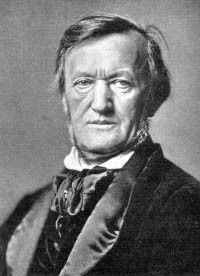
in his 50s
On June 29, Cosima von Bülow and her daughters
Daniela and Blandine visit Wagner in Vienna.
26-year-old Cosima, the daughter of Wagner's old friend Liszt,
becomes 51-year-old Wagner's mistress the following week, and
they swear "sich einzig gegenseitig anzugehören" ['to belong only to each other'].
Cosima becomes pregnant with the first child they will have together.
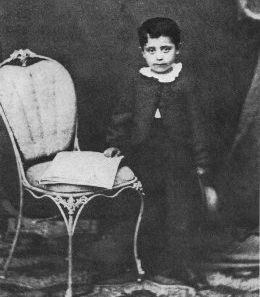
age 6, with one of his manuscripts
47-year-old Suppé produces his operetta
Leichte Cavallerie ['light cavalry'] on March 21
at the Carltheater in Vienna.
in his 40s
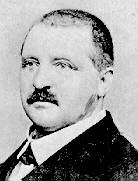
around the time he moved to Vienna

"To escape that 'especially painful scene' between his
father and mother, Mahler rushed away from the house.
At that moment, however, a hurdy-gurdy in the street was
grinding out the popular Viennese air 'Ach, du lieber Augustin'
['ah, you dear Augustine']. In Mahler's opinion the conjunction
of high tragedy and light amusement was from then on inextricably
fixed in his mind, and the one mood inevitably brought the other with it."
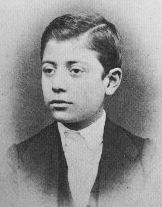
age 10, around the time of his first concert
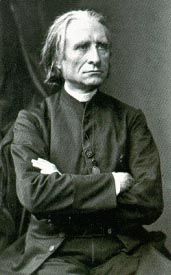
in his 60s
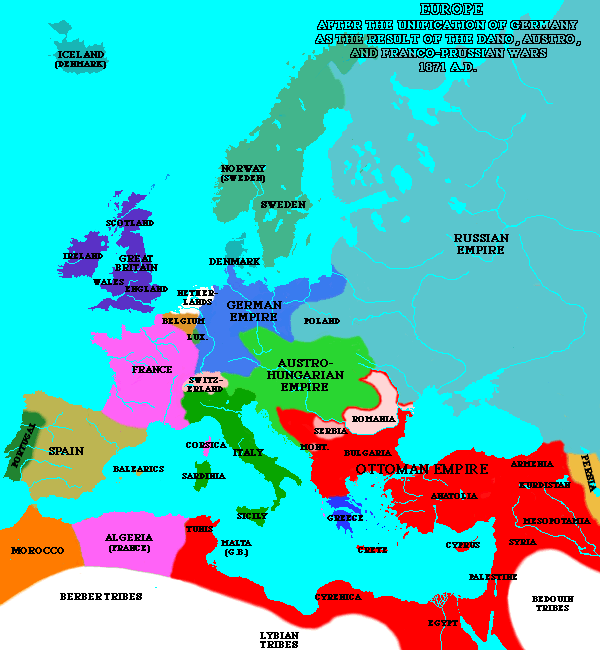
Europe in 1871
1872
The Pfitzner family, with 3-year-old Hans, moves from Moscow to Frankfurt, Germany.
During the summer, 59-year-old Wagner composes the final part of Götterdämmerung, finally finishing his huge Ring project, begun 24 years ago.
| During the summer, 50-year-old Raff completes his 5th Symphony "Lenore", his most famous work. |
Joachim Raff |
45-year-old Bernhard Mahler purchases the house next door at Znaimergasse 6 in Iglau, renovates it, opens an inn at the front of the ground floor and operates a distillery in the back. The Mahler family moves into the floor above.
On August 14, 14-year-old Hans Rott's mother dies.
47-year-old Bruckner completes his 2nd Symphony, which at the time he is listing as his 3rd (because he did not yet negate the "Symphony No. 0").
25-year-old Ignaz Brüll becomes piano teacher at the Horák School of Piano Studies in Vienna, until 1878.
Willi Möllendorf is born. He will be a microtonal pioneer.
1873
In April, 47-year-old Johann Strauss II premières his most famous operetta, Die Fledermaus ['the bat']. On April 22, Strauss conducts the Vienna Philharmonic for the first time in the première of his waltz Wiener Blut ['Vienna blood'], op.354, for the Vienna Opera Ball held at the Musikverein.
In May, the Weltausstellung 1873 Wien ['1873 Vienna International Exhibition'] is held in Vienna's Prater park, featuring exhibits from Japan, China, Turkey, Egypt, Russia, Greece, Hungary, Austria, Germany, Belgium, Holland, Sweden, Norway, Denmark, Italy, Switzerland, France, Spain, Portugal, Great Britain, Brazil, and South America. (The USA was supposed to be represented but didn't prepare an exhibit in time.) The exhibits are not ready on opening day, and Vienna never holds another world's fair.
On May 9, just a few days after the opening of the Exhibition, the Vienna stock market crashes, causing an economic recession in the Austrian Empire.
During July, a cholera epidemic in Vienna kills 3000 people.
Bruckner, 49, decides to not include what we call the "Symphony No. 0" in his catalog of works, thus changing the one after it to "No. 2" (as we know it today), and he composes his 3rd ('Wagner') Symphony.
13-year-old Mahler performs at the piano in several concerts in Iglau.
On August 26 in Council Bluffs, Iowa (USA), Lee de Forest is born. His patent of the Audion in 1907 will be directly involved in the earliest electronic digital computers.
Bruckner makes a few revisions to his 2nd Symphony in preparation for its première in Vienna on October 26, with the composer conducting.
1874
49-year-old Bruckner begins his 4th Symphony ('Romantic') on January 2 and works on it during the whole year.
Hugo von Hofmannsthal is born in Vienna into a wealthy banker's family, Jewish on his mother's side, Austrian and Italian on his father's.
Edmund Eysler is born on March 12 in Vienna. He will go on to compose over 60 operettas.
27-year-old Robert Fuchs receives his first success with his 1st Serenade, for string orchestra, in D-major, op.9.
On April 25 in Bologna, Italy, Guglielmo Marconi is born. At the end of the century his work in radio transmission will be vitally important.
Mahler's 13-year-old brother Ernst, the closest to him in both age and affection, dies after a long illness; Mahler says later that no other death affected him so deeply. While staying at an aunt's house over the summer, he begins composing an opera called Herzog Ernst von Schwaben ['Duke Ernst of Swabia'] which probably reflects on this relationship, but after Mahler goes back home to Iglau the aunt cleans out the attic and, not realizing its significance, burns the manuscript of the opera.
Dvořák |
33-year-old Dvořák enters 15 works (including his 3rd Symphony) for the Austrian National Prize. He wins and receives a much-needed cash prize and gains the admiration and support of Brahms, who is one of the judges. On his recommendation, Brahms's publisher issues Dvořák's Slavonic Dances, which are very successful. |
During the summer, 50-year-old Smetana suffers a throat infection also affects his ears and causes him to become completely deaf. As with Beethoven, he continues to compose. Between 20 November and 8 December 1874, Smetana composes Vltava ['The Moldau (River)'], the second in the set of six symphonic poems which he will assemble 5 years later into Má vlast ['My Country' or more literally 'My Fatherland'].
In the fall of 1874, 16-year-old Hans Rott enrolls at the Vienna Conservatory, studying organ with Bruckner for 3 years and becoming Bruckner's favorite pupil.
Arnold Schönberg is born on September 13 and raised in the Leopoldstadt section of Vienna, also of Slavic Jewish background.
In America, Charles Ives is born in Connecticut on October 20.
50-year-old Bruckner completes the first version of his 4th Symphony ('Romantic') on November 22. This version was never performed during his lifetime.
On December 22, Franz Schmidt is born in Pressburg (then part of the Austrian Empire, "Pozsony" in Hungarian, present-day Bratislava, Slovakia).
Heckel revises Almenraeder's bassoon key-system, and his design remains the modern standard, eventually supplanting the Buffet-system bassoon everywhere except France.

|
1875
In January, Bruckner begins work on his 5th Symphony,
starting with the slow movement.
Friedrich 'Fritz' Kreisler is born in Vienna on
February 2. His father is the son of Sigmund Freud's
family physician, and also an amateur violinist who
teaches young Fritz his first lessons.
42-year-old Brahms becomes the most important member of the
Austrian Commission for the Conferring of Artists' Scholarships.
64-year-old Liszt is appointed president of the
New Hungarian Academy of Music in Budapest.
32-year-old Hans Richter becomes conductor of the Vienna Philahrmonic Orchestra
until 1898.
28-year-old Robert Fuchs obtains a job teaching harmony at
the Vienna Conservatory, which he will hold until 1912.
Brüll began lessons with Epstein at the same time as Mahler.
Altho not actually a pupil of Bruckner,
Mahler admires Bruckner's music, attends his lectures, and develops
a friendship that will last until Bruckner's death.
On December 27, 17-year-old Natalie Lechner marries Alexander Bauer,
a professer with whom she apparently had an affair just before his
first wife died.
1876
In America, on February 14, Alexander Graham Bell and Elisha Gray
both file their papers at the Patent Office for the invention of
the telephone, Bell beating Gray by just a few hours.
Wagner visits Vienna in March, for the last time,
to conduct Lohengrin. Mahler finds himself next to
Wagner in the coatroom after a concert but is too shy to speak to him.
Rott's father dies, leaving the 17-year-old orphaned and broke.
Bruckner allows Rott to continue his studies at the Conservatory
free of charge.
Sometime during this year,
Mahler,
15 or 16 years old,
composes his earliest surviving piece, the
1st movement of a
Piano Quartet in A minor.
At the end
of his first year at the Vienna Conservatory, he wins
two first prizes from the Conservatory, one for piano with
his playing of a Schubert sonata,
and one for composition
with a Quintet movement. (There is much confusion
about Mahler's early quartets and quintets: only the
piano quartet movement has survived intact, and references to quintets
may in fact concern this movement.)
Bruckner completes his 5th Symphony in May.
57-year-old Suppé produces his operetta
Fatinitza in Vienna. It is extremely popular,
and also runs in London and Paris in the next few years.
Wagner's artistic center at Bayreuth is completed and has its
grand opening with 33-year-old Hans Richter conducting
the first complete performance of Wagner's mammoth
Der Ring des Nibelungen, spead over four evenings.
The whole endeavor is dedicated to the realization
of Wagner's ideas of the gesamtkunstwerk ['total-art-work'].
43-year-old Brahms finally completes (after 20 years of work)
and premières his 1st Symphony. Upholders of the classical
tradition immediately proclaim it as 'the 10th', a not-very-subtle
reference to its worthiness as a successor to Beethoven's
great 9th Symphony.
Thanks mainly to the Viennese critic Eduard Hanslick, who is a good
friend of Brahms, the musical game
of the day is to declare yourself either a Brahmsian or a
Wagnerian, the two factions supposedly being exact opposites in
terms of style, technique, and philosophy. Brahms repeatedly claims
to be 'the best of the Wagnerites': the composer of the 'New German
School' whose work he really criticizes is Liszt.
(Despite a life-long admiration of Wagner,
Mahler's later friendship with Brahms will balance his artistic views
quite a bit.
Zemlinsky, after his successful efforts at combining his
admiration of these two composers in his own work,
and then Schönberg -- who both begin as Brahmsians and later
come to admire Wagner -- will be the first to fully reconcile this dilemma.)
Brahms
Hanslick writes a long article praising 10-year-old Busoni's
talents as a pianist and composer. The Busoni family moves
to Graz, Austria.
18-year-old Hans Rott studies composition at the Vienna Conservatory
with Franz Krenn during this school year and the next -- he is thus
a classmate of Mahler, and they become good friends.
[Mitchell 1995, p 296]
On September 15, Bruno Walter Schlesinger is born in a Berlin slum, to Jewish
parents. (He will later drop his last name and be known as Bruno Walter).
12-year-old Richard Strauss writes his first orchestral piece,
a Festmarch ['festival march']. It will be published
five years later with financial help from an uncle as Strauss's opus 1.
Bruckner embarks on a substantial revision of his 3rd Symphony,
initiating the "Second Version".
1877
The Vienna première of Wagner's
Die Walküre occurs on March 5.
In March, 17-year-old Wolf is dismissed from the Conservatory for breaking the rules.
He also visits a brothel and contracts syphilis, which will
ultimately lead to his insanity decades later.
In the Spring, Bruckner completes what is now known as the "1876 version"
(of the "Second Version") of his much-revised 3rd Symphony.
He eliminates the quotations from Wagner's Tristan und Isolde
and Die Walküre and makes other substantial changes,
particularly the addition of a canon to the Finale.
The work will undergo further revision in the Fall.
On 30 April, in Paris, Charles Cros writes a paper which describes
the process of recording sound onto a cylinder by means of a diagaphram
which also enables playback.
18-year-old Hans Rott completes his organ studies with Bruckner at the Vienna Conservatory.
During summer vacation, Brahms, 44, writes his 2nd Symphony.
In September, 55-year-old Joachim Raff becomes a
teacher and administrator at the Hoch Conservatory in Frankfurt-am-Main, Germany.
Bruckner, 53, revises
his 1st, 2nd, and 3rd Symphonies.
In September, 17-year-old
Mahler
enters the University of Vienna.
He drops his piano studies, to concentrate on composition.
Near the end of the year, with his friend Krzyzanowski's help,
he makes a piano-duet arrangement of Bruckner's 3rd Symphony (1877 version).
It is the first of any of Mahler's work to be published, and also
the first work by Bruckner to appear in print.
Josef Petzval
During Mahler's attendance at the University of Vienna,
Josef Petzval is teaching his students about
31edo
and meantone,
and demonstrating instruments he has had constructed in
those tunings. Decades later, Mahler's remarks to
Schoenberg indicate that he was familiar enough with
meantone to complain about its replacement with
12edo (see below, under "1904").
During the Fall, Bruckner again subjects his 3rd Symphony
to revision, making cuts to the Adagio including elimination of the
quote from Wagner's Tannhäuser overture,
elminating the entire canonic section to the Finale which he had
just added earlier this year, and adding a new coda to the Scherzo.
This is now known as the "1877 version" of the "Second Version".
In December, Brahms meets 36-year-old Dvořák for the first time
and from then on will be a strong supporter of his work.
Richter and the Vienna Philharmonic give the world première
of Brahms's 2nd Symphony on December 30.
1878
The Vienna première of Wagner's
Das Rheingold occurs on January 24.
From January 18 to September 30, 54-year-old Bruckner drastically alters his
4th Symphony, making extensive revisions to the first two movements
and entirely replacing the 4th movement with a new one, which has the
title "Volksfest" ['Popular Festival'].
On March 3, Bulgaria becomes independent from the Ottoman Empire.
Montenegro also becomes independent.
Early in the year, in Russia, 37-year-old Tchaikovsky completes
his Symphony No. 4.
In England, James Starley changes the indirect-drive transmission
on his "Salvo" tricycle from one using treadles to one which uses
a chain and sprockets, anticipating a major design change to the bicycle.
During the Spring, 19-year-old Hans Rott begins composing
the 1st movement of his Symphony in E-major, to be presented
upon completion of his composition course with Krenn at the end
of the school year. On July 2,
Rott presents this movement at a composition competetion, and
is ridiculed by all except Bruckner. The main criticism is that
the work sounds "too Wagnerian" -- this will lead Rott to quote
the main theme of the finale of Brahms's 1st Symphony
in the last movement of his own symphony.
In April, 17-year-old
Mahler
completes the poem which will
form the text of his cantata Das Klagende Lied ['the sorrowful song'].
After his 18th birthday in July,
Mahler wins a Conservatory prize for the Scherzo
of a Piano Quintet (no longer in existence).
Mahler
map of the area between Prague and Iglau (Jihlava) --
the red star designates Seelau (Zeliv)
Mahler spends most of the summer vacation with his family in
Iglau [now Jihlava, Czech Republic], and part of it with
his friend Emil Freund in Seelau [now Zeliv, Czech Republic].
He will continue to spend part of each summer in Seelau until 1883.
On July 13, Serbia becomes fully independent.
Now cut off from the rest of the Ottoman Empire,
Bosnia-Herzegovina (capital: Sarajevo) is occupied as a colony by Austria --
a step which angers Serb nationalists who had hoped that Serbia
would annex Bosnia. Austria engages in large-scale development
in Bosnia, determined to make it a showplace of the Empire.
In America, five stockholders buy Edison's tinfoil phonograph
patent for $10,000 and a guarantee of 20% of future profits,
creating the Edison Speaking Phonograph Co, which leases out
demonstration rights for promotional purposes. Edison exhibits
the machine and a few hundred are sold for use by traveling exhibitors.
Many celebrities of the day record their voices, but the
tin foil recordings are not durable enough to offer
commercial recordings for sale.
From August 22 to September 21/22, Hans Rott stays with his friends
Rudolf and Heinrich Krzyzanowski in
Eger [then in the Austro-Hungarian
Empire, now in Hungary], and composes the 2nd movement
of his Symphony in E-major.
48-year-old Bülow becomes Hofkapellmeister ['court conductor']
in Hanover, until 1880.
The Vienna première of Wagner's
Siegfried occurs on November 9.
In December, Bruckner replaces the original Scherzo of his
4th Symphony ('Romantic') with
the famous and much better-known 'Hunting Scherzo', completing
the "second version" of this symphony.
28-year-old Heuberger is engaged as conductor of the
Vienna Singakademie.
1879
Early in the year, 19-year-old Wolf visits Brahms, whom he greatly admires.
But Brahms gives Wolf's work a very negative judgment. Wolf hereafter
hates Brahms, and proclaims it in many of his published reviews.
The Vienna première of Wagner's
Götterdämmerung occurs on February 14.
The entire Ring cycle receives its Vienna première May 26-30.
Henry J. Lawson's "bicyclette"
In August, Mahler stays with his
friend Emil Freund in Seelau [now Zeliv, Czech Republic],
and then returns to Vienna in September.
map of Budapest -- the red star designates Tétény
Bruckner composes his String Quintet, revises his
2nd Symphony, and begins work on his 6th Symphony.
map of the Vienna region -- the red star designates Neustift am Walde
During the end of this year and most of the next,
19-year-old
Mahler is busy
composing his cantata Das Klagende Lied ['the lamenting song'].
In September, Mahler lives at Rennweg 3 in Vienna (very close to the
location of the apartment he will later keep as Director of the Opera).
map of Mahler's home
Later in the year Mahler moves to Karl-Ludwigstrasse 24 in Währing,
outside Vienna, and when he leaves in mid-December, Wolf moves there.
map of the home of Mahler
Wolf
Wolf tells Mahler of his novel intention to write a tragic fairy-tale
opera based on the story of Rübezahl. Mahler insists
that it could only be treated as a comedy,
is inspired by the idea, and a week later
shows Wolf his own libretto for it. Wolf feels that Mahler
stole his idea and is infuriated, stops work on his project,
and ends their friendship. Mahler will continue to work on the
Rübezahl project for several years before finally
abandoning it and recycling some of its music into later pieces
(particularly, I believe, his 1st Symphony).
On November 4 in America, 32-year-old Thomas Edison
files a patent for the first successful electric light bulb.
Bruckner discards the "Volksfest" finale of his
4th Symphony ('Romantic') and begins composing a
new (third) one on November 19, work which will last into the next summer.
Karl Emil Franzos uses a chemical preparation to restore the
faded manuscripts of Büchner's Woyzeck, deciphers the
illigible parts of it, misreads the spelling of the main
character's name as Wozzeck, and issues a performing edition.
The scenes in Büchner's incomplete manuscripts may be arranged in
several different ways, so Franzos is responsible for quite a bit of
editing to assemble the fragments into a coherent whole.
1880
Im Lenz quotes an entire passage from the
contemporary Das Klagende Lied.
Maitanz im Grünen will later be
renamed Hans und Grethe by Mahler and included in his
first published work, a group of 5 early songs. It is also
reworked into a vocal quintet in Act 4 of Mahler's Rübezahl opera project,
and contains musical motifs
which will years later be used in both the 1st and scherzo movements
of his 1st Symphony; the former motif will also become the basis
for the 2nd song (Ging heut' Morgen übers Feld)
of his Lieder eines fahrenden Gesellen.
Unfortunately for Mahler, Josephine's father nips this relationship
in the bud, Mahler never composes the last two songs,
and Josephine marries someone else soon after.
Towards the end of the school year,
Mahler tires of his life as an impoverished student, and on
May 12 he signs a 5-year contract with the Gustav Löwy
(also spelled Löwi, Lewy, or Levi), who will remain Mahler's
agent until 1890.
During the summer, Mahler accepts his first job as a conductor, a very
minor one at the summer theater in Hall [now Bad Hall, Austria], but it is
the beginning of his meteoric rise to fame
as the finest opera-director of his day. Mahler lives during
this time in the village of Pfarrkirchen,
just outside of Hall.
map of the area outside Linz -- the red star designates Hall and the nearby village of Pfarrkirchen
On June 5, Bruckner completes the third version of the finale to his
4th Symphony -- together with the first three movements from the
second version of 1878, this comprises the surviving autograph manuscript.
15-year-old Richard Strauss composes a Symphony in D-minor,
and also his String Quartet in A-major,
op.2, his first piece to be published without a subsidy.
During the summer, 47-year-old Brahms composes his
Academic Festival Overture for the conferment of his own
honorary PhD by Breslau University. This piece is based on a number
of student songs that would have been familiar to those in attendance at the time.
50-year-old Bülow gets into a quarrel with a tenor at Hanover and quits
his job. Bülow then becomes Hofmusikdirektor
['court music-director'] to the Duke of Meiningen, until 1885.
He transforms this orchestra into one of the most famous in Germany,
forcing the players to perform from memory, and putting a big
emphasis on the works of Brahms. His innovations include the
introduction of the 5-string bass and the pedal timpani.
Back in Vienna in September, 20-year-old
Mahler
resumes work on the music
of his first significant composition,
the cantata Das Klagende Lied ['the lamenting song'].
Hans Rott
In September, 22-year-old Hans Rott, suffering from lack of both family and money,
and from an unrequited love,
submits his symphony to the Beethoven Prize competition,
and goes to play it to Brahms, who enters a cruelly
harsh judgment: "the composition contained besides such
beauty so much triviality and nonsense that the former
could not possibly stem from Rott himself". Brahms advises
Rott to give up composition. Rott's symphony boldy combines
the styles of several major German/Austrian composers, and
in the last movement contains a theme presented 3 times which
sounds much like that from the last movement of Brahms's
own 1st Symphony -- Brahms may easily have misinterpreted
the combination of that with Wagnerian-style material as a put-down.
All this stress is too much for Rott and his mind snaps.
On October 22 or 23, he goes insane while traveling, urging another
passenger not to light his cigar because Rott is under the
delusion that Brahms has filled the train with dynamite.
Rott spends the rest of his short life in an asylum, where he
continues to compose and uses his manuscripts for toilet paper,
saying 'that's what human works are worth'.
In February, 57-year-old Bruckner sees the première of his
4th Symphony in Vienna. It is the first adequate performance
of one of his symphonies, and his first real success as a composer.
After this triumph, Bruckner makes another revision of his
4th Symphony, and finishes his 6th Symphony.
Béla Viktor János Bartók is born at
Nagyszentmiklós ['Great St Nicholas'] (then part of
Greater Hungary within the Austro-Hungarian Empire, now
Sânnicolau Mare, Romania) on March 25.
Two rich patrons buy all of 38-year-old
Schindler's paintings, suddenly making him wealthy.
He also takes on Carl Moll as a pupil.
34-year-old Ignaz Brüll becomes Artistic Director at
the Horák School of Piano Studies in Vienna.
31-year-old Heuberger becomes music critic of
the Wiener Tagblatt.
In America, the graphophone, a much improved version of the phonograph
which uses wax-covered cardboard cylinders, is developed by
Chichester A. Bell and Charles Sumner Tainter. Edison shows no interest
in their invention, so they set up their own factory
in Washington D.C. Edison then introduces his own improved phonograph,
based on the graphophone. Bell and Tainter in turn copy Edison's invention
of solid wax cylinders. Both firms compete to try to create interest in
office sound recording devices.
In the fall, 21-year-old Mahler is hired for
his first important post as an opera
conductor, at the provincial theater of Laibach (now Ljubljana, Slovenia),
for one season.
Mahler submits his score of Das Klagende Lied
to the competition for the Beethoven Prize, whose jury includes Brahms and Hanslick.
At the decision in December Mahler fails to win, and for the rest of his life he
blames this loss for his inability to make a living
as a composer and for the resultant necessity to have a conducting career,
"condemning me to the hell of the theater".
Mahler
46-year-old Wilhelm Jahn becomes Director of the Vienna Opera.
1882
Richard Heinrich Stein is born on February 28 in Halle, Germany.
On March 23, in the asylum, 23-year-old Hans Rott attempts to
hang himself, unsuccessfully.
On April 18, Julius Edgar Lilienfeld is born in Lemberg, Austria [now Lviv, Ukraine].
After his emigration to America as an adult, he will publish the first patent
establishing the concept of the FET (Field-Effect Transistor), which will
go on to revolutionize the development of personal computers in the 1970s.
Wagner in his 60s
70-year-old Liszt completes his 13th and last symphonic-poem,
Von der Wiege bis zum Grabe ['from the cradle to the grave'],
S.107/647.
At some point Mahler plays Hans Rott's Symphony in E-major on the
piano to Rott's friends.
Shohé Tanaka graduates from Tokyo University with a degree in science.
Igor Stravinsky is born on June 17 (June 5 O.S.) in Orianienbaum
(now Lomonosov, Russia), near St. Petersburg.
8-year-old Schönberg begins taking violin lessons.
7-year-old Fritz Kreisler becomes the youngest student ever
admitted to the Vienna Conservatory. He studies violin with
Hellmesberger Jr. and theory with Bruckner.
6-year-old Bruno Schlesinger starts school and also begins piano lessons.
The concerts of Charles Lamoureux in Paris begin the Wagner craze there.
1883
On January 10, Mahler is summoned urgently to a theater post in
Olmütz (then in the Austrian province of Moravia,
now in the Czech Republic), and conducts
there until March 18.
Wagner dies on February 13 in Venice, at age 69.
Josef Matthias Hauer is born on March 19 in Wiener Neustadt.
Mahler works as chorus-master for
a season of Italian opera at the Carl-Theater outside Vienna
during the month of April.
Walter Gropius is born on May 18, in Berlin.
In America on May 24, the Brooklyn Bridge construction is completed
and the bridge is opened, crossing the East River to link Manhattan with Brooklyn
(then still a separate city). It is first steel-wire suspension bridge ever built,
and at the time is the longest bridge in the world.
22-year-old Mahler is accepted for a post as "Music and Choral Director"
in Kassel for the season beginning in the fall. He visits Vienna in
June, where Bruckner lends Mahler the score of his 2nd Symphony,
then Mahler spends the rest of the summer with his parents in Iglau and with
his friend Emil Freund in Seelau, also making
a trip to Bayreuth to see Parsifal.
The "high-wheeler" or "ordinary" (also known as "penny-farthing")
is by this time the standard type of bicycle, with a front wheel
diameter as large as 5 feet [~1.5 meters].
Columbia Roadster "ordinary" bicycle, c.1883,
with 54-inch [137 cm] front wheel.
Part of an advertisement from Columbia Bicycle Company,
showing a man riding a high-wheeler.
Alfredo Casella is born in Turin, Italy, on July 25.
During his summer vacation, 50-year-old Brahms completes his
3rd Symphony, which is a resounding success at its première
in December in Vienna.
The composition which you so kindly sent to me,
"Waldmärchen", contains much of value. The poem, however,
does not seem to be of a kind to guarantee it a success.
With highest regards,
'Waldmärchen' ['forest
fairy-tale'] is the subtitle only to Part 1 --
Liszt's letter seems to indicate that he read the poem and
reviewed only this section of the piece.
This rebuff from the foremost "modernist" composer hurts Mahler deeply
(especially considering the reputation Liszt rightfully holds as being most generous,
financially and otherwise, towards young composers),
and in a later revision, he will remove the entire Waldmärchen
section from the work.
Mahler then begins his position in Kassel, but complains about
not being able to work on his opera Rübezahl.
Mahler
Richard Gerstl is born on September 14 in Vienna.
The Vienna première of Wagner's
Tristan und Isolde occurs on October 4.
Anton von Webern is born on December 3, into an aristocratic German family.
As with Zemlinsky, he too will later drop the 'von' (but in Webern's case
it is legitimate), and will be known as Anton Webern.
19-year-old Richard Strauss composes his Piano Quartet in C-minor, op.13,
reflecting his new interest in Brahms, and
begins his Symphony in F-minor.
17-year-old Busoni lives in Vienna and becomes friends with
Goldmark and Brahms.
With Wagner gone, and without any desire or active
participation on Bruckner's part,
Bruckner now becomes the embodiment of Wagnerianism in the 'musical war'.
Brahms at this point is a big admirer of Wagner, and
also completely disinterested in being spokesman for a faction
in this affair, altho he openly detests Bruckner's works.
Anton Bruckner
1884
Late in January, in Kassel, 23-year-old
Mahler gets the first opportunity to
attend concerts conducted by 54-year-old Bülow and is deeply impressed.
Mahler writes a letter to the famous conductor begging to become his
pupil; Bülow, offended by Mahler's breach of authority and protocol,
brushes him off and sends a copy of Mahler's letter to his superiors,
which deteriorates Mahler's relationship with the Kassel Theater.
After leaving the university, Richard Strauss is encouraged by
his father to travel and meet other musicians. In Berlin in
January, 19-year-old Strauss completes his Symphony in F-minor, op.12.
Theodor Thomas, an American conductor visiting Europe, sees the score
and gives the première with the New York Philharmonic
in New York in December.
Rott, living in the asylum, dies of tuberculosis on June 25 at age 25,
the most tragic result of the Brahms-Bruckner dispute.
At the same time in June, for a gala performance on the last day
of the Kassel season,
Mahler
composes incidental music for a set
of "tableaux vivants" ['living pictures', acted out on stage with
scenery] based on the popular poem
Der Trompeter von Sakkingen ['the trumpet-player of Sakkingen'],
the main piece of which, a serenade, will later be used as the 'Blumine' movment
of his Symphonic Poem. (There is also a very popular opera of
this name by Nessler, which Mahler will have to conduct frequently.)
Around this time Mahler falls in love with Johanna Richter,
a singer at the Kassel Theater.
On his summer vacation, Mahler spends a few days with his parents in Iglau, visits
Bruckner in Vienna and persuades him not to revise his 3rd Symphony,
then spends July in Perchtoldsdorf near Vienna.
27-year-old Hirschfeld receives his PhD with a dissertation
on Johannes de Muris, and is appointed teacher of music esthetics
at Vienna Conservatory.
Over the summer, Brahms, 51, composes the 1st and 2nd movments of
his 4th Symphony.
Bruckner, 60, revises his Te Deum and begins his 8th Symphony.
22-year-old Shohé Tanaka is interested in studying
just-intonation,
and in finding ways to implement it in practice. He is given a Japanese
government scholarship to study in Europe, working on his
dissertation under advisors Hermann Helmholtz, Guido Adler, Phillip Spitta,
and Ludwig Bussler. He eventually realizes that
53edo [53-tone equal-temperament] tempers out not only the
skhisma,
which makes it an excellent temperament for
pythagorean [3-limit] tuning,
but also another comma which he was the first to describe, the
kleisma,
which makes it also an excellent temperament for 5-limit just-intonation.
For its practical implementation, he will design and patent a
JI harmonium with 26 pitches per octave.
13-year-old Zemlinsky enters the Vorbildungsschule
['preparatory school'] of the Vienna conservatory and studies
piano and theory.
10-year-old Schönberg begins his first attempts at composition,
writing small pieces for 2 violins modelled after the duets he
plays with his teacher.
Mahler
After his summer vacation,
Mahler,
now 24, returns to Kassel in the fall, and in December,
exasperated over his love for Johanna Richter, he
composes his song-cycle Lieder eines fahrenden
Gesellen [normally translated as 'songs of a wayfarer',
but more properly 'songs of a traveling journeyman']:
On November 26, at the second Philharmonic Concert, the
Vienna Philharmonic under Hans Richter premières
Robert Fuch's 1st Symphony, in C-major, op.37.
1885
Max Staegemann, director of the Leipzig Theater, engages
Mahler to conduct alongside Nikisch for 6 years beginning in June 1886,
but Mahler longs to return to Vienna.
On February 14 Mahler achieves his first great success as a conductor
by leading a festival performance of Haydn's The Seasons in Münden.
Alban Berg is born on February 9 in Vienna. He lives the first 14 years
of his life at Tuchlauben 8 in central Vienna during the main part of
each year, and summers at the Berghof summer villa near Villach and
the Ossiacher See in Carinthia.
Map of central Vienna
Map of the area around the Ossiacher See and Wörthersee in Carinthia: the
red star designates the Berghof, the Berg family's summer home.
Hermann Levi conducts the Munich première of
Bruckner's 7th Symphony, and it is a resounding success.
This turns the tide for Bruckner's career.
55-year-old Hans von Bülow, impressed with Richard Strauss's Symphony in F-minor,
offers the 20-year-old composer a position as Assistant Conductor with
his Meiningen Orchestra -- a position which Mahler had desperately sought.
Brahms is present at Strauss's debut,
and congratulates him on his symphony. Bülow soon resigns,
eventually settling in Hamburg, and Strauss takes over as musical director
at Meiningen.
During this period Strauss composes his Burleske in D-minor for piano and orchestra.
Otto Klemperer is born on May 14 in Breslau, Germany [now Wroclaw, Poland],
of Jewish parents. His mother Ida is a composer and pianist.
On June 19, Natalie Bauer-Lechner's marriage is dissolved, and there
is no record of her existence for the next 5 years.
In June, Mahler is engaged by the Prague Opera for the 1885-1886
season. At a festival in Kassel (frequently cited erroneously as
the Münden festival) on June 29, a week before his 25th birthday,
he gains notice with his outstanding success
leading Mendelssohn's oratorio Paulus ['St. Paul'].
Starley's "Rover" safety bicycle of 1885
In America, the Volta Graphophone Company is
established by Bell & his associates to demonstrate
and promote the graphophone.
Also in America, Jeanette Thurber, the wife of a wealthy New York
businessman, seeking to counteract the heavy European influence in
American music and to develop an American "national character",
founds the National Conservatory of Music in New York
at 126-128 East 17th St, to train
promising musicians and keep them from emigrating to Europe to study.
It is perhaps the first music-school to welcome African-American students.
Brahms in his 50s,
During his summer vacation, 52-year-old Brahms completes his 4th
Symphony, his last, with the 3rd and 4th movements.
24-year-old Julius Korngold graduates from the University of Vienna
and becomes a lawyer. He also begins reviewing concerts for the
Brünner Morgenpost [Brünn Morning Post], then becomes
editor of the newly-formed Brünner Montags-Zeitung [Brünn
Monday Times]. An article he writes about Brahms's 4th
gets the attention of Eduard Hanslick, which eventually results
in Korngold getting a job at the main Brünn paper, the Tagesbote,
and also meeting and befriending Brahms.
42-year-old Schindler moves his family to a small castle called Plankenberg,
in Upper Austria near Vienna, where Alma, now 6, spends her childhood
amidst sumptuous parties and musical evenings.
In August in Vienna, Bruckner completes the short score of his
8th Symphony. The orchestration takes another 2 years.
9-year-old Bruno Schlesinger enters the Stern Conservatory in Berlin.
11-year-old Schönberg enters secondary school and becomes friends
with Oskar Adler, who teaches him the rudiments of music-theory.
Together with his cousin and Adler, the group performs string trios
every Sunday. Schönberg eagerly teaches himself as much as
he can about music as each installment arrives for his family's
encyclopedia. With the addition of another violinist to the group,
Adler produces an over-size viola, strung with zither strings and
tuned like a cello, on which Schönberg can play the cello part
of string quartets. After studying the long-awaited encyclopedia
entry for 'sonata', as well as some Beethoven string quartet scores,
he begins composing quartet movements that can be tried out by his
little ensemble.
On September 10,
15-year-old Mahler goes to live in Vienna and begins
his studies at the conservatory, studying with:
Two of Mahler's classmates and closest friends are Hugo Wolf,
a talented composer of lieder [songs],
and Hans Rott, gifted son of a famous actor, and Bruckner's favorite pupil.
All of them fall heavily under the spell of Wagner.
62-year-old Wagner visits Vienna from mid-October to mid-December,
and attends Richter's productions of Tannhäuser
(Vienna première of the "Paris" version on November 22) and
Lohengrin.
The son of a friend of Adolf von Zemlinszky moves in with the family
and brings his piano. 4-year-old Alex is fascinated with the instrument,
shows musical talent, and begins taking piano lessons.
45-year-old Bülow tours America, and gives the première of
Tchaikovsky's 1st Piano Concerto in Boston on October 25.
In Paris, Frédéric Triébert produces his
Systeme 6 oboe, which is essentially the same as the most
commonly used oboes of the present time. This completes the evolution
of the modern orchestral woodwind section which had begun with
the release of Boehm's flute in 1832.
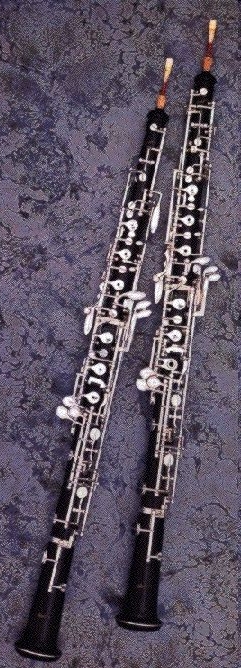
with semi-automatic (left) and full-automatic (right) octave keys
in his 40s
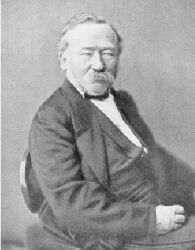
In America (New Jersey), the phonograph is invented
and patented on 15 January
by Thomas Edison, enabling actual sounds to be recorded.
The first model uses a vertically vibrating
needle to inscribe a groove in a sheet of tin foil wrapped
around a cardboard cylinder. The design is very similar to
that described the previous year by Charles Cros [see 1877],
but apparently Edison and Cros were unaware of each other's work.
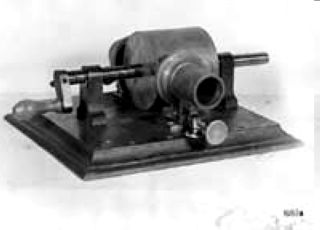
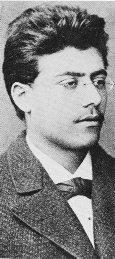
at 18
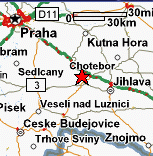
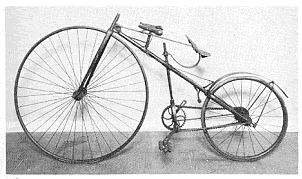
the first chain-drive "safety" bicycle
In England, Henry J. Lawson patents a bicycle design called the
"Bicyclette", which incorporates
the chain-and-sprocket indirect-drive transmission which had been
introduced the year before by James Starley's tricycle, and a
much smaller drive wheel which allows the rider to sit much lower
near the ground. Its primary defect is that, because of the lower
and more rearward seating position, the steering is indirect,
employing connecting rods.
Mahler spends June and July at the estate of Moritz Baumgarten,
in Tétény, Hungary (now a district of southern Budapest),
teaching piano to Baumgarten's son.
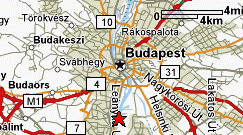
60-year-old Suppé produces his operetta
Bocaccio in Vienna.
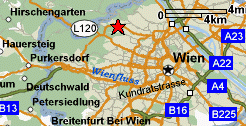
Between July 3 and September 13, during his summer vacation
in Neustift am Walde around his 21st birthday, Hans Rott composes the Scherzo
of his Symphony in E-major. From August to October
he composes the last movement, completing the symphony.
36-year-old Emil Schindler, who is still poor but has become one of
the most important 19th-century Austrain painters, marries Anna Bergen,
who has just completed her musical training and accepted a job in Leipzig,
which she now gives up. Their daughter Alma Maria is born in Vienna on August 31.
During the winter of 1879/80, Robert Fuchs composes his
Piano Concerto in B flat minor Op 27.
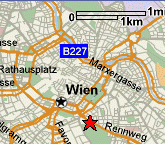
at Rennweg 3 in Vienna
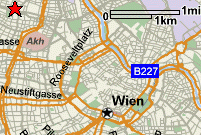
and then Wolf, in Währing
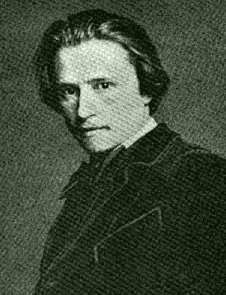
at around 20
In February and March, 19-year-old
Mahler
composes 3 songs of a projected 5, inspired
by his love for Josephine Poisl, daughter of the postmaster
in his hometown of Iglau:
Mahler
then resumes work on his cantata Das Klagende Lied,
finishing the Particell ['short-score'] draft of "Der Spielmann"
['the minstrel'], the original Part 2, on March 21. Mahler re-enters
the University on April 1, and also begins looking for a suitable
post as a conductor.
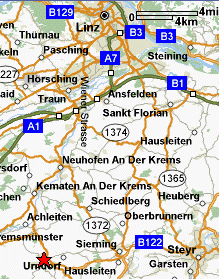
On June 3, Hans Rott goes to Ober-Salmannsdorf 26,
and on July 24 to stay with his friend and patron Joseph Seemüller in Glashütte.
By the end of July,
22-year-old Rott completes the orchestration of
his Symphony in E major
(which will only become known in the 1990s), which exerts a
huge influence on Mahler, who ends up possessing the score,
and who will even quote some of it
literally in his own symphonies after Rott is dead and forgotten.
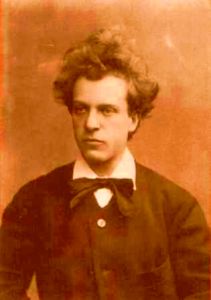
A surviving page of the opening of "Hochzeitstück" ['wedding-piece'],
the original Part 3 of Das Klagende Lied, is dated
"end of October or beginning of November" -- on November 1,
Mahler announces in a letter to his friend Emil Freund
that the composition of the cantata has been completed.
1881
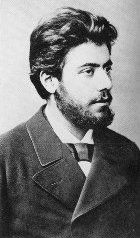
age 21
with full beard
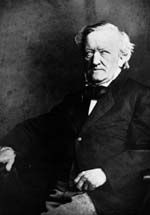
69-year-old Wagner produces his last major work, the religious music-drama
Parsifal.
Mahler
finishes his conducting job in Laibach and leaves on April 1,
spending time over the summer around his 22nd birthday with his family in Iglau,
and returns to Vienna in the fall, working on his
fairy-tale opera Rübezahl, which will remain unfinished,
and which provides material later incorporated into his
Symphonic Poem (the work we know today as his 1st Symphony).
Mahler also composes four songs which will be published in 1892:
Joachim Raff dies of a heart attack on June 25 at the age of 60.
25-year-old Hirschfeld becomes lecturer at Vienna Conservatory.
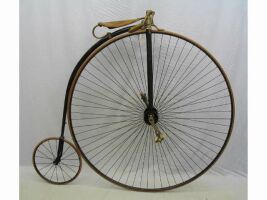
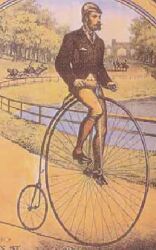
In August, Mahler sends his score of Das Klagende Lied
to Liszt in hopes of getting it performed by the
Allgemeiner Deutscher Musikverein [general German
music association]. Liszt returns it a month later, with the short reply:
Dear Sir!
F. Liszt
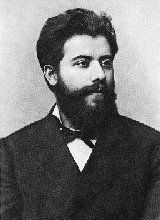
age 23
with heavy beard
Bruckner, 59, completes his 7th Symphony "in memory of Richard Wagner";
its slow movement, with the first theme funereal and majestic and second
theme beautifully lyrical, is perhaps the best thing he ever wrote.
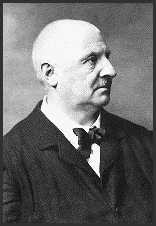
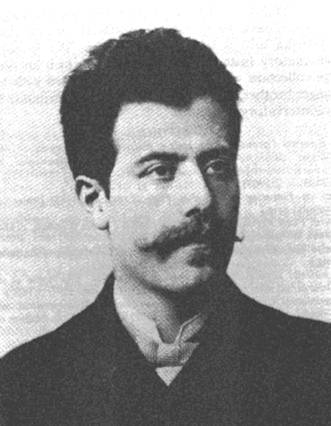
1884, age 24
(with that mustache I think he looks a bit like Queen's
Freddie Mercury)
On December 30, Bruckner's 7th Symphony is premièred in
Leipzig and hailed by some as "a masterpiece" -- 60-year-old
Bruckner's first real success as a composer.
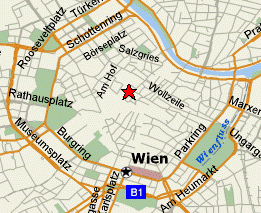
the red star designates the Berg home at Tuchlauben 8.
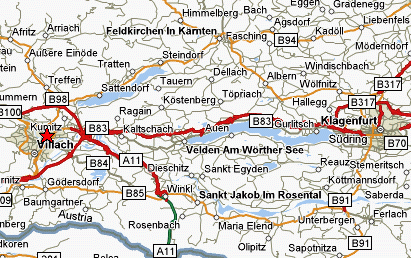
In England, John Kemp Starley patents his "Rover" safety bicycle,
employing the chain-and-sprockets transmission of Lawson's "bicyclette"
(see 1879), but making the size of the two wheels nearly equal
and increasing the angle of the front fork, so that the
steering is direct. This machine incorporates all of the
essential design features of the modern bicycle, and changes
to it since then have consisted of only minor improvements.
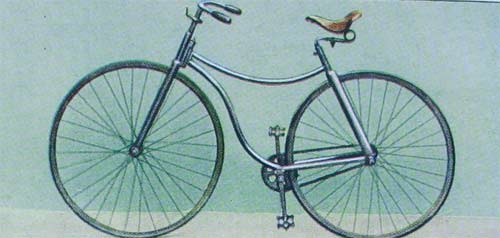
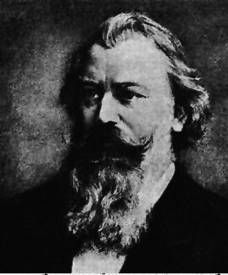
now with the famous long beard
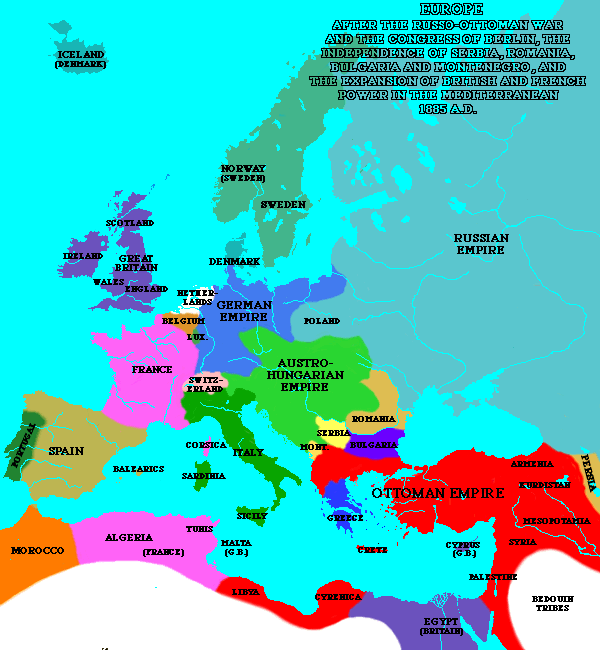
Europe in 1885
1886
The Duke of Saxe-Meiningen reduces the size of the orchestra, so 22-year-old Richard Strauss quits, and returns to Munich in the Spring as third conductor at the Court Opera -- this is an extremely important move in Strauss's life, because it puts him into regular contact with violinist Alexander Ritter, who is married to Wagner's niece and who exposes Strauss to the work and ideas of Wagner, Liszt, and Berlioz. This makes a decisive impact on Strauss's subseqent works.
3 of Mahler's songs are performed at a Prague concert on April 18, his first public appearance as a composer. ---
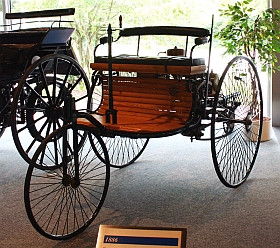
Karl Benz Motorwagen | Karl Benz files a patent on 29 January for his Motorwagen [motor-car] and publicly unveils it in Mannheim on 3 July. |
In Paris during the spring, 50-year-old Camille Saint-Saens completes his Symphonie No. 3 avec orgue ('with organ', known today as the "Organ Symphony"), his last symphony. The score is dedicated to his friend Liszt, and premièred in London on May 19.
| Liszt travels to Bayreuth to attend a Wagner-fest hosted by Cosima, and contracts a serious case of pneumonia. He dies in Bayreuth of a heart attack on July 31, at age 74. |
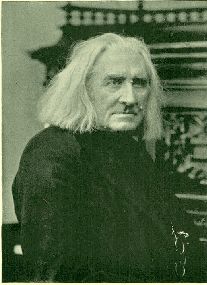
Liszt at 74 |
In America, American Graphophone Company is Established by Bell & Tainter to manufacture and sell graphophones [the original wax-cylinder version of Edison's phonograph] in the United States and Canada under license from the Volta Graphophone Co.
During his first summer vacation in Thun, Switzerland, 53-year-old Brahms composes a lot:
In Russia, during the summer 48-year-old Tchaikovsky composes his Symphony No. 5.
After a trip to Italy during the summer, Richard Strauss, now very interested in Liszt's ideas about program music, composes his 1st symphonic-poem, which he calls Aus Italien, Symphonic Fantasy for Orchestra, op.16. The première of Aus Italien is received badly. Strauss also begins a second symphonic-poem based on Shakespeare's Macbeth (not released in final form until 1890, as his 4th).
26-year-old Mahler begins his post in Leipzig in the fall.
During the fall, 29-year-old Hertz begins a 3-year series of experiments which in 1888 will prove that electromagnetic radiation can be produced and detected, as predicted by Maxwell's theory. The measurement of frequency as cycles-per-second is now named "Hertz" (abbreviated "Hz") in his honor.
1887
During his second summer vacation in Thun, 54-year-old Brahms composes his Concerto for Violin and Cello ('Double Concerto').
Schindler is commissioned to paint and draw pictures of the Dalmatian coastal cities, and ends the trip with a long stay on Corfu, where 8-year-old Alma begins to study music composition.
In America, Edison buys back the assets of the Edison Speaking Phonograph Co. and reorganizes it as the Edison Phonograph Co. Meanwhile, German emigre Emile Berliner is awarded a patent for his gramophone, which uses a laterally-vibrating needle to etch sound waves in disks of smoked glass. Photoengraving is used to etch the patterns in metal disks.
23-year-old Richard Strauss meets the family of Major-General Adolf de Ahna while on vacation in Feldafing, outside Munich, and begins giving singing lessons to the eldest daughter, Pauline, whom he will later marry.
On August 10, 63-year-old Bruckner finishes the orchestration of his last-completed and largest work, the 8th Symphony, and immediately begins composition of his 9th Symphony, the score of the 1st movement of which is dated September 21. On September 4 he joyfully sends the score of the 8th to Hermann Levi in anticipation of a great performance. But Levi does not understand the huge 8th and is afraid to perform it. Schalk breaks this news to Bruckner, who is crushed by it, suffers a nervous breakdown and contemplates suicide. Bruckner expresses a willingness to Levi to revise the 8th, but Levi's rejection spurs a wave of self-doubt which causes Bruckner to go back and also make further revisions to his 4th, 3rd, and 1st Symphonies. -- it is this work on revision of older works which is the main reason why the 9th Symphony is never finished.
15-year-old Zemlinsky graduates to the Ausbildungsschule ['senior school'] of the Vienna Conservatory, studying piano with Anton Door, theory with Franz Krenn, and harmony/counterpoint with Robert Fuchs. Harmony lessons are based on Sechter's figured-bass theory of 1835, counterpoint on Fux's Gradus ad Parnassum of 1725.
27-year-old Mahler achieves his first great success outside of conducting by completing Carl Maria von Weber's unfinished opera Die drei Pintos ['the three pintos'] while in Leipzig, doing most of the work from August to October. Much of the music is composed by Mahler based on themes from other little-known works by Weber, and the order of Weber's sketches is completely rearranged, so it is essentially Mahler's opera -- but for reasons of publicity Mahler's name only gets second billing.
During this period of work on Weber's opera, Mahler also falls passionately in love with 31-year-old Marion von Weber, the wife of the composer's grandson, and they have a stormy affair.
While working on Die drei Pintos, Mahler also finds in the Weber's library the anthology of German folk-poetry Des Knaben Wunderhorn ['the boy's magic horn'], which will be his main source of inspiration until 1900, and he begins composing lieder on Wunderhorn poems.
In October, Richard Strauss performs his Symphony in F Minor in Leipzig, and meets Mahler. The piece evidently makes a strong impression on Mahler (I believe the influence will be seen in Mahler's 1st Symphony), and Strauss is also very impressed with Mahler's work on Die drei Pintos. Strauss and Mahler recognize each other's strengths as composers, and immediately strike up a strong friendship that will last the rest of Mahler's life (Strauss lived many decades longer than Mahler). Mahler, envious over his younger colleague's success, becomes intrigued by Strauss's programmatic symphonic-poem ideas, which affect the direction of Mahler's own works for the next several years.
In Paris, Erik Satie composes his Sarabandes, which are some of the first pieces to make use of chains of unresolved 'major 7th' and 'dominant 9th' chords; these will have a strong influence on Debussy.
On December 7, Ernst Toch is born in Vienna.
On December 18, in a subscription concert, the Vienna Philharmonic under Hans Richter premières Robert Fuch's 2nd Symphony, in Eb-major, op.45.
Near the year's end, inspired by his:
Mahler begins his sketches for two different large-scale compositions:
During the year, with assistance of Ferdinand Löwe and Franz and Joseph Schalk, Bruckner again makes extensive revisions to his 4th Symphony with plans to get it published.
1888
On January 20 the most recent version of Bruckner's 4th Symphony is premièred successfully in Vienna with Hans Richter conducting. After hearing this performance Bruckner again makes extensive revisions to the score in February, and this version is published in September by Gutmann.
January 20 also brings the première in Leipzig of Mahler's completed version of Weber's Die drei Pintos. It is a tremendous success -- its popularity will only last a few years, and then it will disappear from the repertoire, but for that short period it is performed in every large German city. Its publication by Kahnt follows, and the work's popularity gains international attention for Mahler, and will bring in royalties that give him a measure of financial stability. Mahler receives offers from England, America, and Paris.
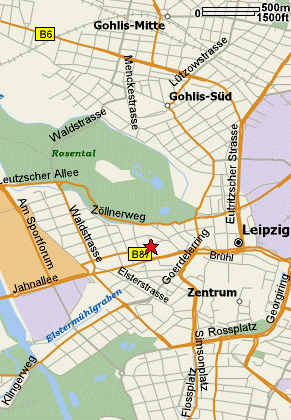
map of Gustav-Adolf-Strasse 12 |
On 21 January, with his room full of flowers and wreaths given to him after the highly successful primère of Die drei Pintos the night before, Mahler is sketching the funeral march 1st movement of his Symphony in C-minor (later called Totenfeier), and hallucinates that he is lying dead in a coffin surrounded by funeral bouquets. This feeling persists so strongly that Marion von Weber finally removes the flowers. From January to March, Mahler works on his first 'official' symphonic work, which he calls his "symphony" but which is later titled Symphonic Poem (and which we now know as his 1st Symphony). On March 9, German Emperor Wilhelm I dies in Berlin, and the theaters are closed for 10 days until March 19. Mahler takes advantage of this time off to work strenuously to finish his Symphony, finally completing it on March 29 in Leipzig. |
In this symphony Mahler makes much use of music he had previously composed:
The final movement of Mahler's symphony, I think, betrays a strong interest in (and perhaps envy of the success of) Strauss's Symphony in F-minor: the main sections are in this same key, which is very remote from the symphony's overall tonality of D major. The work is scored for the standard symphonic orchestra of the time, with 4 horns, 3 trombones and tuba, and trumpets and woodwinds in pairs -- Mahler will continuously augment the orchestra in each successive revision of the work. The Recapitulation section of the finale shows the greatest difference from the later versions of the symphony: in the original version of the Recapitulation, the two parts of the 2nd theme recur in the reverse order of their presentation in the Exposition section, and then the opening of the movement recurs exactly; Mahler will later change these sections considerably:
This original autograph "Leipzig" manuscript is now lost, but its content survives as the base text of a copyist's manuscript which will be used for the première in Budapest in 1889. I believe that this "Budapest" manuscript indicates that Mahler originally planned a 4-movement work which did not include the 'Blumine' serenade.
Mahler is also working in January on the 1st movement of what will later become his 2nd Symphony, and in April he sketches themes for the 2nd movement.
In Russia, shortly after his 44th birthday, Rimsky-Korsakov completes his Russian Easter Festival Overture in April.
On May 10, Maximilian Raoul Steiner is born in Vienna. He will go on to be a child prodigy, finishing his studies early at the Vienna Conservatory, and later emigrate to America, and known as Max Steiner, become an important Hollywood composer during the early era of sound films, his first major score being that for King Kong in 1933.
Mahler's situation in Leipzig comes to a head: Mahler and Marion themselves
tell her husband Karl von Weber that they are in love, naively thinking
that he will find it touching; of course instead Karl puts an abrupt end
to the affair. Karl supposedly goes mad, altho he apparently has lucid moments later.
Mahler realizes that it would be best to get away,
uses an argument at the theater as an excuse to quit his job,
and leaves town around May 19, going first to Munich then to Starnberg
with his old classmate Heinrich Krzyzanowski.
Spending the summer mostly with his family in Iglau, on June 1 Mahler works on 1st movement of his Symphony in C-minor (later known as his 2nd Symphony, "Resurrection"). After its completion this movement will be presented as an independent symphonic-poem called Totenfeier ['Funeral Ceremony']. The title comes from a recently-published German translation by Mahler's good friend Seigfried Lipiner of the epic poem Dziady ['celebration of death'] written by the great Polish poet Adam Mickiewicz, which has the uncanny coincidences of a hero named Gustav who contemplates suicide after an unrequited love affair.
In Belfast, Ireland, on July 23, John Boyd Dunlop patents the pneumatic air-filled rubber tire and applies it to the bicycle wheel. This is a great improvement in bicycle riding comfort, and by 1890 solid tires will be gone forever.
In Russia, during June, July, and August, 44-year-old Rimsky-Korsakov completes his "Symphonic Suite" Scheherazade, a musical depiction of four tales from The Arabian Nights.
During his third and last summer vacation in Switzerland, 55-year-old Brahms finishes his 3rd Violin Sonata.
During the first week of July Mahler is in Vienna for his 28th birthday, then in Prague rehearsing Die drei Pintos, then for another month from mid-July to mid-August back in Iglau, again working on Todtenfeier, completing his sketches for it on August 10. Its scoring includes 4 horns and 3 each of trumpets, trombones, and each woodwind -- these will be amplified to 6 horns and 4 each of the others in the 1894 version. The climax of the development section of this movement contains a progression of two extremely dissonant chords - the first can probably probably best be analyzed as an F#-diminished-7 with a pedal (drone) G both at the bottom and the top, and the second is a G-dominant-7/b9/11/b13 or alternatively Fm9/G7, again with the note G both at the bottom and the top, adding a descending bass line at the end which leads to C-minor and the recapitulation section:
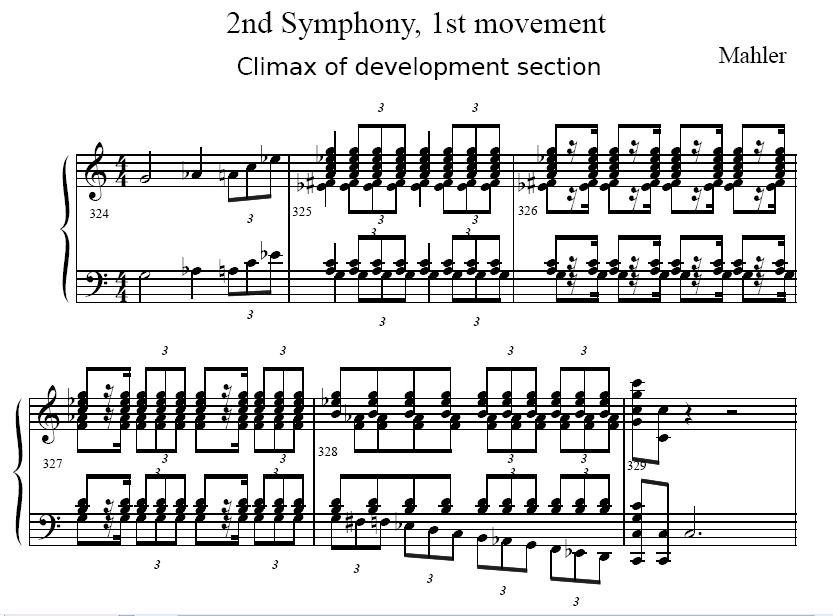
Mahler's creative urge seems to dry up after completion of this movement, most likely in relation to his depression over the end of the love affair with Marion. He will compose nothing new for the next 4 years.
7-year-old Béla Bartók's father dies, and his mother takes the family to live in Nagyszöllös (then in Greater Hungary of the Austro-Hungarian Empire; now Vinogradiv, Ukraine).
58-year-old Hans von Bülow settles in Hamburg.
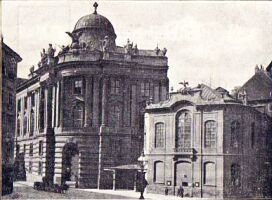
The Hofburg (left) and |
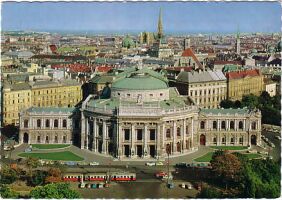
The new Burgtheater in Vienna |
With the completion of the new Burgtheater on the Ringstrasse in Vienna, the old Burgtheater is demolished. Its pipe organ is auctioned off and purchased by Conrad Berg, who installs it in the family's apartment. Bruckner visits from time to time and plays on it -- this is the young Alban Berg's first contact with a professional musician. [Monson 1979, p. 5]
|
24-year-old Richard Strauss completes his second symphonic-poem Macbeth
(only released later after revision as the 4th).
On Bülow's recommendation, Strauss leaves Munich and becomes
assistant to Hermann Levi for the summer festival in Bayreuth.
He begins writing his own libretto to his first opera, Guntram.
Mahler visits Munich before going to conduct the Prague première of Die Drei Pintos in August, and probably spends time with his new friend Richard Strauss, who gets to know Mahler's Symphonic Poem [now his 1st Symphony], which Mahler hopes to get performed in Munich. In the fall Strauss becomes third conductor in Weimar, where he composes the symphonic-poems Don Juan, op.20 (officially the 2nd) -- which will be very successful at its première in 1889 -- and Tod und Verklärung ['death and transfiguration'], op.24 (officially the 3rd), which will be even more popular when introduced in 1890. Don Juan establishes Strauss's reputation as the leading progressive composer in Germany. |
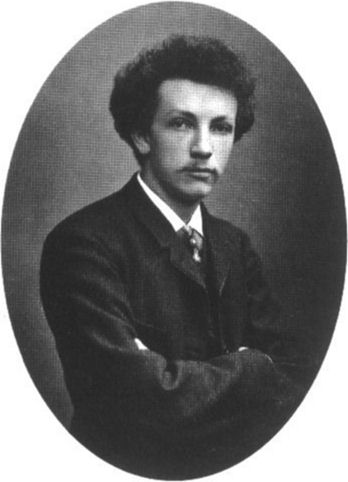
Richard Strauss |
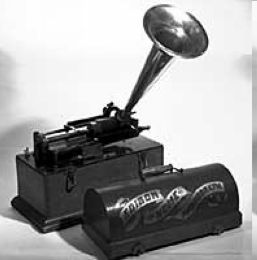
The "Edison Home Phonograph" |
In America, as lawsuits between Edison and American/Volta threaten to eliminate either the phonograph, graphophone, or both, investor Jesse H. Lippincott buys out both firms. Lippincott establishes North American Phonograph Co. to set up a sales network of local companies to lease phonographs & gramophones as dictation machines. Lippincott invests $200 000 in the American Graphophone Company and agrees to purchase 5000 machines per year, in return for sales rights to the graphophone (except in Virginia, Delaware, and the District of Columbia). Lippincott also buys control of Edison patents for $500 000, and exclusive sales rights of the phonograph in the United States from Ezrah T. Gilliand (who had previously been granted the contract by Edison) for $250 000, leaving Edison with the manufacturing rights. Meanwhile, Edison Phonograph Works is established to manufacture and develop the phonograph while patents and sales rights are held by North American Phonograph Co. Edison is disappointed to find that the drug stores who are the main customers use them as crude jukeboxes. The D.C. area franchise, the Columbia Phonograph Company, begins recording and selling wax cylinders containing music and recitations. |
The wax cylinder phonograph is introduced to Europe via licensed subsidiaries, but high prices kept the machine out of homes for some time.
On August 22 in Paris, 65-year-old Belgian composer César Franck completes his Symphony in D-minor.
Mahler's 15-year-old brother Otto follows in his footsteps and enters the Vienna Conservatory; he has talent, but is hardly as serious about his music studies as Gustav was.
13-year-old Franz Schmidt is forced by family circumstances to start earning money, so he takes a job as a private tutor in Perchtoldsdorf, a suburb of Vienna.
Nearby, at around the same time, Hugo Wolf is composing his Mörike-Lieder.
At age 28, Mahler's career takes an abrupt turn to the big-time as he is appointed Director of the Royal Budapest Opera on October 1. He strives with great success to create a Hungarian national opera out of the multi-lingual mess that he inherits -- the lead roles are generally sung by guest artists, who have been singing in their own main language, thus a single opera would often contain Italian, French, and German. Struggling to learn the Hungarian language, he has all of Wagner's works and the other main operas of his repertoire translated into Hungarian. His new responsibilities as Director also keep him too occupied during the season to do anything else.
During the month of December, the entire cycle of available Wagner operas (from Rienzi to Götterdämmerung, i.e., all except Parsifal) is performed in Vienna.
1889
As if prophesied by his death-obsessed music (and not the last time this will happen to him!), Mahler's father dies in February, Mahler himself undergoes a painful hemorrhoid operation over the summer and thus does no composing, then his sister Poldi and his mother both die in the fall. Strangely, considering how much he loved his mother, he misses her funeral and stays with his duties at the Opera (-- I suspect that this is largely because of the work involved in preparing the upcoming première of his Symphonic Poem, as the copyist's manuscript prepared from the original autograph contains many revisions in Mahler's hand). As the eldest surviving son, the 29-year-old feels the burden of responsibility, and becomes head-of-household for the family of two brothers (Alois and Otto) and two sisters (Justi and Emma); both of the brothers turn out to be a tremendous burden indeed.
In February, 12-year-old Bruno Schlesinger has his debut as a pianist with the Berlin Philharmonic. Seeing Bülow conduct at another concert, however, convinces him that he must be a conductor. The conservatism in his training depressing him because of his love for Wagner's operas, Schlesinger finally resolves the problem when he discovers the Wagner scores at the library, and begins tutoring himself.
Also in February, 28-year-old Hugo Wolf finishes the 51 songs of the Goethe songbook.
On March 4, Bruckner completes a revision ("Third Version") of his 3rd Symphony, eliminating the new coda of the Scherzo, and making cuts in the first and last movements. For the next year will be occupied with a revision of his 8th, working in the order: adagio, finale, scherzo, 1st movement.
On March 31 in Paris, the Tour Eiffel ['Eiffel Tower'] is inaugurated as the entryway for the Exposition Universelle, a world's fair marking the centennial of the French Revolution. Destined to be the tallest structure in the world until 1930, the Eiffel Tower is still to this day the tallest building in Paris.
39-year-old Heuberger produces his 2nd opera Manuel Venegas in Leipzig.
In America, a group of men licensed by the American Graphophone Company to sell graphophones in Washington, D.C. establish the Columbia Phonograph Company. They also get a license from the North American Phonograph Company to sell phonographs in the same area.
In Waltershausen, Germany, toy-maker Kammerer & Reinhardt licenses Berliner's gramophone design, and create a tiny toy record player with 5" celluloid or hard rubber disks. Most of the selections are in German, with a small number in English, French, Spanish, Italian, and Russian. The Lord's Prayer and Twinkle, Twinkle, Little Star become the big sellers in England. Kammerer & Reinhardt manufacture gramophones for two or three years, then drop them in favor of more lucrative products.
In New York City, Italian-born Gianni Bettini seeks to uplift the audience for records with better music and better quality recordings, and creates the micro-phonograph, an improved wax cylinder machine. The crystal diaphragm that vibrates the needle is replaced with mica, and the needle itself is mounted on a "spider" (patented this year) which transmits the force of the vibration more efficiently. The results are critically acclaimed, and over the next decade famous instrumentalists and Metropolitan Opera stars who had shunned contact with the phonograph industry gratefully perform for Bettini's machine. His cylinders sell for between $2.00 and $6.00, compared to $.50 for a typical Columbia release (in 2007 US dollars, approximately $44 to $135 and $11 respectively).
Shifting his summer vacation back to Bad Ischl, the main compositional activity of 56-year-old Brahms is not a new piece, but a revision of his youthful 1st Piano Trio from 1854. At some point during the spring or fall in Vienna, Brahms makes a recording on a wax cylinder, of himself performing his Hungarian Dance No. 1 on the piano.
During the summer, in Paris, the Exposition Universelle presents folk music from all over Europe and the 'Orient': Scandinavia, Spain, the gypsies, Arabia, Africa, and perhaps most influential of all, Javanese gamelan. Many Parisian composers witness various performances and explore facets of their impressions in their subsequent pieces. Nikolai Rimsky-Korsakov conducts two concerts of Russian nationalist music, and this begins the 'Franco-Russian alliance' in music.
23-year-old Sibelius goes to Berlin to study music during the academic year.
On October 1, 25-year-old Richard Strauss is promoted to Musical Director of the Grand Duchy of Saxony, becoming Liszt's successor at Weimar. The première of his Don Juan causes a sensation.
Also in October, the Klemperers move to Hamburg, which 4-year-old Otto will consider his hometown.
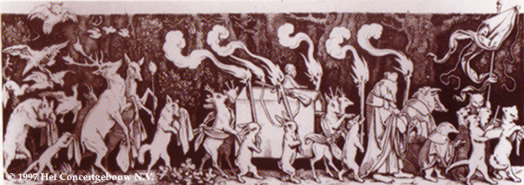
The Huntsman's Funeral,
woodcut after Callot by Moritz von Schwind,
the work which inspired the funeral march of Mahler's 1st Symphony.
On November 20 in Budapest, Mahler's first important première as a composer -- that of his 'Symphonic Poem', in 2 parts (now known as his 1st Symphony) -- is a failure. Part 1 (the 1st movement, 'Blumine' serenade from Der Trompeter, and scherzo) receives some applause, but Part 2 (the 'Bruder Martin' ['Frère Jacques'] funeral march and finale) meets with a total lack of comprehension from the conservative audience. Mahler later says:
When, in my earlier years, I didn't know any better and worked less carefully and skillfully -- as in my 1st Symphony -- I paid for it dearly. What came out was not what I wanted; what one heard was not nearly as transparent and perfect as it could and should have been, so that I had to rescore it later. [Bauer-Lechner, *German* p 62, *English* p 68]
Thus begins Mahler's normal procedure following the composition of each of his symphonies: comprehensive revision of the score after every early performance.
The manuscript used for this performance,
based on the original autograph (which is now lost) but in a copyist's hand,
has extensive revisions by Mahler, including augmentation of
the trumpets and woodwinds to 3 each, and many changes of orchestration.
Based on Mahler's remarks that he "worked less carefully and skillfully"
and "paid for it dearly", his use of the word "rescore" seems to refer
more to the painstaking clarification of phrasing (slurs, staccato dots,
and many rests between notes to emphasize the staccato even further)
than to actual changes of instrumentation, altho certainly his revisions
included the latter too.
In addition there is a major substantive change: the finale still includes the exact recapitulation of the opening of the movement (a section which will be considerably altered by Mahler in 1893), but while the base text also still has the recapitulation of the two parts of the 2nd theme in reverse order (in a passage very reminiscent of Bruckner), Mahler inserts a new version of this section which restores the original order of the two parts of the 2nd theme (and removes the Bruckner sound).
I believe that the facts that the 1st movement and scherzo are bound together in one volume of this "Budapest" manuscript, and that the "3." written at the top of the first page of the scherzo is written over a "2.", indicate that Mahler originally planned a 4-movement work which did not include the 'Blumine' serenade, and that he only decided to include 'Blumine' some time before drawing up the program for the première, and that he simply lifted the score of the serenade whole from Der Trompeter von Sakkingen for this première. (This "Budapest" manuscript is now in the Rosé Collection at the University of Western Ontario.)
During his work on his 9th Symphony this year, Bruckner composes the first of 3 entirely different versions of the Trio to the Scherzo, in F-major; it will later be discarded.
Shohé Tanaka, a pupil of Helmholtz and still in Germany
on his Japanese government scholarship, has
JI
harmoniums built in Berlin and Stuttgart.
Bülow is so impressed with what he calls the
Tanaka Enharmonium that he orders one for himself, and
other renowned musicians interested in Tanaka's work include
Heinrich von Herzogenberg, Joseph Joachim, Mortiz Moszkowsi,
Carl Reinecke, and Anton Bruckner.
1890
Schönberg's father dies in Vienna on New Year's Eve in the flu epidemic, and the 15-year-old is forced to leave school and begin working as a clerk in a bank. His boss soon complains to Schönberg's mother that the young employee is covering all of his papers with musical notations.
At some point during his tenure in Budapest, Mahler invites his old acquaintance Natalie Bauer-Lechner to visit him, and she does. This begins an 11-year period during which, according to Natalie, they have a love affair. During this time she is already involved in an open relationship with Mahler's old friend Sigfried Lipiner, who is already married. Natalie is one of Mahler's few contemporaries at this early stage of his career who really believes that he is a genius. Her new relationship to Mahler is important to posterity because she carefully annotates almost everything Mahler says and does while they are together, to the point that she sometimes becomes annoying to him. She also claims that her belief in his work and her encouragement help to lift him out of the creative lapse he has sunk into after the depression of losing Marion von Weber.
In March, after a year of work, 65-year-old Bruckner completes the revision of his 8th Symphony. In addition to several cuts, the revision augments the woodwinds from double to triple. Unfortunately, Levi has retired from direction of the concerts in Munich, so there is no prospect of a performance under him.
In April, 30-year-old Hugo Wolf completes the 44 songs of Spanisches Liederbuch ['Spanish song-book'].
Bad reviews at the end of the season indicate that Mahler's initial success at reforming the Budapest Opera has already deteriorated. He finally takes a real vacation, at Hinterbrühl in the Wiener Wald [Vienna Woods] during most of June and July, and composes the two books of songs from the poetry collection Des Knaben Wunderhorn ['The Youth's Magic Horn'], to which he had been introduced in Leipzig by the Webers.
18-year-old Zemlinsky is recognized as the 'best pianist in the Conservatory' in his class, winning a Bösendorfer grand piano and a gold medal in a competition on June 26, and giving his diploma concert on July 12, thus completing his piano studies.
26-year-old Richard Strauss finishes a revison of Macbeth, op.23 (which had been the second symphonic-poem he composed, completed before Don Juan in 1888), published as his 4th symphonic-poem.
24-year-old Busoni marries in Moscow, then pursues his career as a piano virtuoso in Boston and New York.
Ida Klemperer decides that her 5-year-old son Otto should be trained as a professional musician, and he begins his studies.
In America, J.H. Lippincott is struck with paralysis and his nearly-dead business empire (in record players) is taken over by Edison. For some reason, Edison still refuses to realize that the phonograph's best utilization is for music.
In Paris, bistro owners Charles and Emile Pathé put an Edison phonograph in their bar, to the delight of their patrons.
Sándor Alexander Jemnitz is born in Budapest on August 9.
Mahler spends most of August in Vienna with his younger brother Otto.
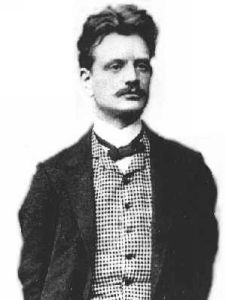
Sibelius |
24-year-old Sibelius goes to Vienna to continue his musical studies, living in an apartment above a shop at the corner of Wiedner Haupstrasse and Waaggasse. He hopes to study with Brahms or Bruckner, but ends up with Robert Fuchs and Karl Goldmark as his teachers. While in Vienna, Sibelius composes the Piano Quartet in C minor, two overtures, the Ballet Scene (depicting his visit to a Vienna brothel), several songs, and the first drafts of his choral symphony Kullervo. |
15-year-old Franz Schmidt enrolls in Bruckner's counterpoint class at the Vienna Conservatory. Needing a major on an instrument, he decides on the cello, studying first with Karl Udel then with Ferdinand von Hellmesberger.
Bruckner becomes ill in September and Robert Fuchs, an ardent Brahmsian, takes over his class. This solution doesn't work too well for those who, like Schmidt, had chosen to study with Bruckner.
Zemlinsky returns to the Conservatory to focus his studies on composition. His new teacher is J. N. Fuchs, brother of his former teacher.
57-year-old Brahms, satisfied with a long and successful career, and feeling his work to be increasingly irrelevant to the changing artistic Zeitgeist, composes his 2nd String Quintet in G, op.111 and intends for it to be his last composition.
In October, some of the members of the Budapest Opera chorus feel that Mahler has insulted their nationality and challenge him to a duel. Mahler publishes a detailed response in the Pester Lloyd newspaper declining the challenge, which only makes his opponents more angry, making his existence in Budapest understandably uncomfortable after that, and hastening his departure.
The première of Brahms's 2nd Quintet in Vienna in November is a sensation.
Brahms adores Don Giovanni so much that he claims to prefer silently reading the score instead of seeing the opera -- in his opinion -- always performed inadequately. In Budapest in December, he is tricked by a few friends into attending a performance of it conducted by Mahler. Brahms is so pleased with Mahler's rendition that, while he continues to hold a low opinion of Mahler's compositions, he proclaims Mahler a genius and becomes a very important ally.
On December 21 the Vienna Musikverein gives the première of the final revised version of Bruckner's 3rd Symphony. The score is published by Rattig, however this is different from Bruckner's "Third Version" of 1889 and today it is still uncertain how much this score reflects Bruckner's wishes and how much of it is due to the influence of Franz and Joseph Schalk. The audience is obviously split into two factions, as Bruckner receives both boos and cheers. 25-year-old Sibelius is there and is very impressed with the work. Outside the theatre, Sibelius gets into a fight with some Brahms supporters and injures his foot.
Also on December 21, Niels Wilhelm Gade (1817-1890) dies in Copenhagen [Denmark].
1891
The new intendant of the Budapest Opera, Count Bela Zichy, is an ardent Hungarian nationalist with a real interest in music, and he usurps much of the director's powers from Mahler, who won't stick around much longer, resigning on March 14. At his last appearances, however, the audience enthusastically shouts 'Viva Mahler!' and does not wish to see him go.
On March 26, 30-year-old Mahler is appointed conductor at the Hamburg Opera. It doesn't take long for 61-year-old Bülow, who had ignored Mahler's request to become his disciple, to notice the young man's talent for conducting.
| For the summer, Mahler rents a flat for his brothers and sisters at Perchtoldsdorf, near Vienna, possibly composing a few Wunderhorn Lieder for voice and piano while there at the end of June. |
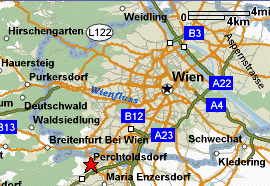
map of the area around Vienna showing Perchtoldsdorf |

map of Mahler's trip thru Scandinavia |
Mahler is in Hamburg for his 31st birthday, attends the Bayreuth Festival at the end of July, then goes on an extensive sailing trip thru Scandinavia for his vacation during most of August, visiting Kiel [Germany], Copenhagen, Helsingor [Denmark], Helsingborg, Halmstadt, Gothenburg [Sweden], Moss, Oslo, Drammen, Larvik, Kristiansand [Norway], Fredrickshavn [Denmark], Sylt, Helgoland Island [Germany], then back to Hamburg by the end of August to begin the new opera season. |
During his summer vacation at Bad Ischl, 58-year-old Brahms, inspired by both the success of his 2nd Quintet and his new love for the clarinet playing of Richard Mühlfeld, breaks his retirement vow and composes his great Clarinet Quintet in B minor and Clarinet Trio in A minor.
50-year-old Dvořák is appointed Professor of Composition at the Prague Conservatory.
Hugo Wolf finishes the 22 songs of his 1st Italienisches Liederbuch ['Italian song-book']. Another collection follows in 1896, after a long period of depression.
On September 27, 30-year-old Julius Korngold marries Josephine Witrofsky. Hanslick begins considering Korngold for the position of his successor when he retires from the Neue Freie Presse [New Free Press], which is at this time the leading newspaper in Vienna, and he commissions Korngold to review provincial concerts and, later, events outside Austria, for the Neue Freie Presse.
Around October, Mahler and Strauss request scores from each other.
The failures Mahler has experienced with his first three
major works awakens an interest in Strauss's very successful
symphonic-poems and encourages Mahler to apply literary programs
to his own work. On October 14
Mahler offers two symphonic-poems to Schott for publication:
the multi-movement (possibly 5, but i think 4) Symphonic Poem, in 2 Parts
(which we now know as his 1st Symphony), and the single movement which
was originally intended to begin his Symphony in C-minor
(which we know now as his 2nd Symphony), now presented
as a self-contained piece entitled Totenfeier ['funeral feast'].
In November Mahler mentions a title for his Symphonic Poem
(the future 1st Symphony) for the
first time, calling it Aus dem Leben eines Einsamen
['from the life of a lonely-one'], and he says that he expects
it to be published shortly by Schott, but the publisher
rejects both symphonic-poems. His compositions finding sympathy with
neither Bülow nor Schott, Mahler tells Strauss that
his scores are "consigned to my desk drawers".
The second surviving manuscript of Mahler's 1st Symphony is the one in Mahler's hand containing extensive revisions done in Hamburg in 1893. This "bottom" layer of this manuscript is based on the latest version of the earliest surviving manuscript (the "Budapest" manuscript described above under 1889: a copyist's manuscript of the original autograph, to which Mahler had made extensive revisions for the première), and it indicates the increased number of winds from double to triple, and includes "comments for the typesetter" -- in other words, it is intended as a Stichvorlage ['engraver's model'], so I think the score in this form is the one which Mahler submits to Schott in hope of publication, and which, after its rejection, he will revise again in Hamburg in 1893, in preparation for the 2nd performance. Several sections of the 1893 Hamburg manuscript are clearly later insertions, written on manuscript paper imprinted with the logo of the Hamburg publisher Böhme -- those pages which are on paper which does not have a publisher's imprint, represent the ones belonging to this 1891 Schott Stichvorlage.
In the 1893 Hamburg manuscript, the 'Blumine' movement still appears mostly in its original form (i.e., on the small paper used in the Trompeter von Sakkingen score), and the revised pages in 'Blumine' are all from 1893 on paper imprinted with the Böhme logo -- thus, since 'Blumine' was apparently not revised in 1891, I believe that the 1891 submission to Schott may not have included 'Blumine'. Mahler seems to have vacillated several times on whether or not to have 'Blumine' in the piece, and in fact it does not seem to have been a part of his original conception of the symphony. (This manuscript is now in the Osborn collection at Yale University.)
| On November 1, Mahler moves into the Hotal Royal at Grosse Bleichen 12, Hamburg, where he will live until the following March. |

Hotel Royal, Grosse Bleichen 12, Hamburg (green pin with orange circle; click image to enlarge) |
In the fall, Mahler encounters the writings of Nietzsche, which have a temporary but strong influence on his thought. His disappointments are also alleviated somewhat at the end of November when the usually aloof Brahms visits his old hometown (Hamburg) and shows real friendship towards Mahler. It is entirely possible that Mahler shows the scores of one or both of his two symphonic-poems to Brahms. Having Brahms on his side will open a lot of doors for Mahler, and I believe that it also provides the stimulus which will reawaken his symphonic creativity, and encourage Mahler to move farther away from the Straussian type of symphonic-poem and to direct his ideas into symphonies which have a more classical form.
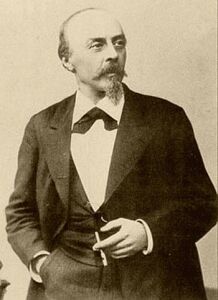
von Bülow |
On November 27 in Lübeck, Mahler finally
gets the opportunity to play one of his compositions
on the piano for Bülow. Mahler chooses his
symphonic-poem Totenfeier.
Bülow has come to have tremendous admiration for Mahler's abilities as a conductor, but while playing, Mahler looks up and sees Bülow holding his hands over his ears. Bülow's negative reaction to Mahler's creative work includes the comment: If what I have just heard is music, then I no longer understand anything about music! Compared to your piece, Tristan seems like a Haydn symphony. This is obviously a huge blow for Mahler, whose own admiration for Bülow's conducting had filled him with hopes of having another important champion not just of his conducting but also of his compositions. |
At the same time, Mahler's own growing success as a conductor gives him the
confidence to know that his compositions will not live only on
paper, but rather will also come alive in performance under his
own baton. This is
an important aspect of Mahler's compositional routine, for he
will continue to revise and refine the orchestration and phrasing of
every new symphony after its première,
and indeed also after subsequent performances under his direction.
In Vienna, Tanaka introduces Bruckner to his JI Enharmonium by playing Wagner's Lohengrin prelude on it. In a lecture, Bruckner relates how he used to pass along the dictum he learned from his teachers that 'our ear cannot tolerate pure intonation, and that for this reason tempered tuning was invented', but that he could never again say this after having heard Tanaka's instrument. I suspect that Bruckner's familiarity with this instrument has something to do with the harmonic experiments in his 9th Symphony, which he is now composing.
In December, 17-year-old Schönberg saves up enough money to buy an old second-hand cello, to replace the makeshift instrument he has been playing.
In Montmartre (Paris), 29-year-old Claude Debussy meets Satie at the Auberge du Clou cabaret where Satie plays piano. Satie talks to Debussy about the need to write really French music 'without Sauerkraut', (i.e., Wagner) and to transpose the methods of painters like Cezanne, Monet, and Toulouse-Lautrec to music.
1892
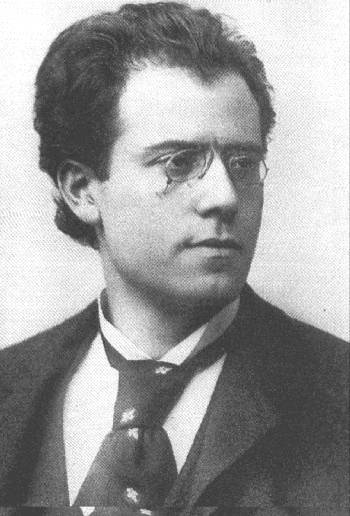
Mahler |
31-year-old Mahler's friendships with Brahms and Bülow, and his growing confidence as a conductor, inspire him back into creative activity after a 31/2-year hiatus, and with the lightest schedule of his period in Hamburg giving him some extra time, he composes 5 of the lieder from Des Knaben Wunderhorn ['the boy's magic horn'] for voice and orchestra, which he collectively titles Humoresken, during the winter:
|
In my opinion, the attention from Brahms probably has a lot to do with Mahler's renewed interest in composing. At the same time, he engages in a deep study of Bach's cantatas, and three small volumes of his early songs are Mahler's first compositions to be published.
|
On 16 March, Mahler moves into an apartment at Bundestrasse 10/III in Hamburg. He will live here until his summer vacation, and then again from the fall to the summer of the next year, for the entirety of the next opera season. |

Mahler's residence at Bundestrasse 10/III, Hamburg (The pin with the orange circle; click image to enlarge) |
During the spring semester at the Vienna Conservatory, 20-year-old Zemlinsky composes the first 3 movements of his Symphony in D-minor [2nd Symphony].
In April, 18-year-old Otto Mahler leaves the Conservatory without graduating, and perhaps even without Mahler knowing.

69 Torrington Square and 22 Alfred Place, London (Torrington is the green pin near Euston Sq., Alfred is the green pin with orange circle; click image to enlarge) |
Summer brings an engagement for Mahler in London, where he stays for 2 months, from 26 May to to 23 July. His first 2 days are at the Hotel DeKeyser's, then for the rest of the trip he lives in the Bloomsbury section of Camden Town [London], first at 69 Torrington Square (29 May to 11 July; no longer exists as a result of expansion of nearby University College), then at 22 Alfred Place (12 July to 22 July). He directs Wagner's Ring at Covent Garden. |
|
Altho publicly successful, Mahler is displeased with the artistic results of his London performances and resists future offers -- this is in part also because he now decides to keep his summers free for composing. He then takes a long holiday from 23 July to mid-September at Villa Hechler in Berchtesgaden, Southern Bavaria [Germany] (~20 km south of Salzburg [Austria]), with his sister Justine and Natalie Bauer-Lechner. At the end of August he makes a trip to Berlin, then returns to Berchtesgaden. His only composition during this time is another Wunderhorn song, Urlicht ['primal light'], which he will decide next year to incorporate into a new symphony. |

Berchtestgaden area, southern Bavaria, Germany, showing proximity to Salzburg [Austria] (click on image to enlarge) |
Edward Steuermann is born on June 18 in Sambor, Poland.
In Paris over the summer Debussy buys a copy of Maeterlinck's drama Pelléas et Mélisande, and immediately begins sketching parts of it to music. The resulting opera will occupy him for the next 10 years.
On July 25, Julius Korngold's oldest son Hanns Robert is born in Brünn.
During the Hamburg cholera epidemic, on a trip to Sylt in the North Sea, Schindler has intestinal pains, but is misdiagnosed by the doctors and continues travelling. He dies on August 9, at age 50. 12-year-old Alma is crushed by the loss. After the family relocates to Vienna, she begins taking counterpoint lessons with Joseph Labor, a blind organist, and also becomes a fervent admirer of Wagner's music-dramas.
28-year-old Richard Strauss becomes seriously ill with pneumonia in May, and goes on a long holiday in Greece and Egypt to recuperate, where he composes most of his 1st opera, Guntram, op.25.
Zemlinsky completes his studies at the Vienna Conservatory, and conducts the Conservatory orchestra in the première of the 1st movement of his Symphony in D-minor [2nd Symphony] as his graduation work at the July 11 concert.
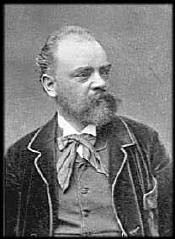
Dvořák |
Dvořák is lured to New York in September when he is offered a huge salary for the job as Director of the National Conservatory of Music. He arrives in America on September 27 with his wife and two of their children (four others remaining in Bohemia), and his personal secretary Jan Joseph Kovarik, a native of Spillville, Iowa. They live at first in the Clarendon Hotel on East 18th Street and then in a brownstone apartment at 327 E. 17th Street, directly across the street from the Conservatory. Dvořák immerses himself in African-American music, and begins writing a symphony "in the spirit" of this music, saying:
|
Back in Hamburg in the fall, Bülow tells
Mahler that he cannot make sense
out of Mahler's strange songs, and that Mahler must conduct the
performance in November. Mahler finally gives up hope of having
Bülow as an advocate of his compositions.
On December 1, 68-year-old Bruckner experiences the greatest triumph of his career at the première of his 8th Symphony in Vienna.
1893
In January, at Hamburg, 32-year-old Mahler revises the 1st movement, scherzo, and finale of his Symphonic Poem (the future 1st Symphony). The 'Blumine' movement, which had been lifted from Der Trompeter von Sakkingen, will only be revised later this summer -- I believe that adding this serenade to the Symphonic Poem had been an afterthought in the first place, and now perhaps Mahler was already considering deleting it. The base layer of this autograph "Hamburg" manuscript corresponds to the latest version of the 1889 "Budapest" manuscript (which is in a copyist's hand with extensive revisions by Mahler), and I believe that it dates from Mahler's submitting the work to Schott [see 1891]. Several sections of the 3rd (scherzo) and 5th (finale) movements are now removed and replaced with entirely new ones, and the whole 1st movement is rewritten. Aside from further changes in orchestration, the one major substantive revision in this manuscript is a whole new beginning for the recapitulation of the 1st theme of the finale (the 'viola eruption', replacing what was originally a mostly literal recap of the cymbal crash and its associated furious opening music); otherwise the form remains the same. At some later time during the year, Mahler adds a title to each movement. (This manuscript is now in the Osborn collection at Yale University.)
Mahler also decides around this time that he will leave Hamburg when his contract expires at the beginning of 1894.
Brahms visits old friends in Hamburg at this time,
and I think it is likely that he meets with Mahler, and that this
further contact with the great master of concert music
may be the inspiration for Mahler to 'renovate' his first symphonic work
and to carry on by expanding smaller old projects into vast new ones.
On February 4, Mahler writes a letter to a young woman
named Gisela Tolney-Witt, in which he clearly states the
autobiographical nature of his compositions:
"My whole life is contained in my [first] two symphonies. In them I have set down my experience and suffering, truth and poetry in words. To anyone who knows how to listen, my whole life will become clear, for my creative works and my existence are so closely interwoven that if my life flowed as peacefully as a stream through a meadow I believe I would no longer be able to compose anything."
On February 10, the orchestra of the Vienna Conservatory
gives the first complete performance of 21-year-old Zemlinsky's
Symphony in D-minor [2nd Symphony]
conducted by his composition teacher Robert Fuchs.
On 4 May (some sources cite 14 May), Ivan Wyschnegradsky is born in St Petersburg, Russia. (His last name is transliterated into the Roman alphabet with various spellings; this is the most common, and is the spelling he adopted himself after emigrating to France in 1920.) He will later become an important pioneer composer and theorist of microtonal music.
In America, for 6 months from May to October, the World's Fair known as the
Columbian
Exposition is held in Chicago, attracting 27 million
visitors. 25-year-old Scott Joplin is there.
The African-American style of music known as "ragtime",
previously confined mostly to the area around St. Louis, Missouri,
is introduced to the larger public for the first time. Over the course
of the next decade the ragtime craze will mark the first widespread
acceptance among Western culture of an African-American art-form.
In New York in May, Dvořák completes his Symphony 'Z Noveho Sveta' ['from the New World'], with themes reminiscent of African-American ['Negro'] spirituals and Native-American dances. Dvořák recycles the "funeral" and "celebratory feast" scenes of his abandoned Hiawatha opera into the symphony's middle movements -- the english-horn tune in the Largo inspired by the death of Minnehaha, and the scherzo by a Native American dance -- while a prominent theme in the 1st movement bears a strong resemblance to Swing Low, Sweet Chariot. Dvořák's symphony is intended to illustrate how American composers might develop a national style of art-music based on their indigenous folk music ... with respect to ragtime, this is precisely what Scott Joplin will accomplish within the decade.
At the end of May Dvořák's other children arrive in America and on June 3, Dvořák and his family leave New York by train to vacation among a colony of Czech immigrants in Spillville, Iowa. They spend June 4 at the Columbian Exposition in Chicago, then continue the long journey by train and carriage to Spillville. Dvořák spends 3 weeks observing and conversing with the professional Negro and Native American entertainers of the Kickapoo Medicine Show, attending every performance and sitting in the front row. He completes his String Quartet in F, opus 96 (the "American Quartet") and begins a string quintet whose 2nd movement shows the influence of Native American music. Dvořák visits the Columbian Exposition in Chicago again in mid-August to participate in "Czech Day", and then again during his return to New York in mid-September.
Also in America, Berliner introduces his first "serious" gramophone and establishes the United States Gramophone Co. to attract investors for the gramophone; investors in Philidelphia contribute $25,000. The hand-turned turntable and heavy rubber discs do not sound anywhere as good as the phonograph/graphophone's wax cylinders, but gramophones are cheap and the discs can be mass produced, the metal engraving produced by photoengraving being used to stamp out records.
Meanwhile, control of the American Graphophone Company is acquired by the president of Columbia Phonograph Co. Both Edison's phonograph and the Graphophone are selling briskly. Hand-cranked models sell for as little as $10. Dozens of small record companies emerged to fill the need for cylinders, which all have to be recorded from live music; hired bands must play the same selection over and over in front of a bank of recording machines. Columbia's catalog lists hundreds of titles, mostly recordings of folk music ("coon shouters" to use Edison's term) and popular ballads.
Oscar Wilde's play Salome, based on the biblical story
and written in French, is published in Paris.
Alois Hába is born on June 21 in the small village of Vizovice in Moravia .
At Bad Ischl for the summer, 60-year-old Brahms completes several sets of miniature piano pieces begun the year before, his Rhapsodies, Fantasies, Impromptus, etc., of opp. 116-119.
In this year Mahler begins a pattern of quiet summer vacations devoted to
composing which he will continue for the rest of his life
(with only two years interrupted due to illness and one due to
his daughter's death). This is almost certainly a routine
that he picks up from Brahms. The chosen
location for the next 4 years is Steinbach, where he has the
first of his 3 famous Hauschen ['composing huts'] built,
on a small peninsula away from the main house, right next to the lake.
Having revamped most of his Symphonic Poem (excluding the
"Blumine" movement - what we now know as his 1st Symphony),
Mahler
decides to return to his original conception
of a "symphony in C-minor", with Totenfeier as the
1st movement,
and over the summer he embarks upon what will become his
2nd Symphony in earnest,
finishing the 2nd movement (a Schubertian Andante, which
he had begun sketching in 1888 in Leipzig) on July 30, and
again (as with the 1st Symphony) expanding old material
from his songs into symphonic status
by:
Mahler wants to write a big choral finale for the Symphony in C-minor, after the model of Beethoven's 9th Symphony, and searches thru 'all human literature', including even the Bible, but finds nothing suitable for a text ... so the symphony remains in this unfinished state for the time being.
If Mahler had considered deleting the 'Blumine' movement from
the Symphonic Poem while revising that work in January, he
now reinstates it; during August, having now set aside the
Symphony in C-minor, he revises the 'Blumine' and includes
it in the "Hamburg" manuscript of what will later become
his 1st Symphony.
Despite his current frenetic rush of important new compositional activity, Mahler apparently feels some apprehension over his realization that from now on he will live the routine of only a 'summer composer', because he thinks back nostalgically to early 1888, when he was giving the celebrated première of Weber's Die drei Pintos which he had completed, and was given enough time off from conducting the regular operas during the season that he was able to compose his Symphonic Poem (1st Symphony) and the earliest of the Wunderhorn lieder, and sketch both Totenfeier and the andante from the 2nd Symphony, and he calls that 'the most fruitful period of my life'.
21-year-old Zemlinsky joins the Wiener Tonkünstlerverein
['Viennese Tone-Artists Association'], and thus secures performances
of several of his chamber works.
Back in Germany and fully recovered from his illness, 29-year-old Richard Strauss completes his first opera Guntram, op.25 in September.
17-year-old Schlesinger obtains a 1-year post at the Cologne Opera.
Returning to Hamburg for the fall season, Mahler is stricken with cholera in September. His sister Justi prefers to nurse him at a private clinic rather than risk fear of further contagion at a hospital, and as his condition worsens, she decides to die with him and eats with his spoon. But Mahler recovers and Justi miraculously remains healthy.
| In October Mahler moves into a new apartment at Fröbelstrasse 14, very close to his previous residence on Bundestrasse. He will stay there until March 1895. |

Mahler's residence at Fröbelstrasse 14 in Hamburg (the green pin with orange circle; click on image to enlarge) |
On October 27 in Hamburg, Mahler gives the 2nd performance of his future 1st Symphony in its heavily revised form. Always attracted to literary themes and seeking (and probably very envious of) the dazzling success achieved by Strauss with his symphonic-poems, Mahler now presents the piece under the name 'Titan', ein Tondichtung in symphonieform ['Titan', a tone-poem in symphony-form], a title certainly inspired by the novel by Jean Paul (one of Mahler's favorite authors, altho Mahler denied that the symphony was in any way 'about' the book), with descriptive titles and information for each of the parts and movements. It is received by this audience much better than at the première, but critics still pan it.
Around this time, 19-year-old Schönberg and other young music students found the modest little amateur 'Polyhymnia' Orchestra. The only cellist in the group (and playing with incorrect technique, using violin fingering), Schönberg becomes friends with its conductor, 22-year-old Zemlinsky, who has a reputation as one of the most diligent and talented young musicians in Vienna. Schönberg's earliest dated manuscripts, two songs, survive from this summer; one of them, Schilflied ['reed song'], is awarded a composition prize from Polyhymnia, in a competition organized by Zemlinsky.
In November, Zemlinsky premières his Piano Quartet in D-major in Vienna.
In St. Petersburg [Russia] during the summer and fall, 53-year-old Tchaikovsky composes his 6th Symphony ['Pathétique'], his last major work. On 6 November Tchaikovsky dies.
In New York, Dvořák's New World Symphony is premièred in December with Seidl conducting the New York Philharmonic at Carnegie Hall; it is the big event of the season and creates a sensation. The New World Symphony has remained wildly popular ever since its debut.
Towards the end of the year, after Schott's rejection of his score of the 1880 cantata Das Klagende Lied (in its more-or-less original version), Mahler decides to revise it, in hopes of getting it performed. He first makes revisions to all 3 movements, reducing the number of harps and vocal soloists in the 1st movement, removing the boys choir, and removing the offstage band in the 2nd and 3rd movements. Then he decides to eliminate the entire Waldmärchen ['forest fairy-tale'] (the original Part 1).
In Paris just before Christmas, Debussy premieres his Prélude à l'Après-midi d'un faune ['Prelude to the Afternoon of a fawn'], to disinterested reviews in the press and criticism from musicians. The piece is today praised as a radically innovative departure from earlier musical styles.
On December 23, Bruckner finally completes the 1st movement of his 9th Symphony. At some point during this year he also composes the second version of a Trio for the Scherzo of this symphony, this time in the key of F#-major, but entirely different from the one we now know.
1894
30-year-old Richard Strauss conducts a concert in Hamburg on January 22, and spends time with Mahler which deepens their friendship. At the same time, Strauss is engaged in negotiations with Mahler's boss Pollini for the Hamburg position, behind Mahler's back. Mahler knows that Pollini desperately wants him to sign a new contract to remain at the Hamburg Opera, and since Mahler wants to leave, he makes outrageous demands, primarily to conduct symphonic concerts. But when Mahler finds out about Strauss's maneuvers, he probably softens some of his demands, and Pollini agrees to all of them, and on February 5 Mahler signs a new 5-year contract. The rivalry between Mahler and Strauss apparently does no harm to their friendship, as they will continue to try to get performances for each other's works.
Strauss also tells Bülow about his convalesence in Egypt, so the ailing Bülow goes to Cairo on February 6. It turns out that Bülow's headaches are being caused by a brain tumor, and he dies in Cairo on February 12, at age 64.
Back in Weimar in February, Strauss begins sketching a fifth symphonic-poem (it will eventually be released as the 6th), Also Sprach Zarathustra ['thus spake Zarathustra'], based on Nietzsche's book, and also begins drafting Till Eulenspiegels Lustige Streiche ['Till Eulenspiegel's Merry Pranks'] as his second opera.
On February 15, Bruckner completes the 2nd movement (Scherzo) of his 9th Symphony, with the third and final version of the Trio, in the key of F#-major and very fast.
Because Bülow disliked Mahler's compositions (particularly the Totenfeier) while at the same time admiring his conducting, Bülow's death most likely removed some psychological barrier to composition in Mahler's mind. While attending Bülow's funeral in Hamburg on 29 March, 33-year-old Mahler hears a children's choir sing a hymn set to Klopstock's poem Aufersteh'n ['resurrection'] that finally inspires him to write the finale for the 2nd Symphony which he has been seeking, saying that it "struck me like a bolt of lightning". He begins working furiously on the 5th movement and finishes it over the summer. He also "renovates" the Totenfeier by April 29, restoring its original place as the 1st movement for the symphony. By 13 June Mahler has a rough draft of the 5th movement finished.
Having been snubbed twice earlier in his life, when the position would have been important to him, Brahms ironically receives an offer for the post of music director from the Hamburg Philharmonic (to replace Bülow), and he refuses. Over the summer Brahms, now 61, writes his two Clarinet Sonatas, op.120.
13-year-old Béla Bartók moves with his family to Presporok (the old Slovak name of the city, derived from the German "Pressburg", "Pozsony" in Hungarian -- then part of the Austro-Hungarian Empire; now Bratislava, Slovakia).
Mahler has been unsuccessfully campaigning to secure the première in Hamburg of Richard Strauss's 1st opera Guntram, which finally has its debut instead on May 10 at the 30th Allgemeiner Deutscher Musikverein [general German music association] festival in Weimar. The festival also includes the new fairy-tale opera Hänsel und Gretel by Humperdinck, and on June 3, the third performance of Mahler's 'Titan' tone-poem [the future 1st Symphony].
The 'Titan' tone-poem is announced in this program with the same titles and descriptions as at Hamburg the year before. Mahler's first symphonic effort is again (for the third time) a failure, received with a mixture of booing and weak applause; there are fights in the street after the performance over the varied opinions of it. Aside from one good review, the newspapers are again hostile. Mahler blames the poor reception on a bad performance, which ensures that he will rehearse future performances of his works with much greater care. At some later point, Mahler again increases the woodwinds in this piece from triple to quadruple, and adds three more horn parts. (This manuscript is now in the Bruno Walter collection at the New York Public Library.)
For this summer vacation, Mahler specifically tells his sister Justine to not invite Natalie Bauer-Lechner, wanting to avoid her "hanging over me like a wet coat", and needing to have more time alone to compose. In his new composing-hut at Steinbach-am-Attersee, Mahler writes the complete sketch of the finale to his 2nd Symphony by 29 June, then works on the full orchestral score of it during July and August, completing the orchestral draft (now lost) of the 5th movement on 27 July.
At the beginning of July, Mahler visits Brahms at Ischl for the second time. During one conversation, Brahms criticizes contemporary music, and Mahler points to a stream and makes his famous remark: "Look, master, the last wave is rolling by!". At the end of July, Mahler visits Bayreuth as an invited guest of Cosima Wagner. Mahler's younger brother Otto has done well with his first conducting job in Leipzig, and then goes to his new post in Bremen.
44-year-old Heuberger remodels his opera Manuel Venegas into the 3-act grand opera Mirjam, oder Das Maifest, which is successful when produced in Vienna.
|
On November 30, 70-year-old Bruckner completes the 3rd movement (Adagio) of his 9th Symphony. It is my hunch that Bruckner's admiration of the JI tuning of Tanaka's Enharmonium has something to do with the strange harmonies Bruckner used in many places in the Scherzo and Adagio of this piece. (To be explored in a future webpage...) For the next 2 years he will work on the last movement amidst deteriorating health, and which he will never complete. |
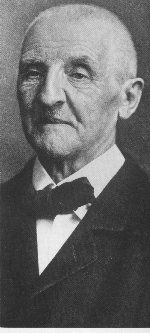
Bruckner |
28-year-old Busoni settles in Berlin, where he will live for the rest of his life.
In Paris, so many people have offered to buy the Edison phonograph in the Pathé brothers's bar that they found the Pathé Frères company to manufacture their own talking machine, which is simply an inexpensive copy of Edison's, and which is first called Le Coq, and then the Pathéphone. Having famous opera stars convenient to their studios make Pathé's recordings an instant success.
In Sedalia, Missouri (America), 26-year-old Scott Joplin is the leader of the Texas Medley Quartette, which is really an 8-member double quartet, singing in a capella "barbershop" style. The Quartette goes on a tour which takes them as far as Syracuse, New York, where Joplin's compositions are published for the first time -- Please Say You Will and A Picture of Her Face, two songs of the sentimental type popular at the time among White audiences.
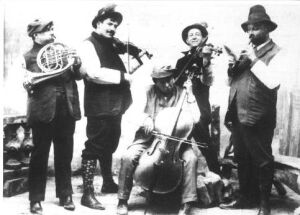
Schönberg playing the cello | Probably written during this year by 19-year-old Schönberg (or possibly even earlier) is his Presto in C for string quartet, his earliest surviving complete movement for an instrumental ensemble; the style reminds one of Schubert more than anyone else. Seeking the advice of a respected musician, this quartet-movement is performed for Alma's teacher Joseph Labor, who is impressed and insists that Schönberg must become a musician, even despite his lack of training. Schönberg is therefore delighted when his employer goes bankrupt and closes down, and proclaims that he'll never work in a bank again. (A famous quip by Zemlinsky: 'Schönberg preferred his music-notes to his bank-notes'.) At this time, on Labor's recommendation, he begins studying with Zemlinsky; Schönberg later credits Zemlinsky's instruction in counterpoint and composition as the only formal training he ever received from a teacher. He and Zemlinsky both earn money by doing copying and orchestrating of other composers's work. |
Hermann von Helmholtz dies on September 8 in Berlin, at age 73.
In September, 30-year-old Richard Strauss marries Pauline de Ahna.
18-year-old Schlesinger is engaged at the Hamburg Opera, where he meets Mahler, who recognizes his talent and becomes a close friend. Mahler exerts a powerful influence over his young colleague.
28-year-old Karpath becomes critic at the Neues Wiener Tagblatt, a job he holds until 1921.
In Hamburg, on his way to school, 9-year-old Otto Klemperer sees Mahler walking around town, and is intrigued with his appearance and unusual way of walking:
"At that time he [Mahler] had a habit of pulling strange faces, which made a tremendous impression on me. I ran along shyly after him for about ten minutes and stared at him as though he were a deep-sea monster." [Heyworth 1984, p.1]
In October, Schönberg completes a set of 3 Piano Pieces
(1st piece,
3rd piece),
his earliest surviving dated instrumental compositions, and
leaves unfinished a
Scherzo in F-sharp-minor for piano;
they betray an intense admiration of Brahms (especially Brahms's
Rhapsodies, Fantasies, Impromptus, etc., of opp. 116-119
from the year before), which is probably at
least partly the result of Schönberg's contact with Zemlinsky.
Zemlinsky is also already quite familiar with, and fond of,
Wagner's musical idiom, and eventually this will also rub off
on Schönberg, but from the evidence in Schönberg's surviving
compositions, this will not happen until after Mahler's arrival
at the Vienna Opera and his radical new productions of Wagner.
During the fall and winter in Hamburg, Mahler copies and corrects his 2nd Symphony with a view towards a performance with Richard Strauss's orchestra in Berlin (the end of the finale is dated December 18). He also spends a lot of time retouching the orchestration of Beethoven's symphonies for his own performances in the subscription concerts.
Quite an important year along the Paris-Hamburg-Berlin-Vienna musical axis.
1895
In January, Mahler conducts Hamburg Opera musicians in a reading rehearsal of the first 3 movements of his 2nd Symphony, but with the order: 1) funeral march, 2) scherzo, 3) andante. He later switches back to the original order (andante before the scherzo), but the score is eventually published with the rehearsal numbers reflecting the order of this reading, the numbers continuing from the funeral march to the scherzo, and with the andante having its own set of numbers.
Thru Mahler's help, his 21-year-old brother Otto has secured a post as conductor in Leipzig. Back in Vienna in February, Otto, whose capriciousness caused Mahler much pain and unneeded expense, and whom Mahler once said was 'a man of great talent, far more gifted than I', commits suicide by shooting himself. (According to Bruno Schlesinger [Walter], Otto leaves behind 2 symphonies and an almost-complete 3rd, and lieder, some with orchestra and some with piano. His music vanishes when Alma's house is damaged during the bombing of Vienna in World War 2.)
It seems entirely possible to me that Mahler's support of Schlesinger at this time is a transference of his desire to see Otto succeed, since they are so close in age; but Mahler doesn't think very highly of Schlesinger's compositions, and so in his opinion Schlesinger's abilities are purely recreative, and I think Mahler will also later find in Schönberg a gifted composer of his brother's generation to whom he can provide assistance.
On March 4, Mahler gives the incomplete première (the first three movements only, announced in the program as 'the First Part') of his 2nd Symphony, in Berlin. It is surprisingly successful with the audience, altho the newspaper critics are more negative.
In Hamburg, Mahler's subscription concerts have been less and less well attended, and he is not hired for the following season.
Also in March, at the première of 24-year-old Zemlinsky's Orchestral Suite in a Society of Music-Friends concert in Vienna, Zemlinsky meets Brahms.
In America, Berliner Gramophone Co. is established in Philadelphia to manufacture all equipment and discs under licence from Washington-based U.S. Gramophone Co. Meanwhile, American Graphophone Co. and Columbia Phonograph Co. consolidate, the Graphophone Co. concerning itself with development and manufacturing and Columbia handling distribution and sales, introducing reasonably priced home graphophones.
54-year-old Dvořák premières his Cello Concerto in America, and after a 3-year stint as Director of the National Conservatory in New York, he returns to Austria and his native Bohemia, and resumes his job as Professor of Composition at the Prague Conservatory.
| Mahler spends the last half of April and whole month of May with Dr. Hermann Behn and his wife Luise, who are on vacation, at Oberstrasse 87 in Hamburg. Mahler purchases his first bicycle and learns how to ride it. |

Oberstrasse 87 in Hamburg, Mahler's residence (the green pin with orange cirlce; click image to enlarge) |
In Vienna, Karl Lüger and his anti-semitic Christian Socialist party win the May elections, setting the stage for a drastic change in Austrian politics that will lead to Lüger's becoming mayor of Vienna, and eventually to Hitler's victories.
Suppé dies in Vienna on May 21 at age 76.
Over the summer, Zemlinsky finishes his first opera Sarema, which is jointly (with Thuille's opera Theuerdank) awarded the prize from Luitpold, Prince Regent of Bavaria.
Zemlinsky encourages Schönberg into more practical musical roles in trying to help his friend earn a living, and around his 21st birthday, Schönberg becomes conductor of a metal-workers choral society.
31-year-old Richard Strauss had drafted Till Eulenspiegels Lustige Streiche ['Till Eulenspiegel's Merry Pranks'] as an opera the year before, but now transforms it into his 5th symphonic-poem. Its success offsets the failure of Guntram a bit.
Hugo Wolf composes his only completed opera, Der Corregidor.
Hanslick at 70 retires from his position at the University of Vienna, and is succeeded by Mahler's 39-year-old friend Guido Adler, who becomes professor of music history.
Around his 35th birthday over the summer in Steinbach, probably the most productive of his life, Mahler composes all the shorter movements of his gigantic 3rd Symphony (the 2nd, 3rd, 4th, 5th, and 6th), as well as several Wunderhorn lieder.
In July, Mahler makes his annual visit to Brahms at Ischl. Brahms has been considering writing a "cantata-symphony", which later transforms into the Vier ernste Gesänge ['4 serious songs'].
| From August 1895 to April 1897, Mahler lives at Bismarckstrasse 86 in the Hohe Luft quarter of Hamburg. |

Bismarckstrasse 86 in Hamburg
(The pin with the orange circle; |
In the fall, the gifted young soprano Anna von Mildenburg debuts at Hamburg. Mahler senses her talent immediately and rehearses with her every day, leading inevitably to a stormy love affair.
Sometime in the fall, the Vienna Tonkunstlerverein gives the private trial performance of Zemlinsky's String Quintet in D-minor. Brahms invites Zemlinsky afterwards to bring the piece to him; he goes over it with much criticism, bringing out a Mozart Quintet as an example from which to learn, but then, showing appreciation of Zemlinsky's talent and inquiring about his finances, Brahms offers him a monthly allowance so that the young man may be able to devote more time to composition. Zemlinsky scraps the final movement and composes a new one, then, heavily under the influence of Brahms's criticism, begins his Piano Trio with Clarinet, op.3, in the same key.
In November, Alma's widowed mother Anna marries Schindler's former pupil Carl Moll, himself a talented painter.
On December 7, Richard Strauss gets down to serious work on his 6th symphonic-poem Also Sprach Zarathustra.
December 13 brings the full première of Mahler's 2nd Symphony in Berlin, and is his first important success as a creative artist, the real beginning of his career as a composer. Half of the cost is supplied by Hermann Behn, a wealthy Hamburg arts patron and music-lover, who also writes a 2-piano arrangement of the work, and the other half of the cost by Wilhelm Berkan.
Also in December (but with a copyright date of 1896), Mahler's original piano score of Urlicht and Behn's 4-hand 2-piano arrangement of Mahler's 2nd Symphony are published by Friedrich Hofmeister in Leipzig. These pieces are the second group of Mahler's works to be published, and also financed by Behn. (Later taken over by Weinberger in Vienna, still later, by Universal Edition).
France unites its African colonies of Senegal, French Sudan, Guinea and Côte d'Ivoire into a large new territory called French West Africa.
1896
In both January and February, Natalie Bauer-Lechner visits Mahler twice in Hamburg, seeming to indicate that their relationship is growing stronger.
On February 1, Puccini's opera La Bohème ['the bohemian'] is premiered at the Teatro Regio in Italy.
In February, at the suggestion of Richard Heuberger, 21-year-old Schönberg composes his Six 4-hand Piano Pieces.
On March 16, a concert in Berlin is devoted to Mahler's music: the Totenfeier, billed as "1st movement of the Symphony in C-minor for large orchestra" (later known as the 2nd Symphony), the première of the Lieder eines fahrenden Gesellen, and the Symphony in D-major for large orchestra (later known as the 1st Symphony), revamped out of what was the 'Titan' by dropping the sentimental 'Blumine' slow movement and eliminating the program and titles. (A manuscript of this version of the 1st exists, but is inaccesible at present, in a private collection.) Played to a half-empty hall, the songs are applauded, but the symphonic pieces get a disappointing reception. It is interesting that the year before Mahler had premièred the first 3 movements from his "2nd Symphony", but here he drops the numbering, perhaps indicating that at this time he still expected to specialize in composing symphonic-poems and not true symphonies.
On March 5, Zemlinsky's String Quintet in D-minor is performed in Vienna by Hellmesberger Quartet, with quite a good reception.
Assured of an autumn performance of his Blumenstück ['flowers-piece'] (the 2nd movement of his 3rd Symphony), Mahler completes orchestration of it on April 11.
From April to July, Zemlinsky composes the cantata Frühlingsbegräbnis ['springtime funeral'] for soprano and baritone soloists, chorus, and orchestra, on a poem by Paul Heyse. Originally composed for small orchestra, it is probably intended for Polyhymnia, but will be revised later for a larger orchestra.
In May, Clara Schumann has a stroke and is very ill. Under this tragic inspiration, Brahms, just after his 63rd birthday, composes Vier ernste Gesänge ['four serious songs'], op.121, his last completed work. Clara dies later that month in Frankfurt, at age 76. It is a tremendous loss for Brahms, who is himself now ill from liver cancer.
In America, National Gramophone Co. is established by Frank Seaman to undertake distribution and advertising of the gramophone, and is given exclusive sales rights. Edison dissolves the North American Phonograph Company and, salvaging his phonograph patents, establishes the National Phonograph Co. to manufacture and distribute phonographs for home use.
21-year-old Franz Schmidt graduates "with excellence" from the Vienna Conservatory, and secures a position as cellist with the Vienna Philharmonic Orchestra, often playing under Mahler's direction.
24-year-old Zemlinsky wins a prize from the Wiener Tonkünstlerverein ['Viennese Tone-Artists Association'], for his Piano Trio with Clarinet, op.3. Brahms had provided the prize money, and he recommends the work to his publisher Simrock, who accepts and publishes it the next year. As with Mahler, the support from Brahms helps bring Zemlinsky greater recognition from the musical public. Over the summer, Zemlinsky composes his String Quartet in A-major, op.4.
36-year-old Hugo Wolf completes the 24 songs of his 2nd Italienisches Liederbuch ['Italian song-book'].
46-year-old Heuberger becomes music critic of the Neue Freie Presse until 1901.
In England, 21-year-old Marconi files a patent for his radio apparatus on June 2, which is the first patent for a radio-wave based communication system.
|
From 1 June to 10 June, Mahler stays in Vienna at Natalie Bauer-Lechner's house, again indicating how close they have become. He makes a one-day trip to Dresden and Leipzig on 3 June to visit colleagues. |

|
During his summer vacation in Steinbach, with Schlesinger and Natalie Bauer-Lechner as his guests for the summer, 36-year-old Mahler from 5 to 28 July Mahler works intensively to compose the massive 1st movement which completes his 3rd Symphony.

Brahms |
At Bad Ischl during the first few days of July, Mahler visits Brahms for the last time, and shows the old master the score to his 2nd Symphony. Brahms considers its Scherzo to be a work of genius (an opinion he rarely expresses), and says 'I now consider Mahler the king of the revolutionaries'. As is always the case with Brahms's ambiguous and sarcastic humor, this may be taken as either a compliment or a put-down, but in any case, Brahms's remark indicates clearly that he recognizes Mahler's superiority over Richard Strauss as a composer. |
From 1 to 8 August, Mahler and Natalie make a trip by bicycle from Salzburg to Berchtesgaden, to visit Siegfried Lipiner and his wife. From 9 to 14 August Mahler goes with his sister Justine to Bayreuth, at the invitation of Cosima Wagner, to attend the 4th Bayreuth Festival.
On August 24, 32-year-old Richard Strauss finishes his 6th symphonic-poem, Also Sprach Zarathustra ['thus spake Zarathustra'], op.30, based on Nietzsche's book. (The opening to this piece becomes hugely popular when it is used by Stanley Kubrick in his 1968 film 2001: A Space Odyssey.) The piece becomes notorius for its unresovled ending mixing a B-major triad on the trombones with a pizzicato C on the basses. It is premièred on November 27 in Frankfurt.
|
On 27 August, Mahler returns to Hamburg for the next opera season. |

Mahler |
In September, just before his 22nd birthday, Schönberg begins composing a Serenade in D for small orchestra, for the Polyhymnia Orchestra to which he and Zemlinsky belong. Only the 1st movement is completed; it sounds very much like Brahms.
In Sedalia, Missouri [America] in the Fall, Scott Joplin publishes Combination March [hear my version which uses, for each of the four strains, the notated form for the first time and a syncopated ragtime version improvised by me for the second time] and The Great Crush Collision March [version as notated, improvised syncopated ragtime version], the latter including a programmatic commemoration of an actual staged locomotive crash. It is clear to me that Joplin played these "marches" in the ragtime form but did not yet know how to notate the rhythms properly.
20-year-old Schlesinger bids farewell to Mahler in Vienna and begins his engagement in Breslau [now Wroclaw, Poland].
During October, Mahler begins a series of letters and meetings to prepare for his attempt to became Director of the Vienna Opera.
Bruckner dies in Vienna on October 11 at age 72, leaving his 9th Symphony unfinished.
On November 9 before a packed hall, the Berlin Philharmonic under Nikisch premières Mahler's Blumenstück (2nd movement from his 3rd Symphony), and it receives the best reception (from both audience and critics) so far for Mahler.
In December, the same orchestra under Weingartner performs the piece in Hamburg, and the audience insists on an encore. Also in December, Mahler conducts the first two movements of his 2nd Symphony in their Leipzig première on the 14th, the first movement to mixed applause and boos, and the 2nd movement more successfully.
Zemlinsky has two premières in Vienna in December: his String Quartet in A-major, op.4, and then a few days later his Clarinet Trio in D-minor, op.3 and . They both sound very much like Brahms, and are received very well.
1897
Composed early this year, or possibly even the year before, is the first version of 22-year-old Schönberg's String Quartet in D-major (1st movement); the work will not be put into its definitive form until after Zemlinsky reviews it and offers criticism. Schönberg later confirms summer 1897 (after Brahms's death) as the date of composition of the Quartet, and the only surviving manuscript (the revised version) bears the date of October 1897, but Hanns Eisler (who will study with Schönberg decades later) and Zemlinsky both indicate this work as the quartet which Zemlinsky shows to Brahms, who is intrigued with the piece, so the discarded version of the Quartet had to be composed before Brahms died. When Zemlinsky tells Brahms that Schönberg has been scraping out a living by arranging and copying music, Brahms offers to pay Schönberg's tuition to study at the Conservatory; Schönberg turns it down. Altho the earlier version was apparently quite different from the revised one which we know, the Quartet in D is indeed the most significant early piece composed by Schönberg, and the only one likely to attract such strong attention from Brahms. It is possible that this is the last piece of new music Brahms reviewed.
The complete orchestral score of Mahler's 2nd Symphony is published by Hofmeister: the third publication of Mahler's music, and the first of his symphonies to appear in print in full score.
In January, Schuch conducts the 2nd, 3rd, and 4th movments of Mahler's 2nd Symphony in Dresden, and Nikisch conducts the Blumenstück [from the 3rd Symphony] in Leipzig, all with great success.
Knowing that his being a Jew will be the biggest obstacle to his career in Austria, on 23 February Mahler has himself secretly baptised as a Catholic. From 11 to 15 March, Mahler travels to Moscow to give a concert, then spends a week in Munich for 2 concerts, then to Budapest for another concert. 1 to 3 April he visits Vienna.
Preceded by a lecture about Mahler which was published as a booklet, in March, in Berlin, Felix Weingartner conducts 2nd, 3rd, and 6th movements of Mahler's 3rd Symphony, before a full house, to very mixed reviews. Later that month, in the midst of his first international concert tour, Mahler successfully performs the Blumenstück in Budapest.
Hugo Wolf composes Gedichte von Michelangelo, songs on poems by Michelangelo.
Brahms dies in Vienna on April 3 at age 63, of liver cancer.
|
The same day brings the founding of the Vererinigung Bildender
Künstler Österreichs ['Association of Austrian
Fine Artists'], commonly known as the Secession. Chiefly the
idea of Klimt, Engelhart, and Moll, it is the most important
event in the fin-de-siècle Vienna art-world.
Because of her ties to both Klimt and Moll, Alma Schindler is intimately involved with the Secession. Alma is considered by those in her social circle to be the 'prettiest girl in Vienna', and she is wooed by many older and well-established men, both single and married. Her strongest ambition is to make a mark as a great composer. |
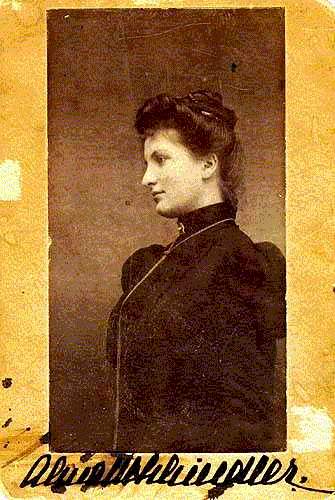
Alma Schindler |
Ever since his college days, Mahler has considered Vienna his hometown. His wish to return is finally fulfilled, in large part thanks to the support Brahms had provided. On 8 April the Vienna newspapers report that Mahler has been appointed conductor at the Vienna Opera. Mahler leaves Hamburg on April 25 at age 36 and becomes conductor and eventually Director (and supreme tyrant) of the Vienna Opera, beginning a decade of artistic achievement that will be remembered long afterward. Mahler makes his Vienna debut with Wagner's Lohengrin on May 11.
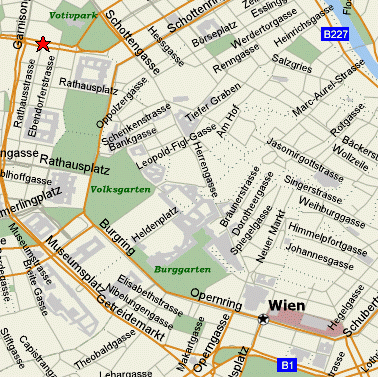
Map of central Vienna |
While looking for a permanent residence, Mahler rents a flat at Universitätstrasse 6, near his alma mater, the University of Vienna. Contracting a bad sore throat soon after arriving in Vienna, Mahler spends the summer convalescing and moving from one temporary residence to another, and does no composing. |
Erich Wolfgang Korngold is born on May 29 in Brünn, the younger of the two sons of the eminent newspaper music-critic Julius.
33-year-old Richard Strauss composes Don Quixote, fantasy variations for cello and orchestra, op.35, which can be considered his 7th symphonic-poem.
21-year-old Schlesinger secures a contract for the Stadttheater in Riga, to begin in 1898, but wants to leave Breslau immediately, so he obtains a post for the coming season as principal conductor in Pressburg [also known in Hungarian as Poszony; now Bratislava, Slovakia]. Over the summer, he visits Mahler in Vienna, gets to know many of Mahler's friends, and feels that he belongs in Vienna, which he visits occasionally from Pressburg (only a short train ride away).
Schönberg himself gives the summer of 1897 as the date of composition of his String Quartet in D-major (1st movement) -- altho apparently it must have originally been composed earlier and shown to Brahms (see above). The 2nd movement is originally a Scherzo, composed 27 July - 7 August, which will later be replaced, in accordance with Zemlinsky's suggestion.
Also during this summer Schönberg makes the piano-vocal score of Zemlinsky's Sarema. Sometime during these years Schönberg also becomes very well acquainted with Wagner's work, claiming later that by the time he was 25 (1899) he had seen each of Wagner's operas 20 to 30 times, evidently mostly in performances that were conducted by Mahler.
Zemlinsky spends the summer composing his Symphony in Bb-major. In October, his first opera, Sarema, is premièred in Munich. He also begins his second opera, Es war einmal ['once upon a time'].
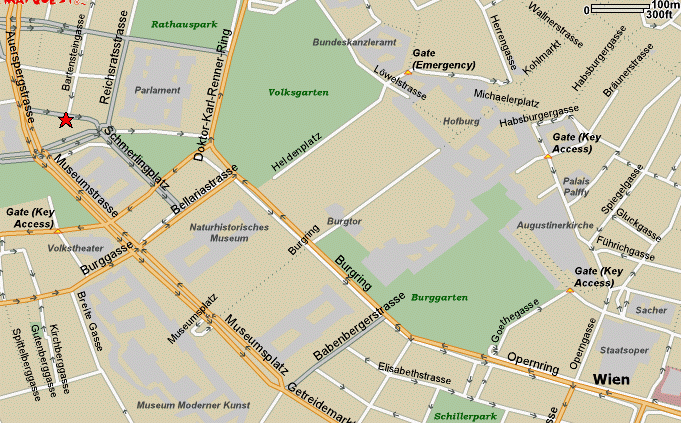
Map of central Vienna
the red star indicates Mahler's apartment in Bartensteingasse.
Mahler returns to Vienna on 27 July, the opera season beginning on 1 August. On August 11, Mahler rents an apartment in Bartensteingasse, a bit closer to the Opera house than his previous flat.
In America, Thaddeus Cahill patents what is to become the "Telharmonium" or "Dynamophone", which can be considered the first significant electronic musical instrument. The tonewheel mechanism of the later Hammond Organ, introduced in 1935, the year after Cahill's death, is essentially the same as that used in the Telharmonium.
In the fall Schönberg shows his String Quartet in D-major (1st movement) to Zemlinsky. Subject to heavy revision after Zemlinsky's critique, Schönberg composes the revisions of the 1st and 4th movements, and two entirely new movements (the 2nd [Intermezzo] and 3rd) in the fall. Sounding very much like Brahms (and, betraying Schönberg's repertoire as a performer, even more like Dvořák), but with some boldly abrupt modulations, the work will be successfully received at both its private and public premières the following year. It is Schönberg's last 'apprentice'-work.
After finishing the Quartet, Schönberg is inspired by the poetry of Richard Dehmel into writing songs which provoke his own more personal compositional tendencies (Mädchenfrühling), with which he is now able to better integrate the techniques learned from Brahms.
62-year-old Wilhelm Jahn, Director of the Vienna Court Opera, has failing eyesight, and is ousted when the new season begins in the fall. Mahler is officially given his job on October 8.
Hugo Wolf |
Needing to find new works to supplement the standard repertoire of the Opera, Mahler renews his friendship with Hugo Wolf in May after a 15-year hiatus, to discuss with him the possibility of producing his opera Der Corregidor. Over the summer, Wolf apparently exaggerates in his mind the definiteness of this première. On Saturday, September 18, anxious about the fact that a decision has not yet been made, Wolf goes to Mahler determined to get a date for the première of Der Corregidor, but the discussion becomes heated and Mahler criticizes Wolf's opera harshly then leaves his office on a pretense. Wolf suddenly believes that Mahler has been fired from his position at the Opera and that he, Wolf, is Mahler's replacement. Wolf rings the bell at Mahler's apartment and demands to be admitted as the master of the house. He then goes to his friends and tells them the news of his appointment as Director. By Monday he turns violent, and is put in a carriage and told that he will be taken to see Prince Liechtenstein to confirm his appointment as director. Instead, the carriage takes him to a mental asylum. |
On 8 October, Mahler is formally appointed Director of the Vienna Opera, his dream come true. His contract gives him great powers over the whole Opera, and provides a good salary and benefits: salary 12,000 guilders, expenses 1,000 guilders, and pension 3,000 guilders.
Mahler contacts Zemlinsky's publisher requesting
a copy of Sarema. Zemlinsky instead proposes
Es war einmal ['once upon a time'], the
opera on which he is currently working, based on Holger Drachmann's
folk-tale comedy Der var engang. Zemlinsky composes
the opera between August 1897 and June 1898.
Late in the year, Mahler's friend Guido Adler, the musicologist, succeeds in getting a grant from a Bohemian art society, to subsidize the publication of Mahler's 1st and 3rd Symphonies, which will be printed by Eberle and published by Weinberger during the next few years. In December, Mahler's Lieder eines fahrenden Gesellen are published by Weinberger.
Weinberger is one of the founding members of the Vienna Gesellschaft der Autoren, Komponisten und Musikverleger, or AKM ['Society of authors, composers and music-publishers']. Mahler becomes one of the original members.
With the following all happening within the time-frame of a few months:
the deaths of Bruckner and Brahms, Mahler's appointment to the Vienna Opera, the public emergence of Schönberg, and the founding of the Secession by their visual-artist compatriots,
the musical climate among many composers in Vienna quickly begins to shift toward a much more modern outlook, while the public's taste remains very largely conservative.
1898
After a few months of treatment at the mental asylum, the doctors decide that Hugo Wolf is well enough to be released early in the year.

Auenbruggergasse 2, Vienna
Mahler's home 1898 to 1909 |
On 19 February, Mahler moves into the 4th-floor apartment at Auenbruggergasse 2, with his sisters Justine and Emma. This will remain his home in Vienna until 1909. |
|
March is an important month for 37-year-old Mahler: in Prague, he gives the
fifth performance, and the first successful one,
of his 1st Symphony,
and Sylvain Dupuis conducts Mahler's 2nd Symphony
in Liège: the first performance of a complete Mahler symphony
without the composer's presence. It is so successful that a repeat
is scheduled.
During this spring, Mahler completes what is intended to be the definitive revision of his youthful cantata Das Klagende Lied, with an eye toward its publication. Mahler is also offered, and seriously considers, a job as concert conductor and Director of the National Conservatory in New York City (the job Dvořák had held from 1892 to 1895). |
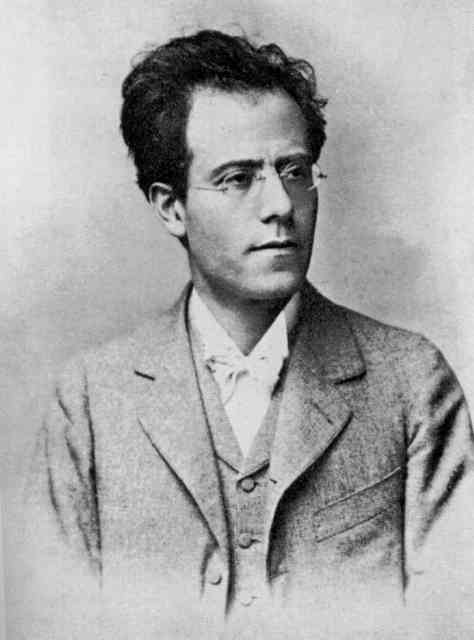
Mahler |
26-year-old Zemlinsky gets on the board of the Wiener Tonkünstlerverein ['Viennese Tone-Artists Association'], and brings Schönberg in as a member. During March, Schönberg's String Quartet in D-major is premièred at a private Tonkünstlerverein concert in Vienna. At this time, Schönberg also converts to Protestantism, being baptised as a Lutheran.
The Gramophone Company (England) is established in London by William Barry Owen and E. Trevor Williams, to manufacture gramophones and records (discs) in Europe.
In Hanover, Germany, the mass-production of phonograph disk records made of brittle shellac begins, and this will be the main material used for records until 1950.
In Berlin during the spring, 32-year-old Sibelius begins composing a multi-movement "musical dialogue" on a programmatic concept depicting winter scenes. He eventually abandons this idea and the work morphs into a symphony (which we know as his 1st Symphony). Work on this will continue for about a year.
Mahler undergoes another operation to stop his more and more frequent hemorrhages, and spends the summer in pain at Vahrn, composing only the 3 Wunderhorn Lieder: Lied des Verfolgten im Turm ['song of the prisoner in the tower'], Wo die schönen Trompeten blasen ['where the proud trumpets blow'], and another unidentified one.
Zemlinsky finishes his 2nd opera,
Es war einmal ['once upon a time'].
34-year-old Richard Strauss composes his 8th and last symphonic-poem, Ein Heldenleben ['a hero's life'].
17-year-old Béla Bartók is accepted into the Vienna Conservatory, but he will only attend for one year.
Over the summer, Schönberg begins exploring ideas learned from the 'New German School', and works on a symphonic-poem called Frühlings Tod ['the death of spring'], which he eventually abandons, and composes his 2 Songs, op.1. These pieces are more expansive than his previous ones, but Schönberg's style will change again with the works written in the next year, after powerful new poetic and personal stimuli (Richard Dehmal and Mathilde Zemlinsky, respectively).
Schlesinger spends the summer in Berlin, visits Mahler in Vienna in August, bringing along his piano-duet transcriptions of Mahler's 1st and 2nd Symphonies, then, at 22, becomes chief conductor at the theater in Riga (Latvia).
Richter conducts Beethoven's Eroica Symphony at the last Vienna Philharmonic concert of the season, which will prove to be his last concert with that orchestra. Over the summer, Mahler engages in secret negotiations with the committee which result in Richter's resignation and in Mahler being offered the position in August. On November 6 Mahler opens the new season also with the Eroica, in the version with his own instrumental retouchings, obviously showing the orchestra and the public that there will be a new way of doing things.
48-year-old Heuberger hires Zemlinsky and Schoenberg to score his operetta Der Opernball, which is a big hit after its première in Munich.
On August 25, Mahler's sister Emma marries Eduard Rosé and they emigrate to America, where Eduard becomes cellist with the Boston Symphony.
In October, with the desire for the première of Der Corregidor still bothering his troubled mind, Hugo Wolf attempts to drown himself but lives, then commits himself to the mental institution again, where he will live out his remaining 6 years.
In December, 24-year-old Schönberg's String Quartet in D-major is given its public première in Vienna, and is well received. In his review of the concert, Hanslick remarks: 'there is a new Mozart growing up in Vienna'.
1899
Mahler goes to Liège himself in January for another performance of his 2nd Symphony. Altho the performers are not adequate, the audience is deeply impressed.
In Russia on February 15, the "February Manisfesto" is issued by Emperor Nicholas II, seeking to restrict the autonomy of the Grand Duchy of Finland (then part of the Russian Empire) and broaden the "Russification" of the Duchy, inspring widespread protest among Finnish people. Sibelius, his sense of Finnish nationalism aroused, composes several protest pieces.
In Vienna in February, Weinberger publishes the score of Mahler's 1st Symphony. In March, Mahler conducts his 1st in Frankfurt-am-Main. The work is met with polite (rather than enthusiastic) applause, but the musicians like it, which pleases Mahler.
Also in March, 27-year-old Zemlinsky's Symphony in Bb-major is premièred in Vienna. At the end of the month Zemlinsky withdraws from the Isrealitische Kultusgemeinde and at some later time becomes baptised. Later in the year he also becomes a Freemason. Some time during the year the Zemlinsky family moves into an apartment at Obere Weissgerberstrasse 12 in the 3rd District.
In April, Schönberg attends the Vienna première of Mahler's 2nd Symphony and, suprisingly, leaves unimpressed, as it is Mahler's first great success as a composer with the Viennese public, something he has dreamed about for nearly 20 years. The critics, however, agree with Schönberg, and roundly denounce the work and its creator.
During this time Schönberg falls in love with Zemlinsky's sister Mathilde, and he becomes deeply engrossed in Richard Dehmel's book Weib und Welt ['woman and world'], setting many of its erotic poems as songs, three of which appear in his 4 Songs, op.2 (Erwartung is #2) and one in his 6 Songs, op.3. Schönberg's style changes dramatically, as he begins to incorporate compositional techniques learned from his study of Wagner, Richard Strauss, and Hugo Wolf.
In the spring, 33-year-old Sibelius completes his Symphony in E minor (now known as his 1st Symphony), which is well-received at its April 26 première in Helsinki. He makes revisions to the work before the next performance and later destroys the score to the original version.
In May, after the Philharmonic season, Mahler completes the final revisions of the 3rd Symphony and Das Klagende Lied, reinstating the off-stage band into the score of the latter. Returning home after a trip to Venice, Alma sees Mahler in the street and thinks it noteworthy enough to mention in her diary.
Johann Strauss, Jr. dies on June 3 in Vienna at age 73.
In Paris, the Pathé company's 1899 catalog features 1,500 wax cylinder selections. Cylinders are popular in France until 1908, whereas licensee's of Berliner's gramophone make discs more popular in Britain and Germany.
Zemlinsky's opera Sarema is published by Berté in Leipzig.
24-year-old Franz Schmidt composes his 1st Symphony.
During his summer vacation at Aussee in the Salzkammergut, Mahler composes Revelge, which he considers may be the most important of his lieder, and comes up with a plan for his 4th Symphony, deciding to use as the finale a song he wrote in 1892 (and which he had intended to use in the 3rd Symphony), and he composes the 1st and 2nd movements. It is a much lighter work than his previous symphonies, and seems to mark a change in his style... (but the real change will come with the next work, his 5th).
Several of Alma Schindler's friends go out one night while she is ill and in bed; when they return, they claim that they spent the night in Mahler's company, and that they sent her a postcard which he signed, but which she never receives. After two weeks, she finds out that the whole story is a lie. Mahler finds out about it too, and, enabling Alma to have the last laugh, actually does send her a card. A few days later 19-year-old Alma and her friends happen to run into Mahler on a bicycle ride; he hopes to be introduced, but she dashes off ahead, wanting not to spoil her admiration for him as an artist by becoming acquainted with him as a man (and presumably learning of his flaws). At this point it is clear that Mahler is already very attracted to Alma.
| Mahler finally has enough capital to have his own summer house built, and Mildenburg recommends an architect who convinces him to do so; construction is begun on the 'villa Mahler' at Maiernigg on the Attersee, in the Austrian Alps, and also, of course, on a little Hauschen [composing-hut] in the woods some distance away from the house, up the hill from the lake. |
|
The red star indicates the Maiernigg post office; Mahler's property was on the shore of the Wörthersee, north of the star. The town of Sekirn, just west of Mahler's villa, was Zemlinsky's summer retreat during 1905. |
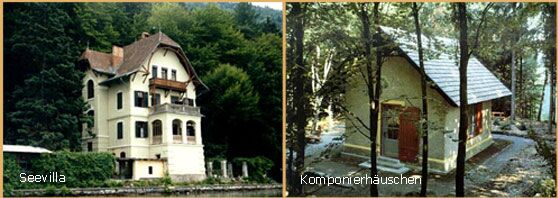
Mahler's villa (left) and composing-hut (right) in Maiernigg
14-year-old Webern writes his first compositions, mostly songs. The earliest one which survives is Vorfrühling ['earliest spring']. This and many of Webern's other early songs are on texts by Ferdinand Avenarius, whose style is an important influence on the composer.
Béla Bartók
18-year-old Béla Bartók begins his studies at
the Budapest Academy.
|
In November, 25-year-old Schönberg composes his tone-poem Verklarte Nacht ['transfigured night'], for string sextet, based on a poem from Dehmel's Weib und Welt ['woman and world']. The piece is very evocative of the moods of the poem upon which it is based. It is obvious that Schönberg has by now already assimilated Wagner and, musically, has reached a great level of maturity, and this becomes his first piece to attract the attention of publishers, and is destined to remain his most popular composition. It is also the first time Schönberg uses a large single-movement form, an idea which will preoccupy him for the next few years in his instrumental works.
Schönberg |
A foreshadowing of things to come:
because of one chord -- a 'dominant 9th' in '4th inversion' position
(i.e., with the '9th'in the bass), which is forbidden by the harmony textbooks -- the
Viennese ensemble scheduled to première it refuses. A critic's
comment:
It sounds like someone smeared the the score of Tristan while the ink was still wet. So with the Wagner-Brahms controversy raging all around him (even tho they're both dead by now), Schönberg, just as he was so often later to seem to be the virtual embodiment of paradox, while in his mid-20s effortlessly combines his admiration for both composers, and it is reflected in his own compositions. |
Also in November, Seigmund Freud publishes his book Die Traumdeuting ['the interpretation of dreams'].
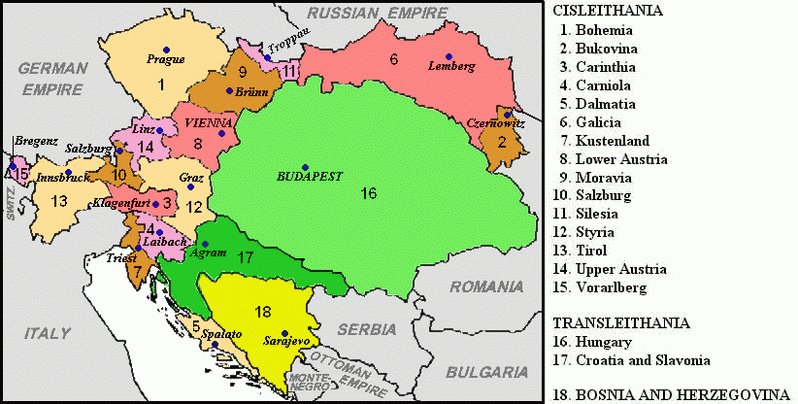
Austro-Hungarian Empire, c.1900
1900
On January 14, Puccini's opera Tosca is premiered at the Teatro Costanzi in Italy.
On January 22, Mahler conducts the première of 28-year-old Zemlinsky's 2nd opera Es war einmal ['once upon a time'], after suggesting, and helping Zemlinsky with, heavy revisions of the text and music. It is very well received and has many performances.
In February, the prestigious Gesellschaft der Musikfreunde ['society for the friends of music'] presents the première of Zemlinsky's cantata Frühlingsbegräbnis ['springtime funeral'] with Zemlinsky conducting the Vienna Philharmonic orchestra and the chorus of the Singverein.
These two performances mark the height of Zemlinsky's career in Vienna ... unfortunately, a position he will never later reach again. Just at this point, Alma Schindler meets Zemlinsky. They develop a strong interest in each other, based at first on their mutual admiration for Wagner and Mahler.
On February 12, 25-year-old Schönberg begins composing a Symphony in G-minor which will remain unfinished.
On February 18, Vienna for the first time hears Mahler's version of Beethoven's 9th Symphony. Newspaper critic Hirschfield hates it and becomes hostile towards Mahler, while Alma loves it.
Franz Ritter von Jauner, director of the Carltheater, has had difficulty balancing the books. On February 23, upon opening the theater's safe and finding it empty, he shoots himself. The job for the upcoming season in September is offered to Zemlinsky.
In March, for a Wiener Tonkünstlerverein ['Viennese Tone-Artists Association'] competition in which Zemlinsky is a judge, Schönberg begins his Gurrelieder as a cycle of 9 songs with piano. Either because he misses the deadline or because he feels he won't win, the songs are never submitted. But by April, disregarding Zemlinsky's doubts, Schönberg changes the piece into a monumental cantata-like work for soloists, choirs, and orchestra. Over the next year he continues composing it, while doing hack-work orchestrating thousands of pages of operettas for a living.
In March, Weinberger publishes both the orchestral and piano versions of Mahler's complete set of songs from Des Knaben Wunderhorn in 2 volumes each.
Zemlinsky's opera Es War Einmal... ['once upon a time'] receives its 10th performance at Vienna on March 28; Alma is there to hear Zemlinsky's music for the first time, and is impressed.
15-year-old Berg's father dies on March 30. During this summer, Berg writes his first songs and a few piano pieces, including Mein erster Walzer ['My first waltz'].
In April, Alma happens to run into Mahler while out walking with a friend. Mahler greets the friend, but stares at Alma.
Under Zemlinsky's influence, Alma starts attending Wiener Tonkünstlerverein ['Viennese Tone-Artists Association'] concerts, and sees Schönberg at an after-concert dinner. Zemlinsky shows an interest in Alma's songs; by May she decides that Labor's emphasis on technique is not enough, and she will supplement his training with additional lessons from Zemlinsky, to learn how to 'capture the atmosphere of a poem' in her songs.
On May 30, the Vienna Philharmonic re-elects Mahler as director by a vote of 86 to 3.
In June, Mahler takes the Vienna Philharmonic to Paris and, indicating his interest in 20-year-old Alma Schindler already, sends her a postcard from there. On June 25, Alma notes in her diary that Mahler is "my idol".
Richard Strauss begins trying to convince Mahler to leave the AKM, saying that the music-publishers are setting the tone rather than the composers.
On June 29, Zemlinsky's father dies, leaving Zemlinsky to take over the leadership of the family; thus, his position at the Carltheater comes at an opportune moment.
During the spring and summer, 34-year-old Sibelius works on the revisions to his 1st Symphony for the European tour of his friend Robert Kajanus and his orchestra. The première of the revised version is on July 1 in Helsinki, and on the tour the symphony is acclaimed by critics in Stockholm, Copenhagen, Hamburg, and Berlin, making Sibelius internationally famous. His patriotic tone-poem Finlandia is premièred on July 2 in Helsinki, and makes him a national hero.
| Settling into his new composing-hut in Maiernigg, Mahler completes his 4th Symphony with the 3rd movement Adagio, then celebrates his 40th birthday a month late, after finishing his work. Mahler regards the first 4 symphonies as "a self-contained tetralogy" of which the 4th Symphony is the conclusion, and there are indeed strong thematic links between the 3rd and 4th -- not surprising, since Das Himmlische Leben (the finale of the 4th) was originally intended as the finale to the 3rd. He also remarks that upon resuming work on the symphony this summer, he began at a point that was far in advance of the sketches he had made last year, invoking a "second self" who was busy composing "in the background" during the opera season while his "first self" was occupied with his regular conducting and administrative duties. |
in Maiernigg |
Mahler has also taken along the score of Rott's symphony, in hopes of performing it; it never happens, but there are bits and pieces of Rott's piece echoed in Mahler's 1st, 2nd, 3rd, and 5th symphonies. (I wonder exactly how long Mahler had this score in his possession...)
Up until now, the companies making wax cylinder records have taken little notice of Berliner's gramophone, but now they begin to get desperate and challenge Berliner's patents. In America, The American Graphophone Company sues Frank Seaman (Berliner's chief salesman), and Seaman ends up making and selling gramophones for American Graphophone. Eldridge Johnson, who makes Berliner's motors, creates the wax-disc mastering process and founds the Victor Talking Machine Co. Eventually Victor and the Berliner companies pool their patents and dominate the record business for nearly twenty years. Cylinder sales drop off sharply after 1901, and the disc "record" is triumphant.
(Recorded-audio-disk technology will improve in the mid-1920s with electrical recording, in 1948 with the invention of the 33 & 1/3 r.p.m. long-playing "LP" -- followed in 1949 by the 45 r.p.m "45" in a more convenient size for the 3-minute "single", in 1950 with the substitution of vinyl for the brittle shellac, and in 1957 with the invention of stereo. But in terms of reprduction technique, it remains essentially unchanged until the invention of the digital "compact disc" or "CD" in 1983).
18-year-old Lilienfeld begins his college studies at Friedrich-Wilhelms-Universität.
24-year-old Schlesinger becomes conductor at the Berlin Opera. A new agent in Berlin feels that he is a rising star, and also secures his first symphony concert, with the Berlin Philharmonic. He occasionally takes the long train journey to make visits to Mahler in Vienna and to see his fiancé in Basle, and quickly becomes unhappy with his job in Berlin.
Franz Schalk is engaged by Mahler as conductor at the Vienna Hofoper ['court opera'] on September 1.
Just before his 29th birthday, Zemlinsky begins his post at Vienna's Carltheater in September.
On October 20, Mahler conducts the Munich première of his 2nd Symphony, and it is a big success with both the audience and the press.
Mahler decides around this time that writing programs to explain his symphonies does more harm than good, confusing the public rather than enlightening them as to the intellectual basis of his work. After the Munich performance, he makes the famous statement 'down with the program books!', and presents all subsequent symphonic works (except the 8th Symphony and Das Lied von der Erde, which have overt texts) as pure music, allowing no explanatory text in the programs at the premières, other than the list of movements with their initial tempo markings (which especially in Mahler doesn't signify much, because his movements change tempo constantly).
On October 3, 21-year-old Alma takes her first counterpoint lesson with Josef Labor. After having been apart for the whole summer, Zemlinsky visits Alma on October 18. Dissatisfied with her progress under Labor, and probably already very attracted to Zemlinsky's musical talent and intelligence, she begins taking lessons with Zemlinsky on November 13. She also becomes friends with Schönberg, since he and Zemlinsky are constant companions. Over the course of the next few months, Alma falls in love with Zemlinsky.
On November 18, Alma attends the Vienna première of Mahler's 1st Symphony. Amid booing and hissing from a few detractors, and loud applause from Mahler's cult following, the audience gives a generally enthusiastic response. But for the newspaper critics it is a unanimous failure. Alma fails to recognize the value of Mahler's compositions, and Schönberg is also apparently there because he too later makes disparaging remarks about the work.
In December, Alma attends a lieder concert including songs by Zemlinsky and the première of Schönberg's 2 Songs, op.1. She finds Zemlinsky's work to be the best on the program, and her opinion of Schönberg's pieces is that they are 'flabbergasting, mind-boggling...by no means uninteresting - but beautiful...?'. Zemlinsky, who is familiar with the monumental Gurrelieder nearing completion by Schönberg, says to her: 'you wait - before long the world will be talking about him'.
1901
At the beginning of the year, Mahler is writing out the fair copy of his 4th Symphony.
Strauss conducts his Ein Heldenleben and other works with the Kaim orchestra in Vienna in January, and begins a long period of close contact with Mahler.
On February 17, Mahler's early cantata Das Klagende Lied is finally premièred in Vienna. It is a rousing success with the audience, but is unanimously attacked by the newspaper critics. 16-year-old Berg attends -- it is his first exposure to Mahler's music and he feels it is "a magnificent work!". A few days later, Webern notes in his diary his admiration for Mahler's 2nd and 4th Symphonies.
That same month, 26-year-old Schönberg completes the unorchestrated score of his stupendous Gurrelieder, the epitome of what a composer steeped in the work of Wagner and Richard Strauss could accomplish. Because of his need to earn money, Schönberg must put off its orchestration, which will not be completed until 1910, and its performance will only occur in 1913, by which time Schönberg will have made his most radical advances, his style by then sounding vastly different from that of the Gurrelieder.
On February 24, on a Sunday afternoon, Mahler conducts a heavily cut version of Bruckner's 5th Symphony in his last Vienna Philharmonic concert; Zemlinsky and Alma are there together. That evening Mahler conducts The Magic Flute at the Opera, then upon returning home, collapses with a severe internal hemmorhage. He is taken to the hospital and given a life-saving operation, then spends the rest of the spring convalescing. This close brush with death marks a dramatic change in his subsequent music.
At the beginning of March, Zemlinsky contacts Hoffmannsthal in hopes of collaborating on a project, and Hoffmannsthal offers Der Triumph der Zeit ['the triumph of time'] as a ballet. Zemlinsky composes the score from April to October.
On March 8, Alma comes uninvited to the Tonkünslerverein concert premièring Zemlinsky's Irmelin Rose songs, which Zemlinsky dedicated to her, and upon seeing Zemlinsky with Melanie Guttmann, causes a scene. On March 23, the affluent young architect Felix Muhr proposes to Alma, and her family puts much pressure on her to accept the proposal and forget about Zemlinsky, but she is not at all interested in Muhr. On April 10, the relationship between Zemlinsky and Alma, while never consummated, becomes physical.
Ernst von Wolzogen, a writer, founds the Überbrettl ['over-boards', a German pun with the less literal meaning of 'super-theater'], an artistic cabaret theater modelled somewhat after those in Montmartre (Paris) during the 1880s-90s. Poetry by Wolzogen and others associated with the Überbrettl is published in a volume called Deutsche Chansons ['German songs', using the French word for 'songs']; Schönberg sets several of these Brettl Lieder to music. When Wolzogen and the Überbrettl are on tour in Vienna, their conductor Fried hires Schönberg to substitute for him at the Carl-theater, where Schönberg and Wolzogen meet. Wolzogen hears his 'chansons', and hires Schönberg to direct his theater in Berlin during the following season.
Around Easter in early April, Mathilde Zemlinsky becomes pregnant by Schönberg.
At Klagenfurt in April, 17-year-old Webern composes the song Tief von fern ['from far away'], the first of 8 settings by Webern of poems by Richard Dehmel.
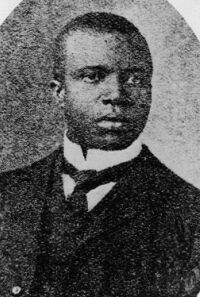
Scott Joplin |
In America, sometime during the Spring, 33-year-old Scott Joplin moves from Sedialia, Missouri, to St. Louis, where the ragtime style of piano-playing is thriving. America has imported many German musicians to lead its musical institutions, and most of them disdain ragtime and other American popular-music forms, but Alfred Ernst, conductor of the St Louis Choral Symphony Society (the major musical institution there), is greatly impressed by Joplin's acute ear, talent as a composer, education, and soft-spoken style. Joplin rapidly gains notice in the city's leading newspapers. His colleagues (other ragtime composers and performers) have little respect for his apparently substandard abilities as a pianist, but he is earning a decent living from royalties paid on his very popular ragtime compositions. |
In May, on the anniversary of Wagner's birthday and just before his own 36th birthday, Strauss completes his 2nd opera, Feuersnot ['fire famine'], with a libretto satirizing Munich's conservative music-lovers, written in Bavarian dialect by the Überbrettl's Wolzogen (also from Munich). The plot:
Bonfires are burning all across medieval Munich during Midsummer's Eve revelry, but amid the fun the people are troubled by a stranger named Kunrad, a sorcerer. Kunrad wants Diemut, the burgomaster's daughter, and he offends her with his erotic approaches. In revenge, she humiliates him, so he uses music for his magic and causes all the fires in the city to go out. Kunrad tells the citizens that the fires can only be relit from "the body of a virgin in heat". Under pressure from everyone, Diemut gives in to him, and her first orgasm relights the fires in a flash.
Kunrad is the pupil of another magician, similarly trounced in Munich, called Reichart der Wagner. Strauss's 1st opera, Guntram, had flopped in Munich.
From May 8 to 17, Zemlinsky composes Ein Lichtstrahl ['a ray of light'], a mime drama with piano accompaniment, for the Carltheater Überbrettl.
On May 18, Alma and her family go to St Gilgen (on the Wolfgangsee) for their summer vacation. Immediately upon arriving, Alma rents a post-office box from which she will have a voluminous private correspondence with Zemlinsky.
At the end of May, Zemlinsky's prospects for the Breslau post fall thru, and he renews his Carltheater contract for the upcoming season.
Doblinger publishes the operettas Das süsse Mädel by Heinrich Reinhardt and Die Landstreicher by Carl Michael Ziehrer. They are hugely successful, and enable Doblinger's owner Bernhard Herzmansky to risk publishing works by contemporary 'serious' composers, including Dohnany, Zemlinsky, and Mahler.
In June, Mahler's publisher Weinberger and printer Eberle and other major Vienna publishers found Universal Edition, the publishing company which eventually takes on all of Mahler's symphonies and much of the work of the '2nd Viennese school'.
In Heidelberg in June, at the 37th Festival of the Allgemeiner Deutscher Musikverein, Richard Strauss is elected president of the association. He puts the focus of the organization on the production of new works.
After recovering from the hemhorrage and operation, Mahler leaves Vienna early to begin his vacation in Maiernigg on June 5, and begins his 5th Symphony, with the 1st movement Funeral March, the stormy 2nd movement (with its big climax), and the monumental 3rd movement Scherzo, which apparently was an earlier idea. Inspired by his near-death experience, and his study of Bach during his convalescence, this work marks a sharp change in style, and the symphony is filled with counterpoint. He also composes 8 songs, including the Rückert Lieder.
In America on 24 June, Harry Partch is born in Oakland [California].
While vacationing in Rapallo, Italy, during the summer, 35-year-old Sibelius begins his 2nd Symphony and completes it at the end of the year in Finland.
During the month of August, Zemlinsky travels widely, visiting Bayreuth to see Parsifal, then Nuremburg and Munich, finally spending the rest of his vacation at Mattsee with his sister Mathilde and Schönberg. Zemlinsky and Alma plan a secret rendezvous in Bad Ischl, but Alma's mother goes there the same day and so they cancel it.
Hedwig Lachmann translates Wilde's Salome into German and it has its first performance in Germany.
In September, 16-year-old Klemperer goes to Frankfurt to study piano at the Hoch Conservatory.
|
Mahler writes to 25-year-old Schlesinger offering him a job in Vienna, and he accepts, becoming once again Mahler's assistant. Dropping his last name on Mahler's advice so that it will sound less Jewish, Bruno Walter (Schlesinger) will remain in Vienna until 1912. |
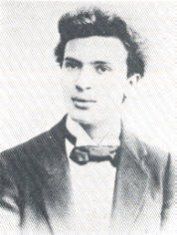
Bruno Walter (Schlesinger) |
31-year-old Oskar Straus becomes conductor for the Überbrettl in Berlin and writes several farces for it.
Zemlinsky resumes his post at the Carltheater in September. Alma's mother finds out about the plans he and Alma had for a secret rendezvous in Ischl, and forbids Alma from seeing him again. Alma threatens suicide, and her mother capitulates.
On September 18, Hoffmannsthal meets with Mahler regarding the production of his ballet collaboration with Zemlinsky, Der Triumph der Zeit, but Mahler, notoriously condescending towards ballet, and finding the symbolism of the text incomprehensible, is not interested. Zemlinsky pushes on with the composition of the music anyway.
On the last day of her vacation, Alma longlingly dreams about having sex with Zemlinsky. The following day, September 25, Alma and her family return to Vienna and move into their new villa on the Hohe Warte. On October 5, Zemlinsky visits her for the first time since May, and their music lessons resume on October 11.
By the fall, Zemlinsky's sister Mathilde is 6 months pregnant by 27-year-old Schönberg. They marry on October 7; thus Schönberg's former teacher becomes his brother-in-law.
On October 14, his 30th birthday, Zemlinsky finishes the short score of his 3-act ballet Der Triumph der Zeit ['the triumph of time']. Act 1 is already orchestrated, and he immediately begins orchestration of acts 2 and 3.
By early November, 22-year-old Alma is totally in love with Zemlinsky. He is becoming irritated with her, probably because she is such a flirt, but she reconciles with him and all is forgiven. At a party the very next day, November 7, she formally meets and finally engages in conversation with 41-year-old Mahler. Alma chastises Mahler for holding on to Zemlinsky's score of Der Triumph der Zeit ['the triumph of time'] for so long without giving the composer a response, and with Mahler criticizing the work an argument develops. Nevertheless, Mahler falls head over heels for her and woos her like a love-crazed schoolboy, sending her an anonymous love-poem. Alma's admiration for Mahler quickly turns to love as he displaces Zemlinsky in her heart. Things move fast. By November 19 she realizes that the poem was by Mahler, and writes in her diary: "Alex von Zemlinsky -- who is he?".

The blue curve indicates one possible route for Mahler's frequent 7.3 km walk home from Alma's house |
While he is courting Alma, after visiting her at her house in the Hohe Warte or dropping her off after their outings, Mahler, an avid walker all his life, usually walks the entire 7.3 km [4.5 mile] distance back to his own apartment in the Auenbruggergasse. |
Julius Korngold and his family move to Vienna in November, where he works at first as a lawyer.
Strauss's opera Feuersnot is premièred under the direction of Schuch in Dresden on November 21.
In Munich a few days later, Mahler conducts the Kaim Orchestra in the première of his 4th Symphony, the first new work of his to be performed since the 2nd Symphony in 1895. Where the public had by now come to appreciate the 2nd, and expected another large imposing work, they are baffled by the smaller scale and 'antiquated style' of the 4th. The critics are almost universally hostile.
The Kaim Orchestra then goes on tour with Mahler's 4th under its regular conductor, Weingartner. At one performance, Weingartner pleads illness, takes a break, and returns to conduct only the finale from Mahler's 4th. Audiences do not know what to make of the work, the tour is a disaster for Mahler's reputation, Mahler breaks his friendship with the conductor, and Weingartner never conducts a Mahler piece again.
On December 1, Schönberg's Songs, op.2 are premièred in Vienna. Schönberg and Mathilde move to Berlin a few days later, where Schönberg begins his job as music director of the Überbrettl; his contract is until July 1902.
Mahler and Alma are secretly engaged on December 7. On the 12th, she tells Zemlinsky that she is in love with Mahler, and on the 16th Zemlinsky bids her a formal farewell. On the 27th, news of the engagement is leaked to the press. Mahler's engagement to Alma abruptly cuts Natalie Bauer-Lechner completely out of his life from this point on.
Mahler conducts his 4th Symphony in Berlin in December, receiving a storm of boos and nasty reviews. His 2nd Symphony is performed in Dresden under Schuch, to warm applause but negative reviews. In Leipzig, Hermann Seemann publishes the first monograph on Mahler, a small book by Ludwig Schiedermair, in his Moderne Musiker series.
According to Alma, around this time she asks Schönberg (who is unaware of her relationship to Mahler) if he will be attending the performance of Mahler's 4th Symphony, and he answers 'How can Mahler do anything with the 4th when he has already failed to do anything with the 1st?'; it will be three more years before Schönberg appreciates Mahler's music.
On December 12, 27-year-old Marconi reports that his radio receiver in Newfoundland (Canada) receives a signal consisting of three short sounds ("dots") representing the Morse Code for the letter "S", which is generated from his transmitter in Poldhu, England. This is the first successful transatlantic radio transmission.
1902
Schönberg's first child, daughter Gertrud, is born in Berlin on January 8.
Mahler's 4th Symphony is published by Doblinger, just before the Vienna première on January 12. Berg, not yet 17, attends and admires the music so much that he manages to steal Mahler's baton, which he keeps as a trophy for the rest of his life.
Alma still fails to recognize the greatness of Mahler's compositions, but since he is chasing her, she is magnetized by his powerful personality, genius as a conductor, and most of all his profound intellectual prowess. Mahler had scheduled a performance of his 1st Symphony for a week later, but replaces it with another performance of the 4th, followed by the second performance of Das Klagende Lied; the newspaper reviews are all negative.
On January 25 in Vienna, 27-year-old Franz Schmidt conducts the première of his 1st Symphony with the Konzertvereinsorchester. Schmidt has been a cellist in the Opera orchestra under Mahler, who is still struggling for acceptance as a composer in Vienna, and the success of Schmidt's symphony causes the press to play him off against Mahler. Partly because of this and partly because of the power which Mahler has vested in his concertmaster Rosé, who doesn't like Schmidt, Schmidt's position in the orchestra becomes difficult. Mahler openly prefers Schmidt's cello playing to all the other cellists, and always assigns the principal roles to Schmidt when he is conducting, but Rosé prefers Buxbaum. Eventually this leads to a confrontation between Schmidt and Mahler, and after that Schmidt sits at the back desk and stays there for the rest of his years with the Opera.
On January 29, Mahler conducts the Vienna première of Strauss's opera Feuersnot. With its ribald humor, the conservative Viennese musical press typically labels it "obscene" and responds negatively. The bad newspaper reviews keep the public away from subsequent performances, and it is dropped after only three productions. Mahler writes to Alma that his involvement with Feuersnot "awakened my productive powers".
30-year-old Zemlinsky, broken-hearted over his loss of Alma, and inspired by Strauss's Ein Heldenleben to compose a large piece for orchestra, begins his "orchestral fantasy" symphonic-poem Die Seejungfrau ['the mermaid'], after Hans Christian Andersen's fairy-tale, at the beginning of February, working on it for a year. Originally sketched as a single large movement, it eventually emerges in a 3-movement form by September.
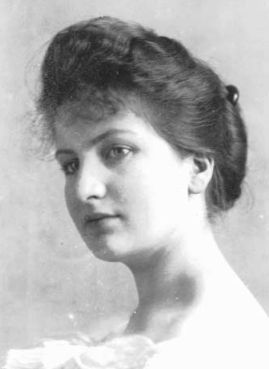
Alma |
Alma's chief ambition is to be a composer, but Mahler tells her bluntly that there will be only one great composer in their house (and guess who that is?...). Alma tries to hold back her tears and accept her fate stoically, but she is heartbroken, and altho she loves him and submits to his demand, she will remain bitter about this sacrifice for the rest of her years with Mahler. At the beginning of February, Alma becomes pregnant by Mahler with their first child. On March 9, Mahler and Alma marry, sealing the fate of her former relationship with Zemlinsky. He accepts the situation stoically, as he too recognizes Mahler's genius and understands Alma's attraction to it, and also because he feels somewhat obligated to Mahler because Mahler expresses a very active interest in Zemlinsky's own work. Mahler and Alma spend 3 weeks in St Petersburg on their honeymoon, where Mahler also conducts 3 concerts. |
After about a year of work, Sibelius completes his 2nd Symphony. On March 8 he conducts the Helsinki Philharmonic Orchestra in the première in Helsingfors [now Helsinki], Finland and is a big success. As with the 1st Symphony, Sibelius will also revise this one after hearing it.
At the beginning of March, 17-year-old Berg gets one of the family's servant girls (Marie Scheuchl) pregnant.
On March 18 is the long-awaited première of Schönberg's Verklarte Nacht in Vienna. Schönberg himself, living in Berlin, is not able to attend, but 18-year-old Webern is there, his family having moved to Vienna. Zemlinsky had shown this score to the critic Max Graf, who claims to have been the first to show it to Mahler, before the break in their friendship in early 1902. Mahler also misses the performance, as he and Alma are on their honeymoon in St. Petersburg, but it is clear that he has indeed seen the score and that it made an impression on him, and he says in a letter that he would have been very interested in hearing the piece.
It is also around this time that Webern first hears Tristan and becomes engulfed in Wagner's musical world; so evidently, Webern began to be influenced by both Wagner and Schönberg at around the same time.
In April, in Berlin, and probably thru Wolzogen, Schönberg meets Richard Strauss, and they become fairly close. Strauss recognizes Schönberg's talent, critiques Verklärte Nacht, and tries to help him earn money.
Debussy's opera Pélleas et Mélisande is premiered in Paris on April 30 -- it rapidly becomes a big success at the box-office.
During the month of May, Zemlinsky and the Carltheater company make a 4-week guest appearance in Dresden. Zemlinsky then visits Mathilde and Schönberg in Berlin.
In June in Krefeld, Mahler finally premières his 3rd Symphony at the 38th General German Music Association festival. This première has been enthusiastically anticipated, the hall is packed, and the symphony is met with a thunderous ovation: this concert is the turning-point in Mahler's career, and really puts him 'on the map' as a significant composer. For a few years after this, rather than having to solicit publications and performances of his works, he will be able to select from the handsome offers of publishers and concert directors.
Over the first of what will be only five happy summers with his new family, Mahler retires to his villa in Maiernigg, and spending the days in his Hauschen [composing-hut], brings his 5th Symphony to completion with the famous 4th movement Adagietto (which, according to Mengelberg, is a love song to Alma), and the 5th movement Rondo-Finale. This work thus finds a unique structural form, and ushers in the triptych of instrumental symphonies of Mahler's 'middle period'.
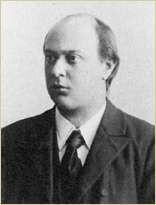
Schönberg |
Schönberg's contract at the Überbrettl theater runs out
in July and is not renewed, probably because Wolzogen himself
has left the theater. Schönberg remains in Berlin anyway, and
Strauss helps him earn money by finding
him jobs orchestrating and copying thousands of pages of operettas.
Now finding the time to begin a large project, Schönberg asks Strauss for advice on an opera text, and Strauss proposes a German translation of Maeterlinck's play, Pelleas und Melisande; apparently both of them are unaware of Debussy's just-completed opera on this text. Probably inspired by Zemlinsky's contemporary work on Die Seejungfrau, Schönberg instead composes a large symphonic-poem on Pelleas und Melisande, which is finished by early next year when he is 28. It is again a long single movement, but this time Schönberg appropriates from Liszt (i.e., the B-minor Sonata) the idea of fusing all 4 traditional movements into a 1-movement form, amalgamating aspects of the other movements of symphonic form (scherzo, adagio, finale) with the first-movement 'sonata-form', something Schönberg will do again in his next two large pieces. |
Pelleas also marks Schönberg's first really adventurous harmonic advances, using:
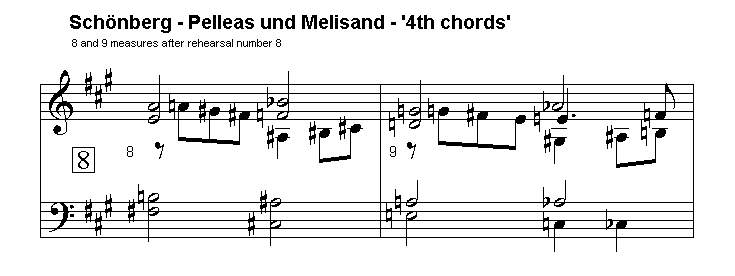
(Click on image to hear mp3)
In 1910, Schönberg will cite this example in his Harmonielehre (although the passage is transposed up one whole-tone, example 330), and write about it:
|
Zemlinsky negotiates a good contract with Theater and der Wien for the upcoming season, but is taken to court by his Carltheater employer and ordered to honor their verbal contract. He spends August with Schönberg, Bodanzky, and Weigl at Altmünster on the Traunsee, and completes the orchestration of the 1st movement of Die Seejungfrau ['the mermaid']. |
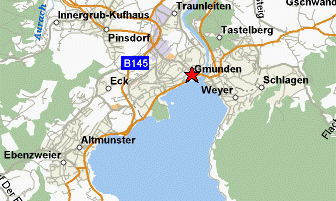
Map of north end of the Traunsee. |
In August, due to Hanslick's influence, Moritz Benedict hires 41-year-old
Julius Korngold to succeed Hanslick as chief music critic of the Vienna
Neue Freie Presse, dashing the hopes Richard Heuberger (the number-two
critic at the paper) had for obtaining the position. While most established
critics, including Heuberger, oppose Mahler's changes at the Opera,
Korngold writes a lead article supporting Mahler, which put Korngold's
name in the public eye from then on. Julius's 5-year-old son Erich
has also by now already learned all the chords in all the keys on the piano,
and begins taking piano lessons and music-theory lessons with
Emil Lamm (a relative), and soon writes his first compositions.
By early September, Zemlinsky completes the short score of his "orchestral fantasy" symphonic-poem Die Seejungfrau ['the mermaid'].
On September 11, Webern composes the song Fromm at his summer home at the Preglhof.
52-year-old Heuberger becomes conductor of the Männergesangverein, and is also appointed professor at the Vienna Conservatory.
Mahler is replaced as conductor of the Vienna Philharmonic concerts by 47-year-old Josef Hellmesberger Jr.
On the recommendation of Strauss, Schönberg obtains a position as teacher of composition at the Stern Conservatory in Berlin. (As far as I know, there is no surviving record of his activity.)
In September, 17-year-old Klemperer also moves to Berlin, following his piano teacher to the Klindworth-Scharwenka Conservatory.
Mahler's early cantata Das Klagende Lied is published in September by Weinberger.
During the fall, Mahler's 3rd Symphony is performed in several German cities.
Mahler and Alma's first daughter Maria is born on November 3.
17-year-old Berg's illegitimate daughter Albine is born on December 4.
On December 16, Alma complains of her loneliness and the loss of her composing.
Lachmann's German translation of Wilde's Salome has a long run in Berlin, by which time Strauss has become inspired by it and has already begun composing an opera based on it.
1903
Bruno Walter and Alma have been trying to convince Mahler of the value of Pfitzner's work. Mahler at least likes Pfitzner's String Quartet, which is performed in Vienna by the Rosé Quartet on January 13.
On February 11, the première of Bruckner's unfinished 9th Symphony is given in Vienna, along with his Te Deum.
On February 18 in Vienna, Ferdinand Löwe conducts Zemlinsky's Drei Balletstücke ['3 ballet-pieces'], which is one of the works Zemlinsky has salvaged from the wreckage of his abandoned project Der Triumph der Zeit ['the triumph of time']. Mahler and Alma are both there, and Mahler likes the piece.
Under the influence of Mahler's new circle of friends via his wife - the artists of the Vienna Secession movement - he becomes receptive to the most avant-garde artistic ideas.
On February 21, Mahler's new production of Tristan und Isolde, in collaboration with imaginative new ideas in scenery, costumes, and especially lighting, by his new stage-director Roller, opens a new era in opera production, becoming ever closer to Wagner's Gesamtkunstwerk ['total-art-work'] concept.
Hugo Wolf dies in the asylum on February 22, just a few weeks before his 43rd birthday.
| Early in the year, Strauss and several other composers form the Genossenschaft deutscher Tonsetzer ['Cooperative of German Tone-Setters'], to keep account of concert performances and pay orchestral composers royalties in the same way opera-composers receive them. Strauss tells Mahler that his membership is essential in getting the organization off the ground, and shows sincere concern for Mahler's financial rights as well. Mahler joins when his membership in the AKM expires at the end of the year. |
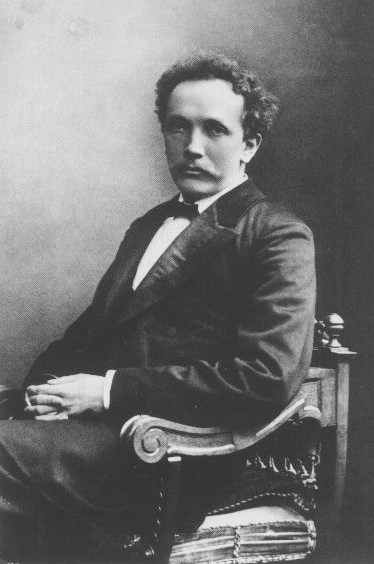
Richard Strauss |
Zemlinsky completes the orchestration of his large "orchestral fantasy" Die Seejungfrau ['the mermaid'] in March. Since August, he has also been sketching a new opera project called Malva, about an old man who leaves his wife for a younger woman, who in turn falls in love with his son. Hoping to interest Mahler in producing it at the Hofoper, Mahler rejects it on April 21, probably seeing the similiarities of its plot to the Mahler/Alma/Zemlinsky situation, and Zemlinsky abandons the project.
On April 10, 19-year-old Webern composes the song Nachtgebet der Braut at his summer home at Preglhof.
In the spring, Schönberg's contract at the Stern Conservatory expires. Knowing he is badly in need of money, Strauss hires Schönberg for himself, to copy the score and parts for his new work Taillefer, for soloists, choir and large orchestra, composed as thanks to Heidelberg University for the festive occasion of conferring on Strauss an honorary doctorate, to be presented in October. Schönberg copies the Strauss piece while he is orchestrating his own Pelleas und Melisande and Gurrelieder.
On May 26, The Vienna Philharmonic elects Hellmesberger over Mahler, 70 to 13.
On May 29, Zemlinsky conducts at the Carltheater for the last time. At the end of the concert season, Zemlinsky also resigns from the Wiener Tonkünstlerverein ['Viennese Tone-Artists Association'], after they refused to play Schönberg's Verklärte Nacht (with Schönberg away in Berlin). Later in the year, Zemlinsky accepts the invitation to become Music Director of a new music-society formed with the intention of sponsoring new music in Vienna, the Ansorge-Verein, named after the composer Conrad Ansorge. The society gives concerts for only one season before folding, and in any case does not fulfill Zemlinsky's hopes.
Around this time, Alma is writing in her diary about nightmares she has, which can clearly be interpreted as an outlet of her feelings of being stifled by Mahler.
| On June 23, in a letter to Schönberg, Zemlinsky cites the Mahler-Roller team at the Hofoper ['court opera'] as the only progressive musical force in Vienna, emphasizes the conservatism of all of Vienna's other musical institutions, and discourages Schönberg from returning to Vienna ... but with little prospect of earning income in Berlin, the Schönbergs see no reason to stay, and decide to return to Vienna in the fall. Schönberg spends the summer in Payberbach, orchestrating his Gurrelieder. In August, he begins working on a string quartet in D-minor (different from op.7) which will remain incomplete; its first movement is a big double-fugue. |
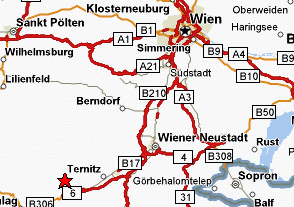
Map of the region south of Vienna |
In July, just after his 39th birthday, Strauss completes his Sinfonia Domestica while vacationing on the Isle of Wight.
Bartok | At the Academy of Music in Budapest [Hungary], 22-year-old Bela Bartók hears Richard Strauss's Also Sprach Zarathustra, and later says that it showed that "there was a way of composing which seemed to hold the seeds of a new life". Inspired by Strauss and Hungarian nationalism, Bartók composes his first major work, the symphonic-poem Kossuth, which honors Lajos Kossuth, hero of the Hungarian revolution of 1848. |
Over the course of another happy summer in Maiernigg, 43-year-old Mahler composes the first 3 movements of his 6th Symphony from June 16 to July 18. About the lyrical second theme of the first movement, Alma says that he tells her 'I wrote you into my symphony'. It seems probable that Mahler got this idea from knowledge of Strauss's Sinfonia Domestica. I believe that here and in each of his subsequent symphonies Mahler portrays himself and his wife in the principal and subordinate themes, respectively, of his first movements, thus personifying the contrast between dramatic and the lyrical in the two main subjects of each symphony.
18-year-old Berg fails his graduation exams. This, together with his unintended fatherhood, prompts him to attempt suicide, but he lives -- given Berg's flair for theatrical drama, it is possible that this is just a call for attention and is not meant to be successful.
At Preglhof for summer vacation after his first year at the University, 19-year-old Webern composes several songs (including Aufblick ['looking upwards'] on August 12, and Sommerabend ['summer evening'] on September 7). In September, he composes Siegfrieds Schwert ['Siegfried's sword'] for voice and orchestra on a poem by Uhland.
| In August, Schönberg and Mathilde leave their summer retreat in Payberbach and return to Vienna (according to some sources, sharing housing with the Zemlinsky family for a time to save money), renting an apartment near the Zemlinskys at Liechtensteinstrasse 68-70 in the 3rd District. Alexander Zemlinsky gets his own apartment on the same floor of the same building shortly after. Eugenie Schwarzwald offers to let Schönberg teach in her school free of charge, and Schönberg begins his long teaching career in earnest, holding harmony and counterpoint classes in Schwarzwald's school. Mainly due to the Strauss's influence, Schönberg is awarded the Liszt Foundation fellowship. |
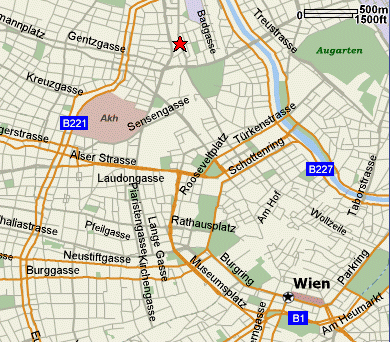
the red star designates the Schönberg and Zemlinsky apartments at number 68. |
In mid-September, Alma becomes pregnant by Mahler with their second child. Mahler puts the finishing touches on the score of his 5th Symphony and sets a fee of 10,000 gulden for its publication by Peters.
In late September, Hellmesberger is involved in a widely-publicized scandal with a young girl, resigns from his post with the Vienna Philharmonic, and is dismissed from the Vienna Opera.
In October, 29-year-old Schönberg's work is published for the first time: the 2 Songs, op.1 and 4 Songs, op.2, by Verlag Dreililien in Berlin, a publishing-house started by the Mahler-admirer and critic Max Marschalk.
From October 18 to 23 Mahler stays with Mengelberg in Holland, for the Amsterdam première (and its repeat the next day) of his 3rd Symphony. He rightly feels that Amsterdam is the first place where people really admire his work, and it becomes the earliest center of Mahler enthusiasm.
Hofmannsthal's German version of Sophocles's Electra premières at Max Reinhardt's Kleines Theater in Berlin on October 30. It is possible that Strauss sees it around this time (we know for certain that he attends a performance in 1905.)
On November 10, the first performance of the revised version of Sibelius's 2nd Symphony is given in Stockholm (Sweden).
In Vienna, Webern composes the songs Heimgang in der Frühe on November 21 and Der Tod on the 24th.
Between November and May, Schönberg composes several songs that will appear in later collections:
Mahler's 4th Symphony is performed with Julius Buths conducting in Düsseldorf.
On December 28, John Louis Neumann is born in Budapest (Hungary, at that time part of the Austro-Hungarian Empire). (A decade later his family will be granted nobility status, and after emigrating to America as John von Neumann, he will play a decisive role in the evolution of the first electronic digital computers ENIAC and EDVAC.)
1904
In America in January, when Harry Partch is 21/2 years old, his father Virgil begins his new appointment as Immigration Officer in Tucson [Arizona], and moves the family there.
Zemlinsky begins composing the music for his 3rd finished opera, Der Traumgörge, which will not be completed until October 1906.
Early in the year, Bartók hears a beautiful folk melody being sung by a Transylvanian servant girl, and noticing how the notes of this song are different from the familiar "Gypsy" music he has known as "folk music", it sparks his lifelong interest in folk music.
On February 17, the first version of Puccini's opera Madama Butterfly is premiered at the Teatro alla Scala in Italy. He will go on to revise it several times, making four subsequent versions.
In early March, Schönberg's Verklarte Nacht is performed for the second time in Vienna, by the chamber group headed by Arnold Rosé, Mahler's concertmaster and brother-in-law. According to Max Graf, Mahler had seen and admired the score in 1902; Rosé, recognizing the quality of Schönberg's music, invites Mahler to the rehearsals, and Mahler is very impressed.
Mahler will support Schönberg's work from now until practically his last breath, even including the first atonal pieces which are beyond his understanding. I speculate that Mahler's feelings for Schönberg run so strong partly because Schönberg is only a year younger than Mahler's brother Otto, who according to Mahler was a talented composer, and who had killed himself 9 years before; it seems possible that Mahler transferred his ambitions for Otto to Schönberg upon meeting the latter and learning his work; together with Walter, who is slightly younger, the pair of musicians provide the outstanding composer/conductor Mahler was himself, and had hoped to see reproduced in his younger brother.
Strauss goes on his first concert tour of North America, conducting the world première of his Sinfonia Domestica in New York at the end of March.
Later in March, Schönberg begins his Sketchbook I with a String Quartet in D-minor (different from op.7), the Orchestra Lied op.8 "Der Wappenschild", and the piece which he will eventually officially call his 1st Quartet, op.7. He eventually abandons the un-numbered D-minor Quartet, but will work on the 1st Quartet on and off for the next year and a half. Underlying the work is a "secret program" which describes not a story-line but rather a succession of moods. In April, his 6 Songs, op.3 are published by Dreililien. He is awarded the Liszt foundation fellowship for the second time.
Also in April, Zemlinsky composes a song for the Ansorge-Verein (Über eine Wiege), his only piece for that society, and leaves it soon after. After the demise of the Ansorge-Verein, Zemlinsky's main goal is to obtain performances of two large orchestral works: his Die Seejungfrau and Schönberg's Pelleas und Melisand. Schönberg, Zemlinsky, Walter, Karl Weigl, and other leading members of the Viennese avant-garde seek out wealthy patrons, and form the Vereinigung Schaffender Tonkünstler ['Union of Creative Tone-Artists'], modelled after the Secession, and name Mahler as honorary President; despite initial promise, it will last only the one concert season 1904-05.
For the next three years, until Mahler's departure from Vienna in 1907, Schönberg and Alma's ex-boyfriend Zemlinsky visit together regularly at Mahler's house. The evenings begin cordially, but in musical discussions afterwards tempers flare, and the argumentative and headstrong Schönberg, who has not yet come around to appreciating Mahler's own compositions, repeatedly causes both of them to be banished from the house because of his disrespect for the master's opinions. Still, Mahler must be intrigued by the force of Schönberg's logic, because inevitably after a few days pass, he asks Alma "What ever happened to those two?", and she promptly invites them back.
During one of these conversations with Schönberg, Mahler laments the loss of meantone as an intonational paradigm in European music:
"The loss of ... distinctive key coloration, which transforms the fixed pitch music of this [earlier] period with subtle coloristic distinctions impossible to imagine until one has heard them, is the great loss we have suffered in changing from meantone to the equal intervals and indistinguishable keys of equal temperament."
This provides the only clue outside of the actual notation used in his scores (much of which has now been "simplified" by editors) as to Mahler's intentions regarding the tuning of his music. It must be remembered that he wrote almost exclusively for the orchestra, which has flexible intonation, and the frequent occurence of "double-sharps" in his sketches may imply that he was often thinking in meantone rather than in 12-edo. (see Yates 1964 and Yates 1990)
54-year-old Heuberger becomes music critic of the Neue Musikalische Presse.
23-year old Bartók has the premières of his symphonic-poem Kossuth in Budapest and Manchester, and begins a a career as a pianist. He composes Piano Quintet and two showpieces in the style of Liszt, Rhapsody, op.1 and Scherzo (Burlesque), op.2. He also makes his first transcription of Magyar folksongs, realizing that this is the true folk-music of Hungary, and not the gypsy-like music that Liszt had incorporated into his popular compositions.
20-year-old Webern has been composing a lot of songs, and on the advice of Guido Adler, his University teacher, he and Jalowetz go to Berlin to meet 35-year-old Pfitzner for the possibility of taken lessons. When Pfitzner disparages Mahler's music, Webern leaves in a rage, and Adler's second recommendation is Schönberg.
Over the summer Webern drafts two large movements for orchestra, which remain incomplete, and composes an orchestral tone-poem, Im Sommerwind ['in the summer-wind'], his last and most significant composition before studying with Schönberg.
In June, Mahler and Alma's second and last child is born, their daughter Anna.
Alma is complaining in her diary of her boredom as "Frau Direktor"; otherwise, they have another blissful summer vacation, and Mahler composes a lot:
several lieder for the song-cycle Kindertotenlieder ['songs on the death of children'], which alarms Alma, considering their own two young children; the 6th Symphony is completed with the Scherzo, where Alma says he portrays in the trio his two daughters playing in their sandbox, and its huge tragic 4th movement, with its bold harmonic experiments; and the two Nachtmusiken ['night musics'] which will become the 2nd and 4th movements of his 7th Symphony.
Alma is troubled by the gloomy despair she hears in Mahler's 6th Symphony, with its 'three blows of fate, the last of which fells the hero', as Mahler described the last movement, composed during a time of such outward happiness. Indeed, this symphony will be nicknamed the Tragic, and again, will seem to be prophetic of the events in Mahler's life in 1907.
Regarding a government move to reorganize the Vienna Conservatory, which has suffered from bad management, Mahler's friend Guido Adler, the great musicologist who is also sympathetic to modern developments in music, endeavors to reform the institution, bringing Schönberg and Zemlinsky in as teachers, and to have Mahler appointed General Director of a board overseeing all Viennese pedagogical establishments. Aware of the growing anti-Semitism in Vienna and Mahler's increasing dissatisfaction with his job, Adler works on these plans for the next three years, in hopes of keeping Mahler in Vienna in the event that his position at the Opera comes to an end; as a result of political changes, the plan will eventually come to nothing.
In July, Schönberg sets aside his work on the first section of the 1st Quartet, to finish the 6 Orchestral Songs, op.8.
In August, the influential critic and teacher Eduard Hanslick dies in Vienna at age 78. While Hanslick had been an anti-Wagnerian and not fond of Mahler's compositions, he admired Mahler's abilities as conductor and director, and his influence was so important to getting Mahler the job in Vienna that I suspect that perhaps his death during the composition of the 4th movement of Mahler's 6th Symphony may have caused Mahler to emphasize the tragic aspects of this music and conclude the piece in that mood, as a sort of tragic memorial to Hanslick.
In America in August, Virgil Partch is moved 50 miles [80 km] east of Tucson to a new appointment in Benson [Arizona], which has become a fairly rowdy "railroad town". This is the location of Harry Partch's earliest memories.
Reger joins the Vereinigung Schaffender Tonkünstler ['Union of Creative Tone-Artists'], and the plans to include his String Quartet in D-minor, op.74 on a Union concert may have an influence on Schönberg when, later in the year, he returns to the composition of his own 1st Quartet, op.7 (in the same key) in his Sketchbook I, sketching the scherzo theme, then continuing work on the first section. [Frisch 1993, p 202 and 211-216]
7-year-old Erich Korngold begins school in the fall, and also writes down his first compositions.
In the fall of 1904, Schönberg, now 30, begins teaching private lessons, taking on as his first students Webern, Jalowitz, Berg, and Stein. Webern and Berg will prove to be the most talented of all of Schönberg's pupils, and the three of them will ackowledge that together they took part in the break away from tonality.
In September, a pocket study score of Mahler's 5th Symphony is published by Peters. Later that month, with the Vienna Philharmonic, Mahler has two reading rehearsals of the work, which Schönberg and Zemlinsky attend. Realizing that his 'new style demanded a new technique', Mahler heavily revises the orchestration; these changes are included in the full score and parts published in November, but the early printing of the pocket score leads to some confusion in subsequent editions.
Mahler travels to Köln [Cologne] in mid-October for the world première of his 5th Symphony on October 18. Alma is supposed to meet him later but gets sick and stays home. Unfortunately, the 5th is such a failure at the festival that Peters, who published it, refuses to publish anything else by him. Immediately after this, Mahler continues on to Holland, to conduct the Amsterdam première of his 4th Symphony -- which is so successful that it is played twice -- and also two performances of his 2nd Symphony.
|
On October 15, Schönberg begins teaching a 4-hour harmony/counterpoint
course from 5:00-9:00 in the evenings at the Girl's Gymnasium in central Vienna
(Wallnerstrasse 2, I District.), basing his course
on Bellermann's 1862 counterpoint treatise Der Contrapunkt
(most likely the 4th edition published in 1901). [Monson 1979, p. 27]
The material in Bellermann's Chapter 2 apparently leads Schönberg to accept the overtone series as a reasonable explanation for the basis of musical harmony, and to formulate his important ideas about consonance and dissonance being "different in degree, not in kind". During the time that he teaches this class, Schönberg resumes work on the first half of his 1st String Quartet. |
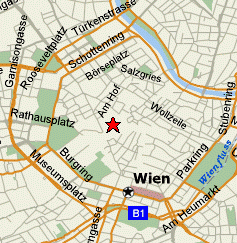
site of Schönberg's music-theory classes. |
On October 18, 19-year-old Berg becomes an apprentice accountant in the service of the Austrian government, and just after, begins taking lessons with Schönberg.
On November 6, Walter Damrosch conducts the American première of Mahler's 4th Symphony in New York.
In England, shortly before his 55th birthday in November, and working for the Marconi Company to improve transatlantic radio reception, physicist John Ambrose Fleming files a patent for the "oscillation valve" now known as the Fleming Valve, a two-electrode diode which is the first thermionic vacuum tube, which ushers in the age of electronics. His vacuum-tube diode will be used for decades, until being superceded by transistors in the 1960s.
On November 23, at the first Vereinigung Schaffender Tonkünstler ['Union of Creative Tone-Artists'] orchestral concert, Strauss's Sinfonia Domestica has its Vienna première. Strauss was supposed to conduct it, but Mahler, as honorary President of the Union, does it instead. I believe that Mahler's reception of the Domestica has a powerful influence on his subsequent compositions, especially the very next one (his 7th Symphony, particularly the 1st movement).
On December 12, Schönberg, Zemlinsky, and pupils from Schönberg's class attend the final rehearsal of Mahler's 3rd Symphony, and are all swept away and finally recognize Mahler's genius. Schönberg becomes so enthusiastic about Mahler's work that he says later that in his admiration he felt 'like a schoolgirl'. For the rest of his own long life, Schönberg will hold Mahler in the greatest esteem.
1905
On January 27, at the second Vereinigung Schaffender Tonkünstler ['Union of Creative Tone-Artists'] orchestral concert in Vienna, Zemlinsky conducts the première of his symphonic-poem Die Seejungfrau ['the mermaid'], a fantasy for orchestra after Hans Christian Andersen's fairy-tale, and on the same concert, the inexperienced Schönberg conducts the première of his symphonic-poem Pelleas und Melisande. Mahler is president of the society, and at his insistence, the pieces are presented without their written programs, leaving the audience to judge them purely as absolute music; thus neither the audience nor the public suspect the personal tragedy which underlies Zemlinsky's score, but his is far preferred over Schönberg's.
Busy with his duties at the Opera, Mahler misses the première but attends the final rehearsal on the 25th and follows Pelleas with the score; he also tells Alma to invite Schoenberg to his house and has him bring the score of Pelleas. Mahler already admits to having some difficulty comprehending the complex and not always harmonious counterpoint, but nonetheless continues to champion Schönberg's cause.
A few days later, the Union has a lieder concert scheduled for the 29th which premières Mahler's Kindertotenlieder. The concert is sold out, and so tickets are also sold for the public to attend the final rehearsal on the 28th. It is a huge success for Mahler. The concert is repeated a few days later on February 3, and Mahler is so pleased that he gives a banquet afterwards for the Union musicians, consisting mostly of Schoenberg's pupils; 21-year-old Webern meets Mahler there.
Pelleas requires a huge orchestra, and both Schönberg's and Zemlinsky's symphonic-poems demanded extra rehearsal, so as with the earlier Polyhymnia society, one big project is enough to bankrupt the association. After a few more concerts of chamber-music during the spring, notably featuring pieces by Bruno Walter (which, Mahler confided to Alma, were weak), the third planned orchestral concert of the Vereinigung has to be cancelled, and the Union folds after this single season, from lack of further financial support.
In February Nikisch conducts Mahler's 5th Symphony in Berlin, in a performance not liked by Mahler.
On February 18, 22-year-old Lilienfeld, who will later publish the first concept of the Field-Effect Transistor, obtains his PhD degree.
In St. Petersburg (Russia), in the midst of the 1905 Revolution, students at the Conservatory begin protests. Rimsky-Korsakov sides with the students and is dismissed after 35 years teaching there, but continues teaching at his home. 22-year-old Stravinsky begins studying with him until Rimsky-Korsakov's death in 1908, and considers Rimsky-Korsakov his "second father".
In March Mahler seeks a visit from Oskar Fried, in Vienna to see Franz Schalk conduct a performance of Fried's choral work Das trunkene Lied ['the drunken song' - settings from Nietzsche's Also Sprach Zarathustra]. Mahler finds Fried's artistic ideas very compatible with his own, and wishes Fried to conduct future performances of his symphonies. Also this month, Mahler conducts his 5th Symphony in Hamburg, and the work receives its American première with the Cincinnati Symphony conducted by Frank van der Stucken.
By late April, Schönberg has completed the draft of the first half of his single-movement 1st Quartet, up to the Trio of the Scherzo (having finished Sketchbook I on April 20 and continuing his draft at the beginning of Sketchbook II). [Frisch 1993, p 202] This piece makes extensive use of the "whole-tone scale" (= 6-edo), and its tonal contrasts are not those of different keys as much as those between tonal and atonal passages.
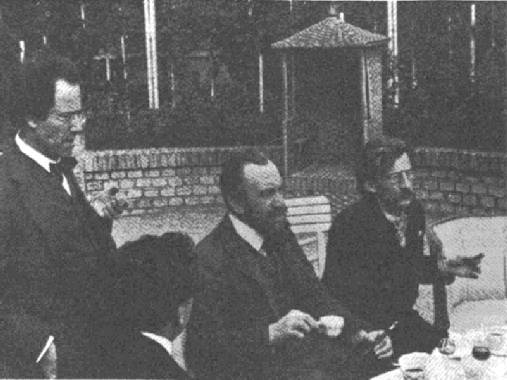
Mahler, Moll, Pfitzner and others, |
In April, around Pfitzner's 36th birthday, Mahler conducts the Vienna première of Pfitzner's opera Der Rose vom Liebesgarten ['the rose in the love-garden']. Initially unreceptive to Pfitzner's opera, Mahler is eventually convinced of its merits by Alma and Bruno Walter, who both admire Pfitzner's work. Mahler also takes a liking to Pfitzner's String Quartet, which is dedicated to Alma. Pfitzner is only one in a long line of men who are enchanted by Alma's beauty and intelligence, even while she is married to Mahler. |
At the end of April, during his Easter vacation in Abazzia [now Opatija, Croatia], Mahler writes out the fair-copy manuscript of his 6th Symphony.
In May, Mahler's 5th Symphony and Strauss's Sinfonia Domestica are teamed up at a Strassbourg music festival. Exposed to the Domestica for the second time, I believe Mahler's interest in the Strauss piece is a big influence on the rest of his 7th Symphony, most of which he composes in the following months. Mahler also hears Strauss play and sing his new opera Salome in a piano store, and he is deeply impressed, and begins campaigning to have the première given in Vienna; he will be unsuccessful in this because of the conservatism of Austrian royalty.
Also in May, after many delays, Schönberg's Verklärte Nacht, op.4 is finally published, by Dreililien. (Pelleas und Melisande is tagged as op.5, but Marschalk does not accept it for Dreililien, and it will not be published until 1912 by Peters.) When the music-theory class he has been teaching concludes on May 15, Schönberg works on completing his 1st String Quartet over the summer.
The Allgemeiner Deutscher Musikverein [general German music association] Festival is held June 1-4 in Graz and June 5-7 in Vienna. At the opening concert, 13 of Mahler's songs are performed and are very successful, leading to a generous offer from Kahnt to publish the 6th Symphony for 30,000 kronen (nearly his annual Opera salary), which Mahler readily accepts, signing the contract on July 15. [La Grange 1999, p 219]
In June, in a letter to Alma Mahler, 33-year-old Zemlinsky first announces his engagement to marry 24-year-old Ida Guttmann, younger sister of his former girlfriend Melanie, whom he had been seeing just before his involvement with Alma in 1900-1901.
|
Physicist Albert Einstein, working as a clerk in a Swiss Patent Office,
publishes several papers expounding his Special Theory of Relativity,
a momentous discovery which will change science.
Einstein, an amateur violinist, had this to say about his theory: "It occurred to me by intuition, and music was the driving force behind that intuition. My discovery was the result of musical perception." |
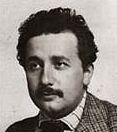
Albert Einstein |
After Schönberg finishes his 1st Quartet that summer, he begins a choral piece Georg von Frundsberg, and a String Quintet, both of which are left unfinished.
During Pentecost holiday in June, 21-year-old Webern and his cousin Wilhelmine fall in love with each other (which will eventually lead to their marriage). Under this inspiration, Webern composes a Langsamer Satz [slow movement] for string quartet. Then after leaving Vienna for summer vacation in Preglhof, and melancholy over his separation from Wilhelmine and inspired by a painting of Segantini, he writes a much larger String Quartet in one movement in July. This quartet has a climactic section, which occurs twice, that is really impossible to analyze in terms of keys: still a lot of late-romantic rhetoric in the style, but the ultra-chromatic counterpoint produces chords with clashing notes that cannot be analyzed in terms of traditional harmony. Recalling the criticisms about Mahler's 2nd and Schönberg's Verklarte Nacht, one might say that this Webern quartet sounds like Tristan on acid... good stuff. In some places this Webern piece is far more advanced harmonically than Schönberg's quartet of the same period.
Also during this summer, Mahler composes the 1st, 3rd, and 5th movements of his 7th Symphony, completing the draft score on 15 August. These movements are full of brazenly dissonant polyphony and chords, and melodic passages using successive '4ths'. It is clear that his familiarity with Schönberg's experiments has emboldened Mahler to stretch his naturally progressive tendencies even further. This symphony has had a difficult reception from audiences since the beginning; Mahler experienced considerable difficulty finding a publisher for it, and to this day, the 7th is still the least popular of all his works (and, I think, unjustly so).
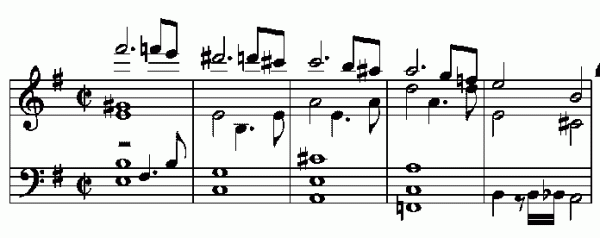
Mahler 7th Symphony, 1st movement, m.531-535: motto in rising 4ths near the end
The themes of the 1st movement of Mahler 7th Symphony seem to me unmistakably to be inspired by the idea of making sonic portraits of himself, his daughter Maria, and wife Alma -- a concept which undoubtedly Mahler got from his familiarity with Strauss's Sinfonia Domestica.
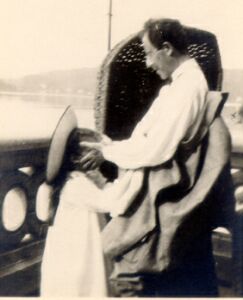
|
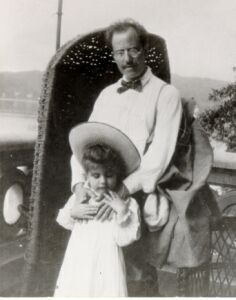
|
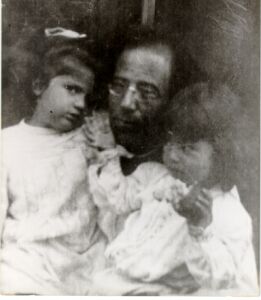
|
Mahler also makes a revision of the 4th Symphony.
His 2nd Symphony is performed in Düsseldorf under
Julius Buths at the Lower Rhine Music Festival.
In Berlin, the firm of Gose & Tesslaff publishes a monograph on Mahler by Richard Specht in its Modern Essays series.
20-year-old Klemperer switches to the Stern Conservatory in Berlin, and studies composition with 36-year-old Pfitzner.
Schönberg takes on Wellesz as a pupil. During September and October, he composes several of the 8 Songs, op.6:
During late October and early November, Schönberg also drafts a programmatic piano quintet called Ein Stelldichein ['a rendezvous'], based on a Dehmel poem, which will remain incomplete.
In Berlin sometime in the fall, Strauss sees Max Reinhardt's production of Hofmannsthal's Elektra, immediately recognizes the similarities with Salome, and the dramatic possibilities, and decides to write an opera on it. (It is possible that Strauss had already seen it in late 1903, when it opened.)
November 8 brings a performance of Mahler's 2nd Symphony in Berlin, with Fried conducting and Klemperer directing the offstage instruments. Mahler goes to Berlin, sees the dress rehearsal, tells Fried that his tempi were all wrong, complains to Klemperer of the incorrect dynamics, and goes over the work in detail. Fried will eventually go on to make the first complete recording of a Mahler symphony, with this work (the 2nd), in 1924.
When Klemperer seeks advice from Fried on how to get Mahler's attention, Fried tells him to focus on Mahler's own creative work -- so Klemperer writes a 2-hand piano arrangement of Mahler's 2nd Symphony (never published and now lost).
Also in Berlin, Nikisch conducts the Philharmonic with Friedrich Weidemann singing in Mahler's Kindertotenlieder, again not to Mahler's taste.
On November 9, Mahler makes player-piano recordings of three of his songs, including the finale of the 4th Symphony, and the 1st movement funeral-march of the 5th Symphony, at the Welte-Mignon comany in Vienna. They are the only reproducable recordings that Mahler ever made of his work as an interpreter.
Mahler had hoped to give the world première of Strauss's Salome in Vienna, but on December 9, Schuch conducts the première in Dresden. The critics are negative, but the opera is wildly successful with the public and performers. Mahler's heroic efforts to have the work performed in Vienna are crushed by the censor, and Salome will not appear in Vienna until 1918, long after Mahler's death.
Also in December, Mahler conducts the Vienna première of his own 5th Symphony. The audience is quite receptive, but the newspaper critics give it extremely negative reviews.
Around Christmas-time, Mathilde Schönberg becomes pregnant with their second child. Inspired by his happy feelings, 31-year-old Schönberg begins his Kammersymphonie [Chamber Symphony]. (In the first edition of his Harmonielehre, written in 1910, Schönberg will characterize the main opening horn theme as "stürmisch und aufwärtsstrebend" ['stormily and upward-striving'], in the revised edition of 1922 as "stürmischer Jubel" ['stormy rejoicing'].)
Schönberg's Kammersymphonie [Chamber Symphony] is saturated (perhaps more than any other piece in musical history) with the "4th-chords" which he had first tentatively used in Pelleas und Melisande (see above, 1902). In 1910, he will write in his Harmonielehre, after describing the instance in Pelleas:
[music example 331]
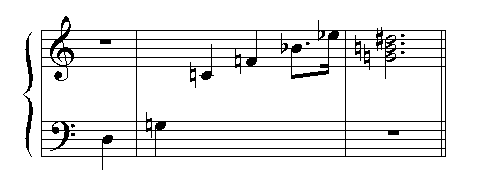
Invented as a stormily upward-striving horn theme, they spread themselves out architectonically over the whole piece, and place their stamp on everything that happens. Thus it turns out that they do not appear here merely as melody or as a purely impresssionistic chord effect; their character permeates the total harmonic structure, and they are chords like all others. [Monzo translation of Schönberg 1911, p 450-451; adapted from Schoenberg 1978, p 403-404]
The earliest sketch of Kammersymphonie opens with a cadence on E, whereas the final version of this beginning cadences on F; Frisch maintains that eventually Schönberg pitted the juxtaposition of F against E as the main tonal basis of the piece; this seems to me too similar to the characteristic cadences in the 1st movement of Mahler's 7th Symphony to be a coincidence. For this and other reasons (chiefly having to do with similarities in intricate details of formal structure, and the prevalence of the "4th-chords"), I suggest that Schönberg was rather more familiar with Mahler's work of the previous summer on that 1st movement than he later admitted (see below, 1909).
All in all, a real banner year for modern music in Vienna.
1906
Early in the year, Strauss approaches Hofmannsthal about using his version of Elektra for an opera.
Universal Edition issues a series of reprints of all of the Mahler symphonies now in its catalog, republishing the 3rd and 4th in January, the 2nd in April, and the 1st in May. Mahler's 6th is also published in March by Kahnt.
In February, Wilhelm Gericke conducts the Boston Symphony in performances of Mahler's 5th Symphony in Boston, Philadelphia, and New York. The newspapers report good performances but very mixed receptions from the audience.
In America, in the early morning hours of 18 April, a strong earthquake occurs in Northern California, and the earthquake and resultant fire practically destroy the city of San Francisco. Because New York banks send a lot of financial aid to San Francisco, it also becomes one of the factors which precipitate the financial crises of the next year (see below, 1907).
24-year-old Richard H. Stein uses quarter-tones in the cello part of his Zwei Konzertstücke, op.26 for cello and piano, the first quarter-tone piece published in the European tradition.
In April Schönberg, having used up all the pages in his Sketchbook II, continues work on his Kammersymphonie [1st chamber symphony] at the beginning of Sketchbook III with the strangely beautiful lyrical theme. Schönberg has apparently either heard about, or seen the score of, Stein's Konzertstücke, because on the very first page of the sketchbook, there is a "Bezeichnung für die Vierteltöne" ['notation for the quarter-tones'] accompanied by a sketch of notes descending by quarter-tones from C to B-flat and then back up again, in which Schönberg uses the "greater-than" and "less than" mathematical symbols to represent 1/4-tone deviations from 12-tone equal-temperament by having the open end of the symbol point towards the higher pitch which comes either before or after the quarter-tone. This is not really a systematically logical way to use these symbols as accidentals, and may perhaps be the reason why he abandoned the idea. [see more on this below under "1909"]
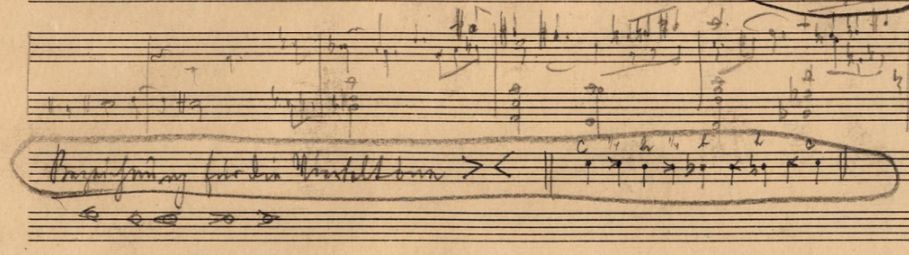
Schönberg's Sketchbook III,
first page, showing the "notation for the quarter-tones" encircled
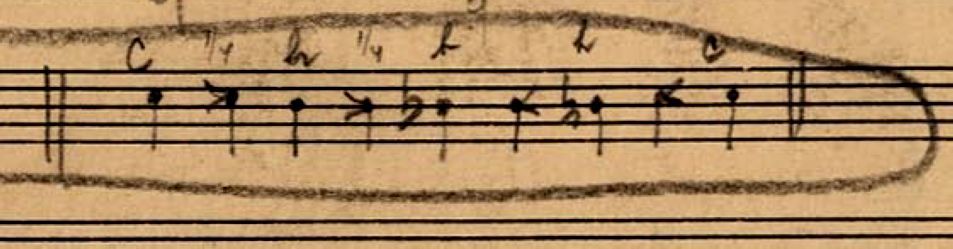
close-up view of Schönberg's notation of a portion of a quarter-tone scale,
descending c : (C-1/4) : h[=B] : (B-1/4) : b[=Bb], ascending b[=Bb]: (B-1/4) : h[=B] : (C-1/4) : c.
(click on the graphic to play an mp3 audio file)
Also in June, Webern graduates from the University with his Doctorate in Musicology, having studied mainly under Guido Adler. His dissertation is on the Choralis Constantinus of Dutch Renaissance composer Heinrich Isaac.
During his last joyful summer vacation in the Alps, and at the peak of his life as composer, conductor, opera director, husband, and father, Mahler composes his stupendous 8th Symphony (beginning of Part 1, beginning of Part 2) in a tremendous 6-week burst of inspiration. Mahler writes in a famous letter to Mengelberg:
... Try to imagine the whole universe beginning to ring and resound. These are no longer human voices, but planets and suns revolving.
And to Richard Specht, he said about the 8th:
All my earlier symphonies are only preludes to this one. In the other works, everything is subjectively tragic -- this one is a great bestower of joy.
Also on vacation in the mountains during the summer, 31-year-old Schönberg finishes his Chamber Symphony, which explores the outer reaches of tonality, and about which Webern wrote:
[Webern]
It made a colossal impression. I'd been his pupil for three years [sic: it had really been two], and immediately felt, 'you must write something like that too!'. Under the influence of the work I wrote a sonata movement the very next day. In that movement I reached the farthest limits of tonality. ... Both of us sensed that in this sonata movement I'd broken thru to a material for which the situation wasn't yet ripe.
Webern is obviously very inspired and begins several different pieces, for both piano and string quartet, and finishes a number of them; it is difficult to determine which one he was describing in the above statement. One possible candidate is a piece entitled Sonatensatz [sonata movement].
In August, hard on the heels of his 1st Chamber Symphony, Schönberg begins and composes much of a 2nd Chamber Symphony, which he will work on intermittently while also beginning the composition of the 2nd Quartet, whose first theme's rhythm has a curious resemblance to the Webern Sonatensatz referred to above. Schönberg will eventually lay aside 2nd Chamber Symphony in favor of finishing the Quartet, and not complete it until 1939 in America.
Also in August, and despite Alma's story about Mahler's revulsion from Nietzsche, a newspaper interview given by Mahler (published after his death) clearly illustrates his continuing reverence for at least some aspects of the philosopher's work.
In America, on August 27, the day after his 33rd birthday, Lee de Forest files a patent for the 2-electrode version of his "Audion", which adds a control grid to the Fleming Valve.
Schönberg's second child, son Georg, is born on September 22.
In the same month, Webern's mother dies. This event has a profound effect on Webern, and will haunt him for the rest of his life -- Webern claims that all his subsequent music is written in memory of her.
In October, Fried conducts Mahler's 6th Symphony in Berlin.
In Vienna in October, Zemlinsky finishes (after nearly 3 years) his 3rd opera, Der Traumgörge.
Also in October, Berg is able to quit his job and devote his life to music, because some real estate inherited by his mother provides the family with an income. He attends six performances of Strauss's Salome.
Schönberg meets a young artist named Gerstl and he and his wife both take painting lessons. (Note that while Gerstl is 9 years younger than Schönberg, their birthdays are only one day apart.)
In December, a series of strokes incapacitates Cosima Wagner, leaving her unable to run the Bayreuth Festival.
While in America, Busoni learns of Thaddeus Cahill's Telharmonium, a forerunner of the synthesizer. This is an electric instrument which is capable of dividing the pitch-continuum in any desired way. It is a big inspiration to Busoni, who, after returning to Berlin, writes his little book Sketch of a New Aesthetic of Music, in which he speculates on the most progressive musical ideas. In it, he examines possibilities for over a hundred new scales which are different from the traditional major and minor, and also proposes 36-tET as a new tuning giving a mixture of two scales of '1/3-tones' a semitone apart. The book is published in January 1907 by Trieste publisher Schmidl, printed in Berlin, and distributed by Busoni himself.
1907
Mahler conducts the Vienna première of his 6th Symphony on January 4, the last time he conducts that work. Having visited Breslau, Munich, Brünn, and Graz (twice) at the end of 1906 to conduct his own symphonies, Mahler asks for 2 1/2 weeks leave from January 6 to 23 to give further performances, and conducts his:
These extended absences are the catalyst for a heated campaign against Mahler in the Viennese press while he is gone, which will contribute to his decision to resign from the Vienna Opera later in the year. |
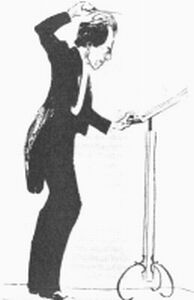
Mahler conducting |
|
In America on January 29, 33-year-old Lee de Forest files a patent for the 3-electrode version of his Audion, which eventually develops into the triode and is instrumental in long-distance telephone and radio communication, radar, and early digital computers of the 1930s and 1940s. In February he is making experimental radio transmissions, including music produced by Thaddeus Cahill's telharmonium (see 1897), throughout the New York City. |
1906 Audion triode vacuum tube
(click the image to download a PDF of the patent)
|
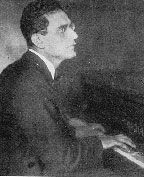
Otto Klemperer | While Mahler is in Berlin, 21-year-old Klemperer gets a chance to spend some time with him by showing him the way to Strauss's home. In the spring, while visiting Vienna on tour, Klemperer gets a recommendation from Mahler which 'will open all doors for me', and he keeps it in his wallet for the rest of his long life. On Mahler's recommendation Klemperer is appointed chorus-master and subsequently conductor at the Deutsches Landestheater in Prague, making his debut with Weber's Der Freischütz. |
| Schönberg begins painting seriously at the beginning of the year. In January, his 8 Songs, op.6 are published by Dreililien. The Rosé Quartet premières his 1st Quartet in Vienna on February 5, and his Chamber Symphony on February 8. A few weeks later, the 1st Quartet is published by Dreililien as his op.7. The concerts provoke two of the most notorious scandals in Viennese concert history; at both of them Mahler loudly applauds amid the booing and hissing, and nearly gets into a fistfight. |
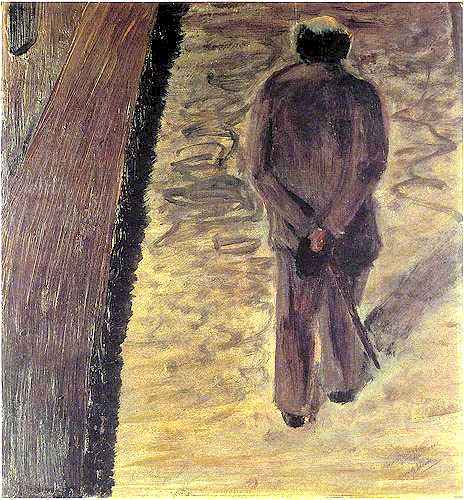
Self-portrait from behind,
|
Mahler confesses to Alma after the Chamber Symphony performance that he himself can no longer follow Schönberg's development. He blames it on his 'old age': 46 years. Mahler had gotten into an argument with Schönberg at one point over whether or not it was possible to create a Klangfarbenmelodie ['melody of tone colors (timbres)'] by constantly shifting the orchestration of a single note; Schönberg was to carry out this idea in 1909 in the third of his Funf Orchesterstücke. With this dispute in mind, Mahler's remark about being too old to have an ear for Schönberg's music was perhaps referring directly to his loss of the ability to hear high frequencies, due to aging and daily exposure to the volume of 100-piece orchestras. In any case, the logic in Schönberg's thought and music are convincing, and Mahler continues to support him all the same.
Mahler's outspoken support of Schönberg, at a time when Mahler feels the pressure of attacks from both other musicians and the press critics, only makes his situation at the Vienna Opera more difficult. In March, Mahler secretly assigns a prominent role in an upcoming ballet to an unknown talented actress, Grete Wiesenthal, in defiance of the choice made by the ballet-master Hassreiter. This causes a rift between Mahler and Prince Montenuovo, the Court official who is in charge of the Opera, and who up till now has always supported Mahler. They secretly discuss the possibility of Mahler's resignation, and from this point on Mahler steers his plans for the future in the direction of leaving Vienna.
During the spring, 23-year-old Webern composes a Quintet for string quartet and piano. It is the earliest of his works for which he retains a fondness later in life, and for 20 years after his death it is the only piece of Webern juvenilia that will be known, until the discovery of a large cache of manuscripts in 1965.
Schönberg interrupts work on the 2nd Chamber Symphony in March, to compose the choral work Friede auf Erden ['Peace on earth'], op.13 (Schönberg frequently visited Mahler during these years -- could he have been inspired to compose a piece for choir from knowledge of Mahler's most recent 8th Symphony?). On March 9, Schönberg completes Friede auf Erden, and also begins his 2nd Quartet, then writes the 2 Ballades, op.12 (Der verlorene Haufen ['the lost heap'] and Jane Grey), which he composes in hopes of winning a competition. Other than these few vocal pieces, since 1905 Schönberg has not written many settings of poetry, searching thru a variety of poets without finding one with a large body of work to which he is sympathetic, as he had been earlier by Dehmel.
During the early spring, 22-year-old Berg meets Helene Nahowski, who is the same age, and quickly falls in love with her. On March 29 (Good Friday), he talks Helene's brother into orchestrating an official meeting. Helene's father does not approve of Berg, but after a difficult courtship they will finally marry four years later. Under this heavy inspiration, Berg composes several songs, including Die Nachtigall.
On April 26, composer/conductor Josef Hellmesberger Jr dies in Vienna at age 52.
On June 21, 35-year-old Zemlinsky marries Ida Gutmann.

Gerstl laughing |
Gerstl spends summer vacation with the Schönbergs in Gmunden, and his friendship with Mathilde turns into a love affair. Schönberg apparently suspects something but brushes it off. Schönberg resumes composition of both the 1st movement of his 2nd Quartet, op.10 and the 2nd Chamber Symphony in July. He drafts most of the 1st and 2nd movements of the 2nd Chamber Symphony, and drafts the 1st and 2nd movements of the 2nd Quartet; at this point, he stops work on the symphony (until the late 1930s) and continues with the quartet. The 1st movement of the Quartet, completed by September 1, retains only the most tenuous links to tonality. |
In June and July in America, just after Harry Partch's 6th birthday, his parents purchase 4 lots of land in Benson [Arizona]. Partch begins playing reed-organ, mandoline, and cornet. In later life he will recall that their home was filled with Chinese furniture and books, and that his father continued to speak Mandarin to his Mandarin guests, and to write letters in Mandarin to friends in China.
37-year-old Oskar Straus composes his operetta Waltz Dream, which is a huge success. It is published by Doblinger.
10-year-old Erich Korngold composes several waltzes and other piano pieces and songs. One of these is a cantata entitled Der Tod [Death], which he will utilize two years later as the opening piece ["Don Quixote's Dreams of Heroic Deeds"] in the suite Don Quixote: Six Characteristic Pieces, which his father Julius encourages Erich to write after he begins reading Don Quixote.
|
1907 is a terrible year for Mahler:
|
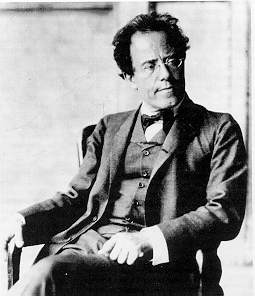
Mahler |
The Mahlers abandon their villa in Maiernigg forever, spending the rest of the summer in Schluderbach. Again, Mahler's music, this time the 6th Symphony, seems to have foretold tragic events in his life; awareness of having had this premonition certainly does nothing to alleviate his suffering.
Alma says that Mahler finds some consolation in reading Die chinesische Flöte ['the Chinese flute'], Hans Bethge's German translation of T'ang Dynasty Chinese poetry. Some of these poems become the basis of his next (and in many ways most beautiful) piece, Das Lied von der Erde ['the song of the earth'], which Alma says he begins sketching in Schluderbach as summer ends. However, The Chinese Flute only appears in print on October 5, after Mahler's return to Vienna (only two weeks before his trip to Russia and Finland), and the manuscript evidence seems to confirm Roller's statment that "That summer [1907] yielded no artistic fruit ... in the summer of 1908 ... his creative drive returned." The Mahlers will stay in Europe until early December, so it is possible that Mahler reads the book and begins conceiving Das Lied von der Erde in his mind sometime during the autumn of 1907 in Vienna, particularly since the manuscript seems to show that the first piece to be composed the following summer (July 1908) is the one entitled "Der Einsame im Herbst" ['the lonely man in autumn'].
In July in Ustilug (Ukraine), 25-year-old Stravinsky begins composing a "fantastic scherzo", a symphonic piece which he originally plans to call Bees.
Over in America, 39-year-old Scott Joplin leaves St. Louis in June, spends some time in Texarkana with his family, and in Chicago, then makes a big move to New York in July.
26-year-old Béla Bartók becomes Professor of Piano at the Budapest Royal Academy, which allows him to stay in Hungary and continue his studies of local folk-songs, particular those from Transylvania.
Ignaz Brüll dies on September 17 in Vienna, at age 60.
On September 25, Sibelius's 3rd Symphony is premièred in Helsinki.
In the fall in Vienna, plans for Mahler to become Director of the Conservatory collapse, since he decides to take the lucrative offer from New York. Mahler's friend Guido Adler, who had been the primary force behind the proposed Conservatory reorganization, seeks to blame Alma's desire for a sumptuous lifestyle as the cause for Mahler's decision, but Mahler reassures him that he needs to make this move for his own reasons. Mahler's primary intention is to make as much money as possible in a few short seasons, so that he can build a house in the country close to Vienna, retire from conducting, and devote all of his time to composing.
In October, the New York Times reports that Mahler plans to conduct his 7th Symphony with the New York Symphony Society in the coming season, but this performance never takes place.
In America, the financial system has been volatile all summer, and during the last half of October the out-of-control speculation results in a run on the banks and a financial crisis. New York City narrowly avoids bankruptcy only because of an infusion of money personally from J. P. Morgan.
On October 15, Mahler conducts Beethoven's Fidelio, which will be the last opera performance he directs in Vienna. On October 19 Mahler travels to Russia, conducting Beethoven's 7th Symphony in St. Petersburg on the 26th. Then he goes to Helsinki for a 6-day trip in Finland from October 29 to November 3, meeting Sibelius and having a famous conversation about their opposing views of what a symphony represents. Mahler conducts Beethoven's 5th Symphony in Helsinki on November 1, then returns to St. Petersburg, conducts his own 5th Symphony on November 9 (Stravinsky was in the audience), then goes back to Vienna on November 12.
On November 7 a concert featuring premières of music by 8 of Schönberg's students is given in Vienna; Webern's Piano Quintet and Berg's Double Fugue for String Quartet with Piano Accompaniment (after the manner of a continuo) are singled out, and get them their first critical notice.
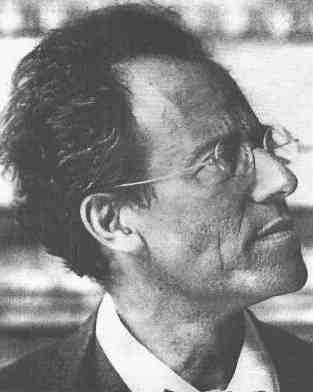
Mahler |
On November 24, Mahler conducts his 2nd Symphony in Vienna and vows that he will never conduct there again. The 2nd is a colossal success, and the audience suddenly seems to realize that it is the end of a long era of musical excellence in that city. After the performance, Mahler is called back to the stage 30 times during the prolonged ovation. Mahler and Alma leave their daughter Anna in Vienna with Alma's family, and depart Vienna triumphantly on December 9, to spend their first season in America. An impromptu gathering of admirers, mainly made up of Schönberg's students, sees them off at the train station. They travel to Paris where they spend a few days, then sail during the middle weeks of the month and arrive in New York on December 21. Mahler conducts at New York's Metropolitan Opera, and they live at the Hotel Majestic in Manhattan's Upper West Side. Felix Weingartner succeeds Mahler as Director of the Vienna Court Opera. |
Schönberg feels a serious sense of loss with Mahler's departure from Vienna, as it was mainly Mahler who supported the work of him and his pupils; this is a large part of the even bigger crisis experienced by Schönberg over the next year. It seems very possible that Schönberg is aware of Mahler's association of the tune "Ach, du lieber Augustin" ['ah, you dear Augustine'] with tragedy (see above, 1870), as Schönberg quotes a deliberately distorted version of this tune at the point where he writes "all is lost" in the score of the 2nd movement of his 2nd Quartet, on which he is currently working -- could this even be a personal message from Schönberg to Mahler?
At the same time, without Mahler around to criticize his ideas, Schönberg suddenly feels the confidence to realize a new ideal of expression that he's had in mind, and finally finding a poet with whose work he feels a great deal of sympathy, he becomes strongly inspired by the style of Stefan George's poetry. On December 17, while Mahler and Alma are on the ship to America, Schönberg composes the first of his many settings of George poems, and the first piece to really display the hallmarks of "atonality", Ich darf nicht denkend, no. 1 of 2 Songs, op.14.
1908
Mahler makes his Metropolitan Opera debut in New York on January 1, conducting Wagner's Tristan und Isolde. He also does three 1-day engagements at the Philadelphia Opera in January and February, and a 4-day trip to direct the Boston Opera in April.
Austria formally annexes its colony of Bosnia-Herzegovina, making it fully a province of the Austrian Empire.
On February 2, Schönberg composes In diesen Wintertagen, no. 2 of 2 Songs, op.14, in a style reminiscent of his earlier tonal work. The 2nd movment of the 2nd Quartet is mostly drafted by now, and he begins sketching the 3rd and 4th movements, which eventually will each employ a vocal part, setting Stefan George's Litanei ['litany'] and Entrückung ['rapture'] respectively. These two movements are originally planned to be in the reverse order in which they will eventually appear in the quartet.
Also in February, just before his 27th birthday,
Bartók embraces pantheism, which causes
Stefi Geyer to break off her relationship with him.
Bartók is despondent and contemplates suicide, but then pours his emotions
into his 1st Quartet, written during the latter part of the year.
This is also his first major composition to show the influence of his studies
into Hungarian, Romanian, and Slovak folk-songs.
Over in America, on February 16, Mahler witnesses the funeral of a fireman from his 11th-floor apartment in New York. A single loud drum stroke, which is muffled by the time it reaches Mahler's ears, leaves such an impression on him that 2 years later he will write it into his 10th Symphony.
Also in New York, on March 5, the New York Age newspaper publishes an article about Joplin and his work on his opera Treemonisha. In a later interview, Mahler discusses "Negro music" and denounces its claim as "American folk music", which seems to me to indicate that he was at least a little familiar with ragtime. Given his old habit of reading newspaper reviews of his concerts, I think it's quite likely that Mahler could have read articles about Joplin in the New York papers. (More about this below under "1910", in regard to Mahler's 10th Symphony.)
At this point, the poetry of Stefan George has become a big inspiration
for Schönberg, and in March he begins setting a non-cyclical group of
four George poems from the cycle
Das Buch der hängenden Gärten [Book of the Hanging Gardens],
(which will later be expanded into his op.15):
Later he sketches another manuscript with three more songs:
Schönberg also makes sketches for settings of many other poets, and for Und Pippa tanzt, an unrealized opera project, while continuing to work on the 2nd Quartet.
On March 30 in Ustilug (Ukraine), 25-year-old Stravinsky completes his Scherzo Fantastique, op. 3. After this Stravinsky composes the short Feu d'artifice [Fireworks], op. 4 as a wedding present for his teacher Rimsky-Korsakov's daughter Nadezhda. Just a few days after the wedding, on June 21 (June 8 O.S.) Rimsky-Korsakov dies.
24-year-old Webern is most likely finished with the composition of his Passacaglia, op.1 for orchestra, by the spring. (This piece is frequently referred to as Webern's 'graduation' work upon finishing his lessons with Schönberg - it is not. That distinction goes to his next piece.)
Mahler travels to Boston to lead the Opera there from April 8 to 11, then returns to New York for his final performances of the season there. On April 23, Mahler and Alma leave New York to sail back to Europe. They arrive at Cuxhaven (the seaport near Hamburg) on May 2, and spend a few days in Hamburg, where Mahler visits old friends and Alma spends time with her family. Mahler goes on to Wiesbaden, where Alma joins him on the 8th for a concert which he conducts, then they arrive in Vienna on May 10. Mahler almost certainly resumes his contact with Schönberg at this time. Mahler spends only one week in Vienna, traveling to Prague for a 3-week stay, giving a concert on the 23rd, and Mahler also makes arrangements for the upcoming première of his 7th Symphony. Mahler and Alma are again in Vienna during the beginning of June, with Mahler back in Prague again a week later. Vienna is abuzz with preparation for the Emperor's Jubilee celebration on June 12. Wanting to escape the commotion, Mahler and Alma decide to spend their summer at a farmhouse in Toblach [now Dobiacco, Italy], and leave for there on June 10.
Between the summer and the following winter, still studying with Schönberg, 23-year-old Berg composes 5 single-movement "Piano Sonatas", and some remaining fragmentary, before tackling his real Piano Sonata, op. 1 later in the year.
In June, Busoni writes a letter to his publisher Schmidl about an expanded version of his book Sketch of a New Aesthetic of Music, but this version is never issued.
Julius Korngold finally sends his 11-year-old prodigy son Erich to study with Zemlinsky. Erich writes the first two movements of his Piano Sonata in D-minor, which he later plays for Mahler, who is very impressed. Mahler also asks Korngold to play something Zemlinsky had assigned to Korngold -- a passacaglia on a theme by Zemlinsky -- and recommends that Korngold use it as the finale for the sonata, which he does.
Back in the Alps for summer vacation by June 11, the mood now one of resignation rather than joy, Mahler complains to Bruno Walter of how lonely he feels, and how "now at the end of a life I must learn to stand and walk as a beginner", a reference to his doctor's orders to moderate his amount of exercise. This is a particularly difficult blow for Mahler, whose spiritual demons in the past led him to take vigorous hikes in the forests and mountains, during which he received most of his musical inspiration.
Mahler apparently begins work in the middle of July on Das Lied von der Erde ['the song of the earth'], considered by many to be his greatest work. He works on it feverishly during the rest of his vacation, finishing it in early September. Mahler tells Walter: "I believe it is the most personal thing I have yet created". Again, there is a drastic change in his style, as he enters his 'third (and final) period'. Alma in her book recalls how, when their 4-year-old daughter Maria had a tracheotomy in 1907 (see above), Mahler had paced back and forth in the next room, and as he approached the door to Maria's room, he recoiled each time he heard the horrible wheezing sound of her breathing -- I think the flutter-tongueing of the woodwinds at the beginning of the 1st movement of this work ( Das Trinklied vom Jammer der Erde ['the drinking-song of Earthly sorrow']) may be intended to portray Mahler's recollection of this event. The entire piece is a setting of poems from Hans Bethge's ['the Chinese flute'], which are German adaptations of ancient Chinese poems, with several of Mahler's own additions and adaptations to the text, and forms a sort of synthesis of song-cycle and symphony. Mahler's banker Paul Hammerschlag visits during the summer, and Mahler expresses his interest in Chinese music. Back in Vienna, Hammerschlag buys some phonograph cylinders of Chinese music and gives them to Mahler.
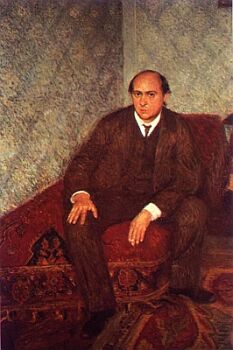
Schönberg |
The summer in Gmunden is disruptive for Schönberg:
he discovers Mathilde and Gerstl in bed together, and on August 27 she
leaves Schönberg and the children and goes back to Vienna
with Gerstl. On August 30 Schönberg returns with the children
to Vienna, but stays without Mathilde for at least a month.
Spurred on by this crisis, Schönberg enters the most productive and most creative period of his career. On September 1 Schönberg finishes his 2nd Quartet, the work which, more than any other, documents the breakaway from traditional concepts of tonality. He dedicates this score to his wife. Schönberg quotes a distorted version of the popular tune "Ach, du liber Augustin" ['ah, you dear Augustine'] in the 2nd movement of his 2nd Quartet, at a point where he writes "all is lost" -- perhaps a personal message to Mahler? (see above, 1870 and 1907). Schönberg revamps the 3rd and 4th movements so that each include a vocal part setting poems by Stefan George, and switches their order, and finally abandons the workings of traditional tonality in the last movement of this piece, writing the first piece of truly atonal music, to George's words "I feel the air of other planets". |
Strauss finishes his opera Elektra, which will be his last work in a progressive style.
15-year-old Hába enters the teacher's training college in Kromeríz, begins to develop an interest in Czech nationalism, and hears the works of Smetana and Wagner for the first time.
Mahler travels to Prague on 5 September for rehersals, and on 19 September conducts the première of his 7th Symphony, receiving only a lukewarm reception. Schönberg misses the première, remaining in Vienna alone due to his marital crisis, but several of his students are among the group of young Mahler admirers who attend. During rehearsals and after the performance, Mahler revises the score. The public reception of Mahler's last three symphonies has been cool, and it will take a year of corresponding with publishers to find one (the small firm of Bote and Bock) willing to print the 7th. He returns the Toblach the next day and over the next 3 weeks completes the orchestral score to Das Lied von der Erde.
During the autumn, Webern writes out his own copy of Schönberg's Friede auf Erden, and it is most likely around this time that he composes Entflieht auf leichten Kähnen ['flee in light boats'], op.2, which is likewise for a cappella chorus, on a text by Sefan George. This piece, and not the Passacaglia, is the last one Webern composed under the guidance of Schönberg.
In his first work written after "graduation" from Schönberg's teaching, but still following very closely in Schönberg's footsteps, Webern is also inspired to set 14 of George's poems as songs over the next year. Some of these are eventually published about a decade later as 5 Songs from Der siebente Ring, op.3 and 5 Songs on poems of Stefan George, op.4, the other four being discovered posthumously and published in 1970. As with Schönberg, the George poems open up Webern's style, and are also his first 'atonal' compositions. (Sketches of two of them also indicate Webern's passing interest in microtonality; more on that below.)
Schönberg threatens to commit suicide if Mathilde does not return to him. In October, mainly at the instigation of Webern, Mathilde reluctantly leaves Gerstl and comes back home to Schönberg. This sours Mathilde's relationship with Webern for the rest of her life.
Now with a much more cynical attitude about love because of his wife's affair, Schönberg decides to expand his settings of Das Buch der hängenden Gärten [Book of the Hanging Gardens] (of which he has already completed op.15 #3-8) into a full cycle of 15 songs, utilizing the whole central section of George's book, which is an interlude about the discovery of love, whose mood progresses from lyrical to menacing. Betraying a further evolution of his style, on September 27, he composes the draft of op.15 #13, Du lehnest wider eine Silberweide, the first piece without any reference to a key, setting a text which describes the lover getting in a boat while his beloved refuses to join him as he drifts away under the weeping willows. As shown above (1906), Schönberg had earlier thought about quartertones and tried to devise a notation for them. It seems to me that perhaps his real interest in microtonal vocals began at this time, with this change in style: the vocal part of this song is declamatory, with no trace of the lyricism in Schönberg's previous songs. This can be inferred from Webern's experiments with microtones at this time in two of his own songs, noting how closely Webern followed Schöberg's innovations (see below; no sketches for the actual use of microtones in compositions survive from Schönberg).
Mahler travels to Munich on October 19 to rehearse his 7th Symphony there, and conducts the second performance of the work for its Munich première on October 27. Then Mahler returns to Vienna for a few days at the beginning of November.
Gerstl waits in vain for an invitation to the upcoming concert of music by Schönberg's students. Having disrupted Schönberg's marriage, of course he never receives one. On November 4, the distraught Gerstl commits suicide at age 25, making a bonfire of his paintings in his apartment, and then hanging himself in front of a mirror (rumor also has it that he stabbed himself first).
Mahler leaves Vienna on 5 November, stops over in Berlin, then visits with old friends upon arriving in Hamburg for an upcoming concert. This time their daughter Anna will be with her parents in New York, so Alma and Anna (with her governess) arrive a few days later.
On November 8 a concert is given in Vienna featuring works by Schönberg's students, including the premières of Webern's Passacaglia, op.1 and Berg's 12 Variations on an Original Theme, for piano. Being close to Schönberg and his students, Mahler possibly attends some rehearsals for this concert before leaving Vienna, and also probably witnesses an early rehearsal of Schönberg's 2nd Quartet, which he finds difficult to follow.
The Gerstl suicide and the events which precipitated it (his wife's affair with Gerstl) appear to have a powerful effect on Schönberg; during the next year he will compose four incredibly original major pieces at an astonishingly fast pace.
Die Glückliche Hand
painting of the set, by Schönberg
Initiating a long-range project, Schönberg begins sketching his music-drama Die Glückliche Hand [literally 'the lucky hand', meaning something like 'The magic touch' in idiomatic English], which is based very closely on the Gerstl affair. He also writes the libretto, as well as very elaborate directions for lighting, with deliberate correllations between color and sound. The characters include 12 "spectral voices" -- right at the time when he began putting into practice his radically new idea of using the 12 tones of the 12-edo chromatic scale as independent elements of the harmonic fabric -- and a "mythical beast", and the work is perhaps the eeriest product of expressionism (a genre already noted for eeriness). Initially conceived in the athematic style of Erwartung, he will compose this piece with long gaps between working on it, returning to it on and off for five years, and completing it finally in 1913, using compositional procedures which return to his older working methods of "developing variation".
Mahler conducts the concert in Hamburg featuring Beethoven's 7th Symphony on 9 November. The Mahler clan (Gustav, Alma, Anna, and Anna's governess) depart from Cuxhaven on the 12th, for Mahler's second season in America. They arrive in New York on 22 November, this time living at the Hotel Savoy (at 59th Street and 5th Avenue). Mahler has negotiated to begin his season by conducting 3 concerts with the New York Symphony, and in one of these, on 8 December, he leads the American première of his 2nd Symphony.
In New York, the Metropolitan Opera season begins on 16 November, while Mahler is still on the ship, with Toscanini conducting Verdi's Aida. It is a tremdendous success for Toscanini, who from this point on will be at odds with Mahler over the leadership of the Met.
From December 6 to around the 17th, Webern is in Berlin looking for work. At this time writes in a letter that he loves Debussy's opera Pelleas et Melisande.
December 21 brings the première, in Vienna, of Schönberg's 2nd Quartet, by the Rosé Quartet. Again, the Schönberg première causes a scandal, with more shouting than music. Rosé answers the outcry by scheduling a repeat in January. Schönberg's published attacks to the critics's behavior mark the beginning of his long literary career.
Around Christmas in Vienna, 11-year-old Erich Korngold begins serious work on his pantomime Der Schneemann ['the snowman'], the plot of which is written by he and his father, and which will occupy him until Easter.
1909
On January 25, Strauss's Elektra, his most progressive score, is premièred in Dresden under Schuch.
On February 1 in New York, Alma Mahler has a miscarriage.
In St. Petersburg (Russia) on February 6, a concert premieres 26-year-old Stravinsky's recently completed Scherzo Fantastique, op. 3 and Feu d'artifice [Fireworks], op. 4. In the audience is Serge Diaghilev, impressario and owner of the Ballets Russes. Diaghilev is impressed with Stravinsky's pieces, and his desire to stage a ballet based on the Russian "Firebird" tale leads to his first of several successful commissions for Stravinsky.
|
In February, 34-year-old Schönberg sketches the song Am Strande
[On the beach] (which will remain incomplete), and finishes his song-cycle
Das Buch der Hangenden Garten ['book of the
hanging gardens'], op.15, which contains the
first pieces which do not refer to traditional tonality at all,
and about which he says:
[Schönberg] I have succeeded for the first time in acheiving an ideal of form and expression that I have had in mind for quite some time, but for which I had previously lacked the courage to execute. |
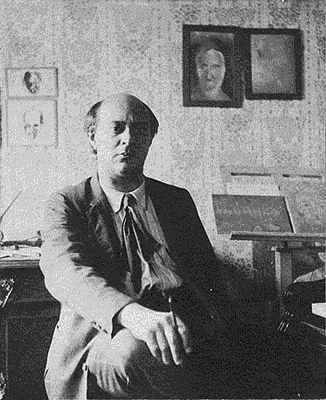
Schönberg |
A letter to Busoni written later this year shows that Schönberg had been interested in microtonality. Considering his later comments on lack of instruments to play microtones (in Harmonielehre), and the possible similarities with Webern's work discussed below, his interest in them was probably in connection with the dispassionate declamatory style of the vocal parts written during the second phase of composition of the George Lieder, op.15 (September 1908 - February 1909, particularly in #13 Du lehnest wider eine Silberweide and 14 Sprich nicht), since both works after op.15 will be for instruments alone.
Sketches for two of Webern's George-songs, An Bachesranft ['At the brook's edge'] and Das lockere Saatgefilde ['The relaxed seed-realms'], contain indications for microtonal pitches, which are eventually abandoned. At the end of the Bachesranft sketch Webern wrote the same microtonal accidentals Schönberg used (see Schoenberg's 1909.8.24 letter to Busoni), showing how true Schönberg's statement was that "I have to keep all of my new ideas secret from Webern, because he steals everything as soon as I mention it." But apparently this worked both ways, since Webern actually was bold enough to write down the microtonal notes in these sketches.
Webern's notation for the microtonal pitches uses little crosses in place of note-heads, which are identical to the notation used a few years later by Schönberg for the sprechstimme ['speech-voice'] in the published scores of his Gurrelieder, Pierrot Lunaire, and Die Glückliche Hand, and which therefore seems to indicate that Webern was the one who originated this idea at least a year before Schönberg used it.
Schönberg pays for the first publication of his 2nd Quartet on 13 February. Schönberg is eager to apply his new melodic and harmonic techniques to instrumental forms, and also composes the 1st and 2nd of his 3 Piano Pieces, op.11, on 19 and 22 February, respectively. The first of these is generally considered to be the first completely atonal composition. Schönberg detests the term 'atonal' with which the critics tag his work, preferring 'pantonal' (see my work-in-progress, Searching for Schönberg's Pantonality), but the negative term sticks like glue, and in later years Schönberg will use it himself in his own writings.
Sometime during the spring, Berg completes his Piano Sonata, op. 1, and also composes the 2nd and 3rd songs of his 4 Songs, op. 2.
Mahler and Alma leave New York on 9 April to sail back to Europe. They arrive in Paris on 19 April, where they will spend the rest of the month. This is their only long stay in Paris during which Mahler has no commitments, and so they are mainly tourists.
Around Easter, a little before his 12th birthday, Erich Korngold completes the piano version of his pantomine Der Schneemann, the piece which will make him famous as a child prodigy. As a result of several music-critics being impressed upon receiving the private printing of Erich's compositions from his father Julius, articles begin appearing in newspapers in cities near Vienna. Moritz Benedikt, editor of the Neue Freie Press, realizes that his paper can no longer ignore Erich's talent, but also that it would be improper to have Erich's father write the article, so Ernst Decsey is hired.
28-year-old Béla Bartók and 26-year-old Zoltán Kodály travel together into the Hungarian countryside to collect and research old Magyar folk melodies. Bartók marries his piano student Márta Ziegler.
Carl Moll has commissioned a bust of Mahler from the famous sculptor Auguste Rodin, and so Mahler meets and sits for Rodin every morning during his stay in Paris. Rodin sculpts a clay bust of Mahler and makes several bronze copies. During this time Mahler also meets 25-year-old Alfredo Casella for the first time. Casella has studied all 6 of Mahler's published symphonies, and Mahler is impressed with Casella's own compositions (his 2nd Symphony is very imitative of Mahler) and authorizes Casella to write the 2-piano 4-hand arrangement of his 7th Symphony. On 1 May Mahler and Alma return to Vienna.
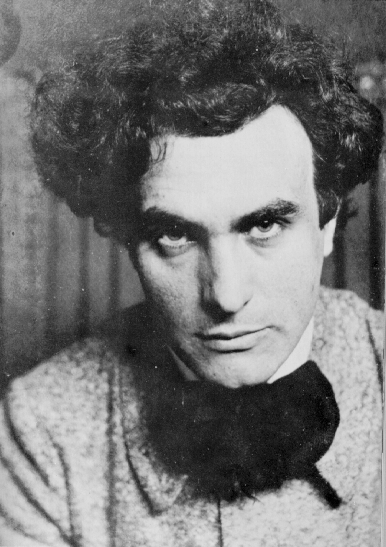
Edgard Varèse |
On 31 May, 25-year-old Edgard Varèse meets Mahler, in hopes of getting his symphonic-poem Bourgogne premièred. |
24-year-old Berg writes the last of the songs which he will include in his Sieben Frühe Lieder ['7 early songs'] for voice and piano (orchestrated in 1928), and sometime during the summer, composes the first song of his 4 Songs for medium voice and piano, op.2.
During May, Schönberg composes the first of his Funf Orchesterstücke ['5 Pieces for Orchestra'], op.16. He finishes the draft of the 1st piece on 23 May, and the fair-copy of it on 9 June. During early June he works on the 2nd piece, finishing the fair-copy on 15 June
On June 9 the Mahlers travel to Levico, a few hours train ride south of Toblach, where Alma will spend a month relaxing on her doctor's recommendation. Mahler goes on to Toblach alone, with his usual plan to spend the summer composing. Alma finally regroups with Mahler at Toblach on July 12, missing his birthday.
In mid-June, 25-year-old Webern completes 5 Movements for String Quartet, op.5, which are even more radical than Schönberg's pieces so far. The pieces still exhibit the technique of "developing variation", but some of them are extremely short, and will influence both Schönberg and Berg (see below, describing August 1909). Webern announces the completion of this "string quartet to Schönberg on June 16.
During the latter half of June, Schönberg composes the 3rd piece of his 5 Pieces for Orchestra, finishing its fair-copy on 1 July. This 3rd piece is an experiment in Klangfarbenmelodie ['tone-color-melody']: very little harmonic movement with overlapping entrances of the instruments - one of the ideas about which he had argued with and angered Mahler.
At the end of June Schönberg goes with his family and friends to spend the summer at Steinakirchen-am-Forst, and full of confidence and enthusiasm over his attainment of a long-sought "new mode of musical expression", he spends the first half of July working on the 4th of the orchestral pieces of op.16.
Hofmannsthal begins working on an original libretto, loosely adapted from Louvet de Couvrai's novel Les amours du chevalier de Faublas and Molière's comedy Monsieur de Pourceaugnac, for Strauss's fifth opera, Der Rosenkavalier ['the knight of the rose'], which they want to be in a light-hearted comic style. After seeing Schönberg's latest work, Strauss has turned his back on the musical progressivism that he himself helped to initiate.
Over the summer, 12-year-old Korngold assembles his Don Quixote: 6 Characteristic Pieces for piano, adapting his earlier cantata Der Tod as the opening piece of this work.
In America during the summer, when Harry Partch has just turned 8, his older brother Paul joins the Navy at San Diego [California]. From that visit, Partch will later recall vague memories of Southern California, where he will eventually spend a great deal of his life, including his last years actually in San Diego.
Mahler and Anna |
On June 26, spending the summer in Toblach in what is now the Italian Alps, Mahler signs his first contract with Universal Edition, for the publication of his 8th Symphony. During July and August, Mahler works feverishly to compose his entire 9th Symphony. Its 1st movement makes a deep impression on all those to whom he plays it, especially Berg. |
In mid-July, Schönberg writes to Strauss about his orchestra pieces:
... There is absolutely nothing symphonic about them, quite the opposite -- no architecture, no construction. Purely a diverse, uninterrupted alternation of colors, rhythms, and moods.
On July 17, Schönberg completes the 4th of his Funf Orchesterstücke ['5 Pieces for Orchestra'], op.16. On July 28, Schönberg sends the score of the first four of the 5 Pieces to Strauss asking for a performance, but Strauss replies that his audience is far too conservative to accept these "daring experiments", and adding that it is unlikely that Schönberg will find any conductor willing to perform them -- a severe blow to the confidence Schönberg had expressed about his hoped-for reception of these pieces.
Late in July, Busoni sends Schönberg a copy of his Sketch of a New Aesthetic of Music, which Schönberg reads with interest.
On July 31, Webern travels to Steinakirchen to visit Schönberg, and almost certainly brings along the score of his 5 Movements for String Quartet. The extreme brevity and nearly athematic style of Webern's pieces will leave a strong impression on Schönberg.
Immediately after reading Busoni's book and seeing Webern's Quartet, Schönberg enters an entirely new and radical change in his style of composition: his next pieces are the first to exhibit athematicism. Whereas all of his previous works were based on "developing variation" of themes, he now composes pieces which are meant to express "pure feeling", without any recurrence of motivic musical material. The first work in this new style is the 3rd and last of his 3 Piano Pieces, op.11, completed on August 7. A few days later on August 11, Schönberg completes the last of the 5 Pieces for Orchestra, continuing the athematic aesthetic. It is probable that this development was Schönberg's reaction to the radical brevity of Webern's 5 Movements for String Quartet, op.5, composed two months earlier; there is much documentary evidence that Schönberg and Webern had a rivalry over which of them was the most radical composer. Schönberg will adhere to this athematic style for only a few years, until 1912.
Now ready to tackle an opera project, Schönberg asks Marie Pappenheim to furnish him with a libretto.
In regard to Busoni's Sketch of a New Aesthetic of Music, Schönberg writes a letter to Busoni on 24 August commenting on both the latter's description of 'third-tones', and a notation Schönberg had previously devised for quarter-tones using the mathematical signs < and > as accidentals (see the sketch above, 1906). He tells Busoni that he ultimately rejects the use of microtones. (He will explain why a year later in Harmonielehre.)
Immediately after writing the letter to Busoni follow two incredible weeks (August 27 to September 12) during which Schönberg composes his amazing 'monodrama' Erwartung ['expectation'], op.17, on Pappenheim's libretto, with a morbid story-line and a solo female character who is psychotic. The piece has been called 'athematic' (as well as atonal), since there are no recognizable repetitions of any motifs, and in my opinion it marks the sharpest break with tradition in the history of European music. Schönberg's letter to Busoni speaks about his desire to free his music from all formal bounds, and to express "pure feeling" -- I think to a great extent this is exactly what he achieved in Erwartung. He will later write in 1929:
The aim is to represent in slow motion everything that occurs during a single second of maximum spiritual excitement, stretching it out to half an hour.
In September, Schönberg also signs a publishing contract with Universal Edition. The success of Universal does a lot towards disseminating the work of both Schönberg (and ultimately also Berg and Webern) and Mahler.
Also in September, Webern, brooding over his mother's death 3 years before, composes his 6 Pieces for Orchestra, op.6. The original version uses a huge orchestra, which will be toned down in the revised 1928 version.
In October, 12-year-old Erich Korngold completes his 1st Piano Sonata.
Mahler completes the draft of the orchestral score of his 9th Symphony on 2 September, returns to Vienna on 6 September for 10 days, spends the third week of September visiting Fritz Redlich in Hodonin (Moravia), and goes back to Vienna for 4 final days. Mahler and Alma move out of the apartment at Auenbruggergasse 2 after accepting Carl Moll's invitation to stay at his villa in the Hohe Wart (where Alma was living when she met Mahler) during his and Alma's future short stays in Vienna. Mahler travels to Holland on 26 September, to conduct his 7th Symphony in The Hague on 2 October and twice in Amsterdam, on 3 and 7 October, with Oscar Fried present at Mahler's invitation.
On 8 October Mahler travels to Paris to join Alma and daughter Anna, and again sits for Rodin as work on his bust continues. On 12 October the Mahlers sail from Cherbourg to America for Mahler's third season there. They arrive in New York on 19 October, livng again at the Hotel Savoy in Manhattan. Having given up his position at the Metropolitan Opera, leaving Toscanini in charge, Mahler instead directs a season of concerts leading the reorganized New York Philharmonic orchestra.
On 3 November, Schönberg attends the Vienna première of Mahler's 7th Symphony conducted by Ferdinand Löwe, and is greatly impressed by Mahler's music, even despite his reservations about Löwe's abilities as an interpreter of Mahler. Schönberg sends a glowing letter to Mahler telling him what a powerful impression the work left on him, writing to Mahler that "I am now wholly yours". After this confession, and considering the prevalence which Schönberg gave to "4th-chords" in his Kammersymphonie (see above, 1905), composed just after Mahler did the same in his 7th, it is hard to believe Schönberg when he will write the following summer in his Harmonielehre:
Mahler's 7th is published in December by Bote & Bock.
Paul Landau edits a new version of the play Wozzeck in Georg Büchner's Collected Works. Landau uses Franzos' reading of the words of the play (the only one available to him), but revises the ordering of the scenes. Berg will later use this version for his opera, altho he apparently believes that it is the version by Franzos.
12-year-old Erich Korngold begins composing his Piano Trio in D-major, op.1. Julius Korngold, because of his position as the leading Viennese music-critic, is apprehensive about revealing his young son Erich's amazing talent as a composer to the public. In December, he decides to issue 3 of Erich's compositions (Piano Sonata No. 1, Don Quixote: Six Characteristic Pieces, and Der Schneemann) in a privately-printed and numbered edition, to musician friends and associates, with a preface stating explicitly that the pieces are not to be brought to the attention of the public. The responses are all extremely enthusiastic, including an often-quoted one by Richard Strauss in which Strauss encourages Julius to get Erich away from composing and to take him skiing and sledding "lest his young brain becomes prematurely tired and worn out before it reaches its full productivity".
On 16 December, Mahler conducts his 1st Symphony in New York; it is met with bewilderment by the audience. Apart from the busy season at Carnegie Hall, Mahler makes occasional trips with the orchestra to conduct in Brooklyn and Philadelphia.
1910
In January, Fried conducts the two Nachtmusiken ['nocturnes': the 2nd and 4th movements] from Mahler's 7th Symphony, in Berlin.
In New York on 26 January, Mahler conducts Brahms's Symphony 3 as part of a "historical concert": one of the rare performances of Brahms by Mahler.
Around January and February, Berg composes the 4th song of his 4 Songs for medium voice and piano, op.2, and begins drafting the 1st movement of his String Quartet.
Mahler responds to Schönberg from New York, and also tells him that he has the score of Schönberg's privately-published 2nd Quartet with him, and that he studies it from time to time, but he confesses that "it is difficult" for him to follow.
On February 8, Schönberg composes two very short complete pieces for chamber orchestra, and a fragment of a third piece shortly after (published in 1962 as 3 Pieces for Chamber Orchestra), which embody, more than anything else he ever wrote, the ideals propounded in his 1909 letters to Busoni: an expression of pure feeling, without logical musical development or architecture. Schönberg was apparently influenced a great deal by Webern's 5 Movements for String Quartet, op.5, but Webern's pieces are not as radical as Schönberg's.
Schönberg had gone confidently into bold new areas of musical expression during 1909, with his 3 Piano Pieces, op.11, Funf Orchesterstücke ['5 Pieces for Orchestra'], op.16, and 'monodrama' Erwartung, but the lack of understanding for these pieces from other composers who are close friends (Strauss, Reger, Busoni, and Mahler) now causes a period of intense self-doubt. After abandoning the 3 Pieces for Chamber Orchestra, he spends the rest of 1910 working intensively on his massive Harmonielehre textbook and composes nothing significant for a whole year, all the while being drawn more closely into his small circle of supporters, who are mainly his students. He meanwhile continues to work on the text of his opera project Die glückliche Hand.
From February 23 to 26, Mahler takes the orchestra on a short tour to New Haven [Connecticut], Springfield [Massachusetts], Providence [Rhode Island], and Boston [Massachusetts].
Bartok's 1st Quartet is premièred in Budapest on March 17.
12-year-old Korngold's Der Schneemann is premièred in its 4-hand piano version in Vienna on April 14 at a soireé held by the wife of the prime-minister, and causes a sensation. The success is so great that another performance is prepared for an expensive benefit concert on April 26, which sells out. Prince Montenuovo (the Court Chamberlain) brings the work to the attention of the Emperor, and a production is planned for the Vienna Court Opera later in the year, which requires that it be performed by the orchestra -- thus, Zemlinsky then teaches Korngold orchestration by having Erich observe as Zemlinsky scores Der Schneemann.
During the spring, at his home in Ustilug (now Ukraine), Stravinsky is composing his ballet L'Oiseau de Feu [The Firebird]. As he is finishing Firebird he also has a vision of a "solemn pagan rite" which will form the basis of his later ballet Le Sacre du Printemps [The Rite of Spring].

Charles Ives |
While having the score of his 9th Symphony copied by Tams in New York, Mahler sees the score of Ives's 3rd Symphony at Tams's office and asks to have a copy of it. Musicians who played under Mahler will much later tell anecdotes of having heard or performed it in Munich, but none of their stories have ever been substantiated. Nevertheless, Mahler had a genuine interest in discovering new music by American composers for his New York concerts, and it is understandable that he would be interested in Ives, because of the strong links between their compositional techniques and ideas. |
On April 5, the Mahler family leaves New York and sails back to Europe. The Mahlers arrive in Paris on April 12, visit with their close friends there (the "Dreyfus Quartet"), and Mahler conducts his 2nd Symphony on April 17. Then they travel to Rome, where Mahler is to conduct 3 concerts, but with most of the players already on summer vacation, it is a disaster and Mahler cancels the last concert.
|
On May 3 Mahler, Alma, and Anna return to Vienna, staying now as guests of Alma's parents at Villa Moll on the Hohe Warte. Mahler already begins rehearsing singers and choruses for the fall première of his 8th Symphony. On May 21 Mahler negotiates a contract with Universal Edition for the publication of Das Lied von der Erde and his 9th Symphony. |

Villa Moll at Wollergasse 10, Hohe Warte, Vienna |

Villa Mahler (now Werfelweg 6), Breitenstein am Semmering (green pin with orange circle; click image to enlarge) |
Immediately upon arriving in Vienna, Mahler buys land in Semmering (about 96 km [60 miles] and a 2-hour train ride southwest of Vienna) for the country home he plans to build soon for his retirement, in hopes of devoting the remainder of his life to composing. After his death Alma will build the house and it will become home for her and Anna, and eventually her later husband, writer Franz Werfel. |
Around his 13th birthday in May, Korngold also completes his Piano Trio in D-major, op.1, which he rightly sees as his first fully mature work.
In May, 25-year-old Berg completes the 1st movement of his String Quartet, op. 3, and begins overseeing rehearsals of it, which probably also teaches him a lot about string technique. He also embarks on composing the 2nd (and final) movement of the Quartet.
Zemlinsky is working on his opera Kleider machen Leute [Clothes make the man].
In May, Stravinsky discusses his idea of a piece based on an ancient pagan rite (later to develop into Le Sacre du Printemps) with Nicholas Roerich, a Russian artist, mystic and stage designer, and expert on ancient rituals and folk art.
Alma Mahler has not been feeling well, so Mahler decides that she and Anna should spend 6 weeks at the spa in Tobelbad. He takes them there on June 1, then returns alone to Vienna. Shortly after her arrival at the spa, 30-year-old Alma meets the handsome and brilliant 27-year-old architect Walter Gropius, and they fall in love with each other and have a passionate affair during the whole month of June.
In June, Mahler begins traveling to coordinate the rehearsals for the monumental première of his 8th Symphony coming in Munich in September. He goes to Leipzig on June 10 for choir rehearsals, and then on to Munich on the 14th for rehearsals of choirs and the orchestra. By June 21 Mahler is sensing from Alma's letters that something is not quite right, and when he leaves Munich on June 26 bound for Toblach, he instead decides to take a detour to Vienna and then to Tobelbad to see her and Anna.
In Klagenfurt, from June 15 to 23, 26-year-old Webern composes 4 Pieces for Violin and Piano, op.7.
By the end of June, 35-year-old Schönberg completes the text for his opera project Die glückliche Hand. After this, during the summer and continuing into 1911, Schönberg is absorbed in writing his Harmonielehre ['treatise on harmony'] textbook. Mostly a review of traditional Austro-German harmonic theory, it ends with such radical new ideas as chords built on 4ths, unresolved passing-tones, and Klangfarbenmelodie ['tone-color-melody'], and includes speculations on microtonality and unrestricted use of the chromatic scale. He gives as main reasons for rejecting microtones:
Schönberg's influence will go a long way towards entrenching 12-ET ever deeper into Western musical practice for the rest of the century.
In July, Berg completes the 2nd (and final) movement of his String Quartet, op. 3.
After spending the weekend visiting Alma and Anna in Tobelbad, Mahler leaves on July 3, stops in Graz on July 4 to visit friends, then continues to Toblach on the 5th. He receives many greetings for his 50th birthday, which he must answer, and then is engaged in difficult negotations with New York about his fee for the extra concerts he must conduct in the upcoming season; the final agreement is for $23,000 (equivalent to about $500,000 in 2009 dollars). Then he hopes to begin composing his 10th Symphony (unfinished).
|
There is a section near the very end of Mahler's 10th Symphony which uses typical ragtime chord progressions and voice-leading, which leads me to believe that Mahler may have become familiar with some ragtime (probably Scott Joplin's) while living in New York. As an habitual reader of the reviews in the the newspaper music sections, Mahler in New York would not have failed to see mention in the local papers of Joplin's ambition to produce his ragtime opera Treemonisha. And Mahler once said to William Ritter: "One can learn from everything, even jazz." [La Grange 2008, p.259] The 2nd movement of this symphony features almost constantly changing meters, and is probably the first piece of music to do so to such an extent (a few years before Stravinksy's famous use of this in Le Sacre du Printemps ['the rite of spring'] -- see '1913'). I suspect that his too may reflect Mahler's familiarity with the syncopated rhythms of Joplin's ragtimes. |
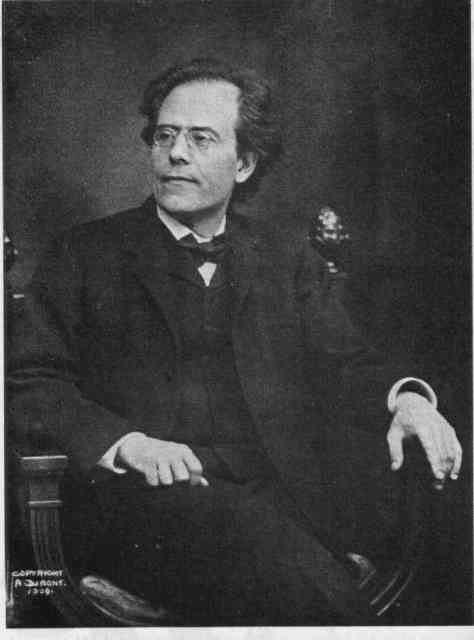
Mahler |
In Paris on June 25, 28-year-old Stravinsky's ballet L'Oiseau de Feu [The Firebird]I> is premiered as part of ballet impressario Serge Diaghilev's Ballets Russes productions, the first one to have an all-original score, and is a big success with audiences and critics. It is Stravinsky's first collaboration with Diaghilev, and the piece which begins Stravinsky's rise to fame. Diaghilev immediately requests another ballet from him for the 1912 season, and Stravinsky tells Diaghilev about his idea for Le Sacre du Printemps.
Alma finally leaves Tobelbad and joins Mahler in Toblach around the middle of July, but continues corresponding with Gropius every few days. At the end of July, Gropius writes a love-letter to Alma which he "accidentally" addresses directly to Mahler, and thus Mahler discovers that they have been having an affair, and is shattered. Alma, sensing that the time is right to seize power over their relationship, bitterly blames his lack of interest in her life and work for causing her to flee to Gropius. A week of conflict and argument ensue.
Right at this moment, on August 2, Schönberg, now in a desperate financial situation, writes to Mahler begging for a loan of money for 2 months rent. Mahler immediately sends a bank transfer, and never asks to be repaid.
Alma has been pleading with Gropius to not make any attempt to come and see her, but ignoring her, Gropius shows up in Toblach around August 4. Mahler goes to find him, brings him to their house, and tells Alma: "Whatever you do will be right. Make your decision.", demanding that she choose between them. Having convinced her that abandoning him would quite literally cause his death, Alma sends Gropius away. But secretly she still continues a regular correspondence with Gropius, expressing her love for him, looking forward to having a life and child with him after Mahler is dead, and even signing her letters to Gropius as "your wife".
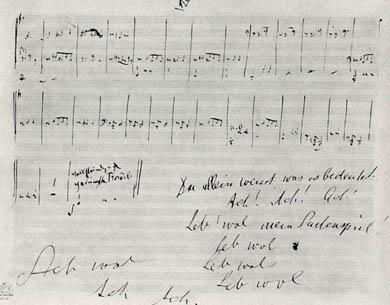
Mahler's 10th Symphony manuscript: last page of Scherzo II
(4th movement), with Mahler's messages to Alma about the
drum-stroke ending the movement (see 1908):
[You alone know what it means. Oh! Oh! God!
Farewell my lyre! farewell farewell farewell
-- Oh well. Oh oh.]
|
During August, Mahler suffers a nervous breakdown over the feeling of betrayal. Mahler's manuscript of the unfinished 10th Symphony is littered with anguished messages to Alma which express Mahler's torment over the Gropius affair. |
Alma's cruel reproaches also force Mahler to awaken to the realization of how little attention he has been giving to her, and also what a mistake it was to force her to stop composing; he reconciles with her in this respect, delighting in playing and singing her songs - and, even according to Alma, overestimating their value - and now encourages her to compose and publish her work. Mahler is so delighted that Alma chose to stay with him that his love for her reaches an intensity it never had before. At the same time he becomes a cuckold, since he realizes that Alma really loves Gropius, and that he must indulge her intention to continue to see him discreetly.
|
In a famous meeting on August 26, Mahler travels 1000 km all the way to Leiden [Netherlands] to consult the psychologist Sigmund Freud, who is about to end his holiday on the Dutch coast.
|
|
Freud identifies a mother-fixation in Mahler, and Mahler also reveals his childhood experience of witnessing an argument between his parents, at which he ran out into the street and encountered an organ-grinder playing Ach, du lieber Augustine, forever associating the vulgarity of popular music with tragedy in his compositions. The discussion with Freud does help Mahler to restore his emotional equilibrium, but from this point on he will continue to consider himself a slave to Alma's love, so much so that she even complains about his obsession to it in a letter to Gropius, written on the day of Mahler's meeting with Freud, and fearing for Mahler's sanity. |
|
On the train coming home from Leiden, Mahler writes a poem to Alma which includes the lines: "Together flowed into a single chord / My trembling thoughts and my roaring feelings." After returning to Toblach, with only 6 days available to work on the 10th Symphony before traveling to Munich to begin final rehearsals for the 8th, Mahler adds an outburst based on this idea to the last and first movements of the 10th. The first movement contains a climax culminating in this 9-note dissonant chord:
Because of the long-held "A" and the dissonance of the chord, this sonic inspiration for this passage seems to me to be the moments before and during the tuning-up of the orchestra before a rehearsal or performance. This chord is also almost identical to those at the climax of the 1st movement of Mahler's 2nd Symphony (see above, 1888). The emotional inspiration is clearly the trauma Mahler has just experienced over Alma's affair with Gropius, and thus musicially it seems to hark back to his distress over the breakup of his youthful affair with Marion von Weber. |
In Klagenfurt, in August, Webern composes 2 Songs on Poems of Rainer Maria Rilke, op.8.
After the summer, Zemlinsky leaves Vienna to begin his conducting post in Prague.
With Zemlinsky gone from Vienna, 13-year-old Korngold's apprenticeship is over, and his compositions already sound like the work of a fully mature man. Over the second half of the year, he composes his 2nd Piano Sonata, in E-major, op.2 and 7 Märchenbilder ['fairy-tale pictures'] for piano, op.3. Korngold refers to the orchestration of the Märchenbilder as the end of his instruction under Zemlinsky, but Korngold had only composed a few of these before Zemlinsky moved to Prague. (The orchestrated version was never published.)
During his last remaining week in Toblach, Mahler works feverishly to complete what he can of his 10th Symphony, with the final work on it being done on 2 September. The next day he travels to Munich to prepare for the prèmiere of his 8th Symphony.
On September 9, Schönberg begins to compose the draft score for his opera Die Glückliche Hand, but composes only a few short disconnected sketches while he is preoccupied with the writing of the Harmonielehre textbook.
On September 12, Mahler premières his great 8th Symphony (nicknamed 'Symphony of a thousand') in Munich, a musical event the size and spectacle of which has never been seen before -- even the hall was specially built for the event. Mahler becomes dismayed with the circus-like atmosphere created by the advertising, but with the addition of the awe-inspired music -- flawlessly executed by its massive body of performers (there are actually more than 1000), thanks to a whole summer of rehearsals for which Mahler traveled feverishly all over central Europe -- it is by far the crowning achievement of Mahler's life as both conductor and composer, and an event that will be remembered for decades afterward by all who were present. Among those attending are Schönberg, Webern, Strauss, the Korngolds, Klemperer, Fried, Bruno Walter, Arnold Rosé, Alfredo Casella, Leopold Stokowski, Stefan Zweig, and Thomas Mann. The occasion also provides the first meeting between Korngold and Strauss.
Mahler returns to Vienna on 14 September, with only 1 month left until leaving for America.
Late in September, 46-year-old Strauss finishes his opera Der Rosenkavalier, marking an abrupt regression in style, back to a more romantic-era idiom.
At the end of September, Stravinsky, at his winter home in Clarens, Switzerland, is visited by Diaghilev to discuss the new ballet Le Sacre du Printemps. But Stravinsky is hard at work on an entirely different project: a concert piece about a puppet who comes to life and constantly disrupts the orchestra. Diaghilev immediately senses the theatrical possibilities of this idea and thinks of the Russian tale of Petrushka. It will become their next ballet collaboration, Stravinsky working on it all winter into early 1911.
|
Schönberg's 3 Pieces for Piano, op.11
are the first of his compositions to be published
by Universal Edition (with whom he will have a long
association), and also the first of his
atonal compositions to appear in print.
Schönberg has the first exhibition of his paintings, in Hugo Heller's bookstore, opening on October 8, and Mahler anonymously buys three of Schönberg's paintings to give him much-needed financial support. Mahler hears rehearsals of Schönberg's 2nd Quartet, which is performed at the bookstore on October 12 along with the 1st Quartet. Schönberg is also appointed teacher of composition at the Imperial Academy for Music. |
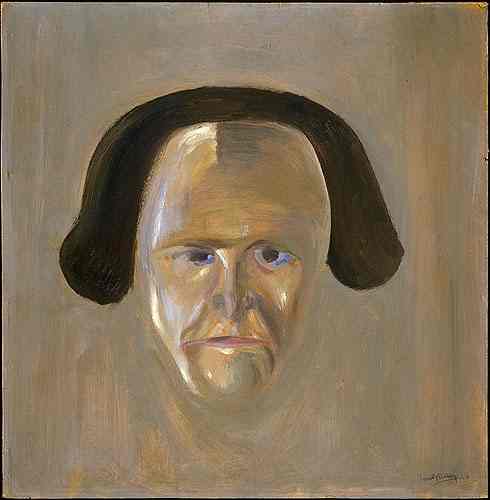
portrait of Mahler |
On Emperor Franz Josef's name-day, October 4, the orchestrated version of 13-year-old Korngold's ballet-pantomime Der Schneemann is performed at the Vienna Court Opera, and causes a sensation. The cafés of Vienna are filled with gossip about the father and son Korngolds, many people suspecting that Julius or Zemlinsky were the real composers of the music.
In the middle of October, on their way to America, Mahler allows Alma to travel alone to Paris, and he knows that she is going there to have a liason with Gropius. Mahler travels alone to Berlin and Hamburg visiting old friends, and sails alone from Cuxhaven on the 18th to meet Alma on the French coast. After her days with Gropius, Alma takes the train from Paris to Cherbourg and meets Mahler there on the ship. They sail for the last time to America, this time bringing along their daughter Anna, and staying again at the Hotel Savoy in Manhattan. During the course of the winter in New York, Alma confesses in her letters to Gropius that Mahler has become a most attentive husband, and she expresses genuine happiness.
During November, Sibelius is working simultaneously on his 4th Symphony, and on music for Edgar Allen Poe's poem The Raven which will remain incomplete.
In America in November, Virgil Partch receives a grant for 160 acres [64.75 hectares] of land in Benson [Arizona]. But Virgil is also transferred to Phoenix [Arizona], where 9-year-old Harry attends 5th Grade and sits under the school's outdoor steps playing piano.
|
Also in America, besides the regular concerts at Carnegie Hall in New York, Mahler conducts Brahms's Symphony 1 in Brooklyn on 20 November, the last of his rare performances of Brahms. 2 weeks later he takes the Philharmonic on a tour with the following hectic schedule:
Route of the December 1910 NY Philharmonic tour
(routes shown are by automobile, not by train as was actually used by the orchestra, but they are similar;
click on image to enlarge)
|
1911
In January, Fried conducts Mahler's
7th Symphony in Berlin.
Again after the January 22 concert at Carnegie Hall, Mahler takes
the Philharmonic immediately on another tour, this time a smaller one:
Schuch conducts the première of Strauss's Der Rosenkavalier in Dresden on January 26. It is immensely popular, with premières following in the next few weeks in Nuremberg, Munich, Hamburg, Vienna, Berlin, and Milan, and will remain Strauss's most successful opera.
Having completed and begun the procedure of publishing his Harmonielehre textbook, and breaking a year-long hiatus in his musical output, on February 19 Schönberg composes the first five of 6 Little Piano Pieces, op.19. (no. 2.) Instead of continuing to push on into new territory as he had done in 1909 and 1910, he reverts back to the idiom of his earlier atonal pieces.
Weingartner resigns from the Vienna Opera, and Hans Gregor, a theatrical director and not a conductor, replaces him as Director. Walter tries repeatedly during the season to terminate his contract.
Mahler's 8th Symphony is published in February by Universal Edition.
On April 3, Sibelius's 4th Symphony is premièred in Helsinki.
26-year-old Alban Berg marries Helene Nahowski on May 3.
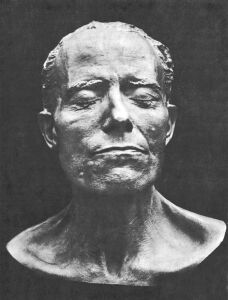
Mahler's death-mask |
Against his doctor's advice to relax,
Mahler has kept up a feverish pace with his conducting work,
becomes seriously ill and against his doctor's orders,
conducts the February 21 concert
in New York with a high fever, his last concert. His condition
continues to worsen, he is diagnosed with bacterial endocarditis
(for which at that time there was no cure; penicillin was discovered
in 1928).
Mahler returns to Europe for treatment
in Paris. When this is unsuccessful and it becomes obvious that
he is dying, he is taken back to Vienna to be buried in his adopted hometown.
Even on his deathbed, he laments:
'what's going to happen to poor Schönberg now that I'm gone?',
which illustrates vividly his faith in Schönberg's gift.
On May 18, Mahler dies at age 50 -- the end of an era viewed in retrospect by many as a "golden age" in Viennese music. His last word is 'Mozartl' [a diminutive nickname, something like 'my little Mozarty' in English]. |
Mahler's early death has a profound effect on everyone in the Mahler and Schönberg circles. The following month Schönberg writes the last of 6 Little Piano Pieces, op.19 as a memorial to Mahler. Over the summer, Schönberg's Harmonielehre is published with a dedication to Mahler's memory - the book was intended to be dedicated to Mahler while he was alive in recognition of his superiority not only as an artist but also as an intellect and a human being: Schönberg calls Mahler "a saint". The iconoclastic Harmonielehre will bring Schönberg as much notoriety as did his radical compositions.
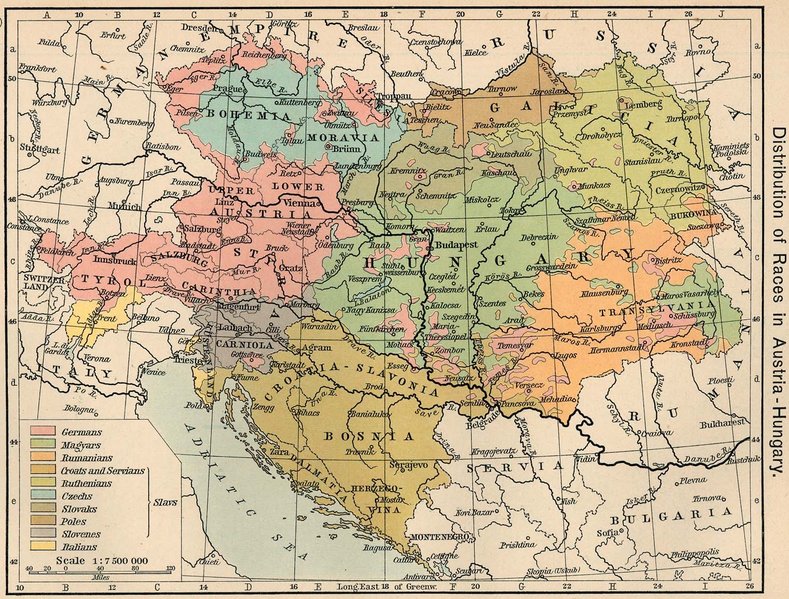
Ethnic distribution in Austria-Hungary, 1911
Stravinksy's ballet Petrushka is premiered on June 13 in Paris, famous for its bitonal "Petrushka chord": C-major and F#-major triads played simultaneously.
During June and July, Webern composes the 1st and 4th pieces of 5 Pieces for Orchestra, op.10, and during the summer, the 2nd, 3rd, 4th, and 5th of the 6 Bagatelles for String Quartet, op.9.
A revised and enlarged version of Busoni's book Sketch of a New Aesthetic of Music is published in English translation.
30-year-old Béla Bartók composes his opera A Kékszakállú herceg vára ['Bluebeard's Castle'] for a competition. The first judges who review it reject it for its "lack of theatricality", and it is possible that the musical judges never even see the score.
In July, Stravinsky visits Nicholas Roerich in Talashkino, where the finalize the struce of the ballet which will become Le Sacre du Printemps.
From April to September, 14-year-old Erich Korngold composes his first piece for orchestra, Schauspiel Overtüre ['overture to a play'], op.4, which is premièred in December by the Leipzig Gewandhaus Orchestra under Nikisch.
In Vienna, 39-year-old Willi Möllendorf and Jörg Mager build quarter-tone harmoniums.
In August, 37-year-old Schönberg becomes involved in an altercation with a neighbor in his building; when it turns violent, Schönberg abandons his Vienna apartment and stays with Zemlinsky in Starnbergersee. During the summer, Schönberg composes the end of Scene 2 and the opening of Scene 3 of his opera Die Glückliche Hand, the first significant music he produces for this project. In late September he decides to leave his devoted students behind and to move back to Berlin, with a job giving lectures at the Stern Conservatory.
In September, at Stravinsky's summer home in Ustilug (now in Ukraine), he works on the "Augurs of Spring" and "Spring Rounds" movements of Le Sacre du Printemps. In October he moves to his winter home in Clarens (Switzerland), and composes the rest of the score during winter 1911-1912.
In Berlin, Schönberg finally finishes the orchestration of his huge Gurrelieder, composed 10 years ago in a style from which he has by now moved away completely. He says later that this stage of work on the piece involved only minor bits of composition, primarily in Klaus the fool's melodrama, which involves the earliest use of sprechstimme ['speech-voice'], where the singer follows the rhythms precisely, but only sings the pitches tenuously, gliding away quickly as in speech. This technique is apparently a result of Schönberg's (and his former pupil Webern's) interest in microtonality (see above, under "1909"), and is one that will be used by Schönberg thru-out his long career.
Schönberg had written positively about the possibility of microtonality in music in his Harmonielehre, but dismissed it as being impractical, mainly because of the lack of instruments; note that he left Vienna at precisely the time that some composers there made those instruments available. Even tho he was certainly exposed to Busoni's microtonal ideas while in Berlin, he probably did not get the opportunity to actually hear microtonal music, as Busoni wrote none; given the microtonal activity in Vienna in the next few years by Möllendorf and Mager (and, a bit later, Hába), I believe that Schönberg and his circle might have explored quarter-tones further had Schönberg stayed in Vienna.
Mahler's Das Lied von der Erde is premièred posthumously under Bruno Walter in Munich in November. Berg travels there from Vienna to attend, and Webern from Berlin; Schönberg wishes to go but cannot because he begins a lecture series in Berlin -- upon returning to Berlin, Webern plays it for him on the piano.
Back in Vienna immediately afterward, Berg begins sketching his Altenberg Lieder
In December, Schönberg composes Herzegewächse, op.20 ['foliage of the heart'], has the première in Vienna of Friede auf Erden, and his Harmonielehre is published. He begins touring to other European cities to conduct his works (Amsterdam, St. Petersburg, London), Scherchen going with him.
1912
At the end of February, Schönberg is to conduct his Pelleas und Melisande in Prague. With Webern following him from Berlin, Zemlinsky already in Prague, and Berg and several other Vienna students joining, it is a big reunion of the "Schönberg Circle". Webern presents Schönberg with a copy of the "Tribute Book", written by Schönberg's students about him, in hopes of interesting other students in studying with him.
At the end of March, 37-year-old Schönberg composes the first song for his cycle Pierrot Lunaire, featuring his novel sprechstimme ['speech-voice'] technique.
In late March, 27-year-old Berg begins composing Five Orchestral Songs to Picture-Postcard Texts by Peter Altenberg, op. 4, completing the first song (probably No. 4) before April 10. Berg then has to interrupt the composition of this set until July, to make a piano-vocal arrangement of the 3rd and 4th movements of Schönberg's 2nd Quartet.
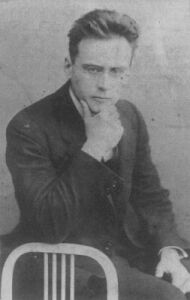
Anton Webern |
28-year-old Webern is occupied during most of April and part of May with writing a 2-piano reduction of Schönberg's 5 Pieces for Orchestra. Then he goes on vacation in Klagenfurt and Vienna, with a mountain climb in between, stops in Berlin to see Schönberg, and moves to Stettin on June 21 to begin a new job at the theater. |
|
In June, at a music festival in Vienna, Walter gives the posthumous première of Mahler's 9th Symphony, and conducts the Vienna première of Das Lied von der Erde. |
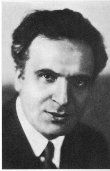
Bruno Walter |
The Mahler 9th concert is framed by two concerts featuring music of Schönberg and his students, notably Schönberg's Buch der hängenden Garten and 2nd Quartet, Berg's Piano Sonata, and Webern's 4 Pieces for Violin and Piano -- and this time, surprisingly, the "new music" is a big success with the audience ... but the newspaper critics still hate it. The brochure accompanying these concerts contains the first critical study of the music of Berg and Webern.
Feeling that he is finally ready to compose a big piece, Erich Korngold begins his Sinfonietta in B-major a few weeks before his 15th birthday in May.
Schönberg composes "Gebet an Pierrot" for Pierrot Lunaire on March 12, takes a trip to Prague later that month, then composes virtually all the rest of Pierrot during April and May, featuring sprechstimme ['speech-voice'] thru-out, and completing it in July. After this, he gets back to serious work on his opera Die Glückliche Hand, which contains his first use of sprechgesang with a full choir of voices. By now, Schönberg has rejected the ideas he expressed in his 1909 letters to Busoni, and his new work relies much more on traditional musical architectural procedures, as is plainly evident in comparing Die Glückliche Hand with his other opera Erwartung.
In June, Stravinsky and Claude Debussy together play Stravinsky's four-hand piano arrangement of the first half of Le Sacre du Printemps. Diaghilev decides to delay the premiere until the 1913 season, so Stravinsky puts it aside and resumes work on it in the autumn.
At the same time, during August, Schönberg conceives a huge "theater piece" based on Blazac's religious novel Seraphita, comprising 9 scenes presented over the course of 3 evenings, with a huge chorus and orchestra ... but musically not much progress is made on this project.
In July, Berg completes the second of his 5 Altenberg Lieder, song No. 3.
Schönberg's Pelleas und Melisande is published by Universal Edition in Vienna as op.5, and Funf Orchesterstücke ['5 Pieces for Orchestra'] is published by Peters in Leipzig as op.16; Schönberg receives only 500 gulden as payment for the latter (in contrast to the high fees that had been earned by Mahler and Strauss for their works).
Alma sets up the Mahler Foundation, to award prize money to worthy young composers in Vienna, with Strauss, Busoni, and Walter as jurors. The immediate reason for its existence is to continue Mahler's financial support for Schönberg, and so the first grant is given to him.
After finishing his studies, 19-year-old Hába gets a job as teacher in Bílovice, a small town near the Hungarian border, and continues his musical studies independently.
In August, 15-year-old Korngold completes the unorchestrated score of his Sinfonietta in B-major, op.5, a work that is on a much grander scale than its title implies (really a full-blown late-romantic symphony), and begins his Violin Sonata in G-major, op.6.
At the end of August, Berg announces the completion of the third of his Five Orchestral Songs to Picture-Postcard Texts by Peter Altenberg (No. 5), and the beginning of the fourth (No. 2). He finishes the whole set with the last song (No. 1) by late September.
Pierrot Lunaire is premièred in Berlin in October, and is quite a success with the audience, while the critics remain hostile. Stravinsky attends a rehearsal and is impressed; his enthusiastic reception of Schönberg's progressive style will provide much inspiration for his experiments in Le Sacre du Printemps ['the rite of spring'].
48-year-old Strauss premières his latest opera Ariadne auf Naxos (again in a more old-fashioned style) in Stuttgart.
In December, Schönberg conducts his Pelleas und Melisande in St. Petersburg, then on December 27, sketches the beginning of the final scene for his Seraphita project, which he says in a letter to Alma Mahler "requires a chorus of at least 2,000 singers", but work on this progresses no further.
1913
In January, Walter becomes 'Royal Bavarian General Music Director' in Munich.
On February 23, the Gurrelieder is finally premièred, in Vienna, and is Schönberg's first big triumph in his native city; the by-now-very-old-fashioned piece is a resounding, even overwhelming, success, the greatest of his long career. Schönberg, bitter over the scandals from the audiences and hostility of the critics at the previous concerts of his more progressive works, refuses to acknowledge the audience's tremendous 15-minute ovation, turning his back to them, bowing only to the performers, and exiting.
Shortly after this, Schönberg makes his first tentative contact with Hauer, who will later also claim priority as inventor of a 12-tone method.
In Clarens (Switzerland), on March 8, Stravinsky finishes the full score of Le Sacre du Printemps.
|
On March 31 in Vienna, a concert which will become notorius includes the following compositions:
The audience responds disruptively to the Webern and Schönberg pieces, then fights break out during the performance of Berg's songs, the concert is stopped, and lawsuits result. The newspapers report on it not in the Arts section but rather in the Urban Crimes section. It goes down in history as the Skandalkonzert, and is still today known as the worst riot in Viennese concert history. The audience's ire is particularly inflamed by Berg's Altenberg Lieder. 28-year-old Berg, who for 12 years has written only songs and chamber music, writes 4 pieces for clarinet and piano in April and May, in the same type of miniaturist aphoristic style then being used by Schönberg and especially Webern. He also tells Schönberg about his plans to compose a symphony after his planned trip to Berlin in June. In May, Berg is reading Vom Tode, a new German translation of Maeterlinck's La Mort ['death'], probably in hopes of finding an inspiration for an opera. Towards the end of May, the Schönbergs move to 17a Berlinerstrasse in Berlin-Südende, the second floor of a house partly owned by Albertine Zehme. |
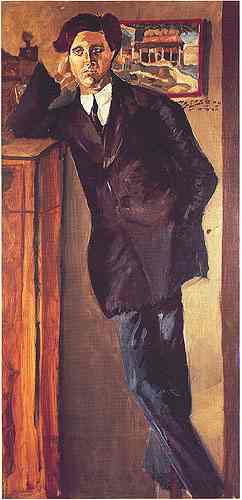
Alban Berg |
In Paris on May 29, at the Théâtre des Champs-Élysées, under the direction of Pierre Monteux, Stravinsky premières his ballet Le Sacre du Printemps ['the Rite of Spring']. As with the Schönberg concerts a few months earlier, the sharply divided opinions of the audience lead to a riot, probably the most famous in the history of classical music. The work is now recognized as a milestone in the history of European music, not only for its almost constant dissonance, but particularly for the constantly changing time-signatures of the last section (but for a work which presaged this, see references to the 2nd movement of Mahler's 10th Symphony under '1910').
Berg visits Schönberg at his new house in Berlin in June, and experiences a rehearsal and performance of Schönberg's Pierrot Lunaire prepared especially for him, and it makes an indelible impression. But on the last day of the visit, upon showing his tiny clarinet pieces to Schönberg, Berg is harshly criticized -- most likely because Schönberg perceives that Berg is going against his nature by writing such small fare. Schönberg knows that Berg has a flair for drama, and encourages him to write an opera, and also to compose a suite of dances for his big orchestral piece, instead of the symphony which Berg was planning. The harshness of Schönberg's criticism leaves a deep scar on Berg's psyche. The orchestral piece which will result (Drei Orchesterstücke ['3 pieces for orchestra'], eventually to become his op.6) is obviously a reaction to Schönberg's rough words.
Upon going to Trahütten for the summer on June 18, steeped in his admiration of Mahler's 9th Symphony (especially its 1st movement) and taking Schönberg's censure seriously to heart, Berg tries to begin composing the recommended "suite" with a Praeludium for very large orchestra, but finds that his compositional tendency keeps leaning towards designing a Mahlerian symphony with a vocal solo in the last movement from Balzac's novel Seraphita, to satisfy his need to write 'something big'.
By this time Richard Strauss has decided to retreat from the
expressionism and modernity which was displayed in his Elektra,
and has regressed to a more old-fashioned idiom, first evidenced
by his latest opera Der Rosenkavalier.
Strauss goes along with the other jurors (Busoni and Bruno Walter)
in awarding Schönberg the Mahler Foundation grant for the
second year in a row, but he confides to Alma that:
[Strauss]
Schönberg 'would do better to shovel snow [the lowest-paying and most menial job in Berlin] than to scribble on music paper, but give it to him anyway...who knows what posterity will think?'.
Schönberg finds out about these comments and writes a nasty letter about Strauss. Their previously warm friendship is over.
During June and July, Webern finishes the 6 Bagatelles, op.9 with
the composition of the 1st and the 6th, and during September and October he finishes the
5 Pieces for Orchestra, op.10 by composing the 3rd, 2nd, and 5th.
38-year-old Franz Schmidt composes his 2nd Symphony.
20-year-old Hába writes his first compositions, displaying an unwillingness to 'follow the rules' that he will maintain all his life.
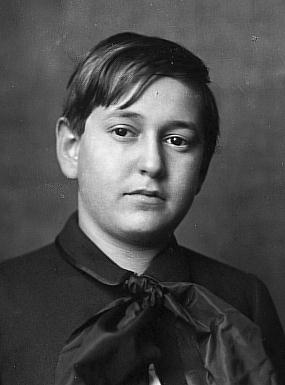
Korngold |
In August, 16-year-old Korngold completes his Sonata in G-major for violin and piano, op.6, and in September, finishes the orchestration of his Sinfonietta in B-major for large orchestra, op.5, a work whose title fails to convey its true size and scope: it is in every respect a large late-romantic symphony, sounding like the work of a man far older than a teenager. The theme of the Scherzo's Trio is very much like the music Korngold will later write for the movies in Hollywood, and which will set the tone of film-scores for decades. The première is given in Vienna on November 30, conducted by Weingartner, and is a huge success -- which is envied by Webern in a letter to Berg. Meanwhile, since the summer Korngold has also been composing his first opera, Der Ring des Polykrates, op.7; he completes the piano score around Christmas. |
Having worked on his music-drama Die glückliche Hand on-and-off for 5 years, Schönberg gets down to serious work on it during the summer and fall of this year, while vacationing in Göhren on the island of Rügen. But he again interrupts work on it during September and early October, to compose the complex orchestral song "Seraphita", on Stephan George's German translation of a poem by Ernest Dowson -- the title is the only thing this has in common with his stalled theater-piece project of the same name. (In 1916, Schönberg will join it with 3 other songs, to comprise 4 Songs for Voice and Orchestra, op.22.)
Feeling the need to jettison the athematic aesthetic he had introduced with Webern in 1909, Schönberg finally completes Die glückliche Hand on November 8. This score's careful coordination of text, music, action, and lighting makes it perhaps the closest realization to Wagner's Gesamtkunstwerk ['total-art-form'] idea to be achieved up to this time.
In America in November, when Harry Partch is 12 years old, his father Virgil is transferred to Albuquerque [New Mexico], where Partch will complete high school and work as a pianist in the local movie theaters.
On Webern's 30th birthday, December 3, the première of Franz Schmidt's 2nd Symphony takes place in Vienna. Rather traditional and late-romantic in style, it is successful, which irks those in the Schönberg circle.
1914
Schönberg is making arrangements to produce a film version of Die glückliche Hand (silent, of course, with live orchestral or organ accompaniment), but the project never reaches fruition.
Now having abandoned the aesthetic of athematicism, Schönberg is writing sketches for a huge Symphony which will remain incomplete. The Scherzo movement exhibits his first attempt at basing a piece on a 12-tone row.
In the Spring, 16-year-old Korngold completes the orchestration of his first opera, the 1-act Der Ring des Polykrates, op.7, and begins sketching the music for his second, Violanta, op.8, on which he will work for the rest of this year.
In March, 29-year-old Berg begins composing a march and a waltz for his projected symphony/suite. He finishes the march before leaving Vienna for the summer.
In May, Berg attends several performances of the play Wozzeck in Vienna; it is unknown today whether it is the version of Franzos or that of Landau. Berg is immediately inspired to write an opera based on it (using Landau's version).
In June, Webern composes the 3 Little Pieces for Violoncello and Piano, op.11, some of the shortest pieces ever written.
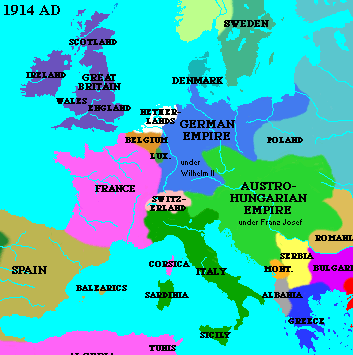
Europe in 1914 |
Austria views Serbia's growing power with suspicion. At the end of June, Archduke Franz Ferdinand, the heir to the Austrian throne, is assassinated in Sarajevo (then part of the Austro-Hungarian Empire), and the fragile system of European political alliances breaks down. Austria makes demands on Serbia, but Serbia wants to negotiate, so without waiting for clarification, on July 28 Austria declares war on Serbia. Russia responds by sending troops to guard its border with Austria. 4 days later, Austria's ally Germany declares war on Russia. 2 days after that, Germany declares war on France and invades Belgium to begin a push toward the French border. The following day England declares war on Germany. World War I has begun, changing life in Europe for everyone, forever. |
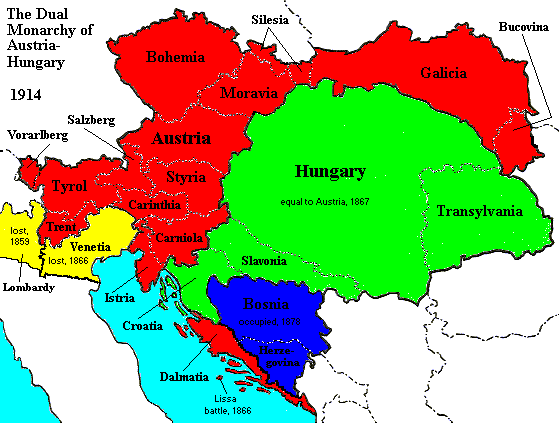
Austria-Hungary in 1914
With the start of war,
21-year-old Hába, dissatisfied by small-town life, moves
to Prague and becomes a pupil of Novák at
the Conservatory. Here he analyzes Debussy, Reger, Scriabin, and Strauss,
and studies non-functional harmonization of Moravian folk-melodies.
During June and much of July, while Helene Berg is away at the Karlsbad spa for the summer, Berg is alone in Vienna teaching and composing. Rather than continuing with the symphony, he completes the Praeludium and decides to use it as the first of Drei Orchesterstücke ['3 pieces for orchestra'] (to become his op.6), makes the march the 3rd piece, and transforms the waltz idea into the 2nd piece Reigen ['round-dances']. He continues his work even more intensively after going to Trahütten for the summer on July 21. On August 2 Berg announces that that he has completed the Praeludium, and on August 23 he announces the completion of his Drei Orchesterstücke, but the middle piece Reigen is not yet finished.
Schoenberg spends the summer mostly in Murnau, working on a large Symphony which is to remain unfinished after many years of work -- the project eventually morphs into Die Jakobsleiter.
In Panama (Central America) on August 15, the Panama Canal construction is finished by the United States, and the canal is officially opened. The ship route from New York to San Francisco is cut from 14,000 miles [23,000 km] to 6,000 miles [10,000 km].
After sending the completed scores of the Präludium and Marsch from 3 Orchesterstücke with a dedication to Schönberg for his 40th birthday, Berg spends most of the fall working on a piano reduction of Schönberg's Kammersymphonie.
At the end of the year, Schönberg turns his attention to religious poems by Rainer Maria Rilke, setting two of them as songs accompanied by chamber orchestra: from November 30 to December 4, he composes Alle, welche dich suchen ['all who seek you'], and on New Year's Day, Mach mich zum Wächter deiner Weiten ['make me the watchman of your expanses']; these will later be incorporated as the 2nd and 3rd songs of his 4 Songs for Voice and Orchestra, op.22.
During World War 1
Schönberg will serve on active duty twice during the war, being inducted in 1914 and finally discharged in 1917. His major work during the next decade is on Die Jakobsleiter ['Jacob's Ladder'], which will remain unfinished.
Berg thinks a lot about his first (and only completed) opera Wozzeck, preparing the way to compose it after the war.
The teenage Korngold finishes the orchestration of his second opera, the 1-act Violanta, op.8, which is produced on a double-bill with Der Ring des Polykrates in Munich on 28 March 1916, under Bruno Walter.
Richard Strauss composes his An Alpine Symphony during 1914 and 1915, based on ideas from 1899.
Sibelius begins composing his 5th Symphony in autumn 1914, premières the first version of it in 1915, the second version in 1916, and the third and final version in 1919.
In 1915 Möllendorf has another quarter-tone harmonium built, this time with a special keyboard. In 1917 he gives a presentation on it in Vienna which is so succesful that he repeats it 10 days later.
The 2nd German edition of Busoni's Sketch of a New Aesthetic of Music, further revised and enlarged, is published in Leipzig in 1916. Picked up by a book club, it achieves much wider distribution this time.
In July 1916, Schoenberg composes Vorgefühl ['Premonition'] for voice and orchestra, the text again a poem by Rilke. This completes his set of 4 Songs for Voice and Orchestra, op. 22.
Hába is drafted into the Austrian Army and sent to the Russian front, to the Italian front in 1917, and then to Vienna in early 1918, where he is assigned the collection of Slovakian soldier's songs. Inspired by recitals given by Möllendorf, Hába writes his first quarter-tone piece, Suite in the quarter-tone system, for two pianos tuned a quarter-tone apart. He studies with Jan Brandts-Buys, then Richard Stöhr, and becoming dissatisfied with these strict counterpoint lessons, in the spring of 1918 becomes a student of Franz Schreker, who brings out his more radical tendencies.
After World War 1
Austria surrenders on 4 August 1918. The former Austrian Empire is now broken up into several different pieces, comprising the new nations of Austria, Czechoslovakia, and Hungary, and other parts of the former Empire now belonging to Yugoslavia, Romania, Poland, Ukraine (as part of the Soviet Union), and Italy.
Immediately after the surrender, Berg goes to Trahütten on leave and composes two large "melodrama" scenes from Wozzeck, which use Schönberg's Sprechstimme vocal technique.
Schönberg returns to live in Vienna for the third time, and founds the Society for Private Performances in order to rehearse and perform difficult contemporary music properly.
Remaining in Vienna, Hába attends Schönberg's Private Society concerts and studies Schönberg's works, becoming particularly influenced by the 'athematic' style used by Schönberg in Erwartung. He works as proof-reader at Universal Edition, which enables him to study many of the most recent scores by Schönberg and his students, and results in the first publication of his compositions (including the 2nd Quartet, his first major quarter-tone work). Hába follows Schreker to Berlin in 1920, finds his first success as a composer there, and begins publishing theoretical treatises. In 1923 he meets Busoni, who had advocated the sixth-tone (36-tET) system (altho he never composed in it himself), and who encourages Hába to continue his work in microtonality. Hába attempts the establishment of a school of microtonal music, only acheiving it in the 1930s in Prague.
|
In 1920 Witkowski publishes a new version of Woyzeck
based on a new reading of the manuscripts.
Berg becomes aware of this and notes the spelling of
Woyzeck's name, but decides to leave it as "Wozzeck"
for his opera because he doesn't want to change the sound
of its pronunciation.
Berg completes the composition of Wozzeck in late 1921 and the orchestration in April 1922. Thanks to Alma Mahler's intervention, Universal Edition accepts it for publication in March 1923. There is a good deal of positive press, and in the fall of 1923 the conductor Erich Kleiber accepts it for the Berlin Opera; the première finally takes place 14 December 1925 and Wozzeck is by far the biggest success of the entire 'Second Viennese School'. |
There's a remarkable resemblance between Berg and actor Christopher Walken ... some film producer should make a movie about Berg so that Walken can play the role! (click on image to view a collage of photos) |
The big musical development in Viennese circles after the war is Schönberg's publication of his '12-tone-method'. Schoenberg has also been in contact with Hauer, who discovers the "twelve-tone law" in 1919 at age 36 through the study of his own works, and first applies it intentionally in his Nomos for Piano Op. 19. From the popularity of Wozzeck and the critical debate over the 12-tone method, Schönberg and his circle obtain quite a bit of recognition in the 1920s.
In Paris in 1921, 85-year-old Saint-Saens composes his last works, including solo sonatas (with piano) for oboe, clarinet, and bassoon, then dies at age 86 on December 16.
In 1921, 39-year-old Lilienfeld migrates to America, eventually settling in Malden, Massachusetts. He files many patents related to electronics, including in 1925 the first description of what will later be known as the FET (Field-Effect Transistor).
In 1923 Mathilde Zemlinsky-Schönberg dies. The following year Schönberg marries Getrude Kolisch, and in 1925 they move to Berlin, where upon Busoni's death Schönberg is appointed head of an academic master class. Here he writes much of his opera Moses und Aron, which remains unfinished.
Sibelius produces his 6th Symphony in 1923, and his 7th Symphony (his last completed) in 1924, and after this produces almost no new music despite living until 1957.
Another big operatic hit of the late-1920s is Ernst Krenek's Jonny spielt auf ['Johnny plays up'], written in 1925, and one of the earliest uses of jazz by a German composer.
In 1924, Ivan Wyschnegradsky takes Möllendorf's quarter-tone harmonium (with the special keyboard) with him to Paris. Microtonality enjoys a certain vogue for a few decades largely because of the efforts of Hába and Wyschnegradsky, but the rise to power of the Nazis and then the Communists brands it as a 'decadent' practice, and only in the 1980s and 1990s does it begin to become a major trend in Western music, becoming even more pronounced in the 21st century with the advent of the internet.
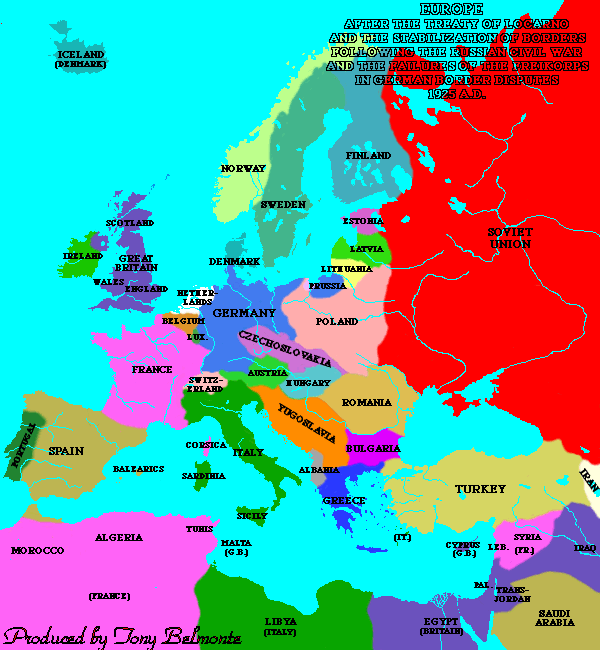
Europe in 1925
World War 2 and later
The coming to power
of Hitler and the Nazis causes the emigration of many Jewish musicians
from Europe, including Schönberg and Korngold, who settle in
Los Angeles, and Walter, who goes to New York.
Schönberg converts back to Judaism in 1933 and vehemently reaffirms
his Jewish ancestry; he also changes the spelling of his name to
Schoenberg because of the lack of umlauts on American typewriters.
Korngold's chief occupation in America is composing film scores
for such 1930s Warner Brothers classics as The Sea Hawk
and Captain Blood -- his style sets the tone for the sound
of Hollywood soundtracks into the 1950s, and enjoys a big revival
again after 1977 with John Williams's Star Wars, whose main
theme is almost a carbon-copy of Korngold's King's Row.
Berg composes 3 more major pieces: his Lyric Suite, for string sextet,
slightly unfinished opera Lulu, and Violin Concerto,
and dies in 1935. Webern is accidentally
killed by an American soldier during the occupation of Austria just
after World War 2 ends in 1945. Schoenberg thus outlives both of
his most famous students.
Schoenberg has an influential teaching career at UCLA, even
counting George Gershwin among his students and friends; still,
he has much difficulty obtaining both recognition from his colleagues
and much-needed financial stability. He suffers a 'temporary death'
in 1946, and composes two of his
most powerful works after his revival: the String Trio, which
he said was specificially meant to depict his 'death', and
A Survivor from Warsaw, based on a story related to him
by an actual survivor of the Nazi extermination policy.
Schoenberg dies in 1951 and Korngold and Sibelius both in 1957.
Pierre Boulez's notorious obituary Schoenberg est mort ['Schoenberg
is dead'] heralds an era from the 1950s to 1980s,
centered mainly in Paris and New York but affecting academic
musical circles all over the world, during which
Webern is the most admired of modern composers.
Boulez's
Le Marteau sans Maître ['the hammer without a master']
is widely considered to be one culmination of this movement.
During the 1950s, Egyptian engineer Mohamed Atalla at Bell Labs
proposes a new method of semiconductor device fabrication using a layer
of silicon oxide over a silicon wafer allowing electricity to reach the silicon,
develops the metal-oxide-semiconductor (MOS) process.
and with his colleague Dawon Kahng invents
the metal-oxide-semiconductor field-effect transistor (MOSFET) in 1959,
leading to mass-production of silicon integrated circuits and eventually
personal computers and almost all electronic devices after that.
Major trends in music after the 1950s originate mainly in America,
particularly rock'n'roll, minimalism, and rap, and by the end of the
millenium, with the recycling of 'samples' of previously-recorded
music in new pieces, it is hard to find anything 'new' outside of
microtonality.
Hobsbawm, Eric. 1962.
Hobsbawm, Eric. 1975.
Hobsbawm, Eric. 1987.
Jean Sibelius: The music (website)
http://www.sibelius.fi/english/musiikki/ork_sinf_01.htm (accessed 2022.0202)
updated:
2000.01.24
2000.04.30
2000.08.14
2000.11.25
2001.01.14
2001.04.02
2002.04.03
2002.09.24 -- added section about Mahler's intonation (1904)
2003.06.25 -- added section about Wagner and Tristan und Isolde (1857)
2003.06.29 -- rearranged beginning sections, added photo of Freddie Mercury
2003.07.07 -- added info about Chopin (1830, 1831, 1849)
2003.07.24 -- added info about Bartok (1908, 1910), expanded on 1911, 1912
2003.08.02 -- added info about Franz Schmidt (1874, 1888, 1896, 1899, 1913)
2003.08.15 -- expanded sections 1913, 1914, During World War 1, and After World War 1; added Berg references
2003.08.16 -- added much info about Beethoven, Bruckner, and Wagner, and many photos
2003.08.21 -- added info on Schubert
2003.08.24 -- added info on history of the phonograph, graphophone, and gramophone (1877-1900)
2003.09.06 -- updated info on Mahler's early career and 1st Symphony (1878-1888)
2003.09.11 -- added complete info on Liszt's symphonic-poems
2003.09.14 -- added info on Dvořák (1841, 1891-3, 1895)
2003.09.27 -- added speculation that Hamburg MS of Mahler's 1st was originally written in 1891.
2003.10.14 -- added much info on Zemlinsky (1892-1905)
2003.12.01 -- added info on history of woodwind instruments (1830s-1840s)
2003.12.07 -- added photos of woodwind instruments (1830s-1840s)
2004.01.24 -- corrected erroneous date of Schoenberg's father's death (1890), added Kammersymphonie 1/4-tone sketch (1906)
2004.01.30 -- added more details about the French Revolution (1787-93), and links to Joplin's list of works
2004.05.11 -- added info about emergence of American world power (1815 and 1823)
2004.06.22 -- added info about Bartók and Kossuth (1903)
2004.12.09 -- added photos of systeme-6 oboes (1875), and Edison phonographs (1877 and 1888)
2005.04.24 -- cited complete quote from Mahler regarding the loss of meantone tuning (1904)
2005.07.23 -- added birth of Ernst Toch (1887)
2005.09.30 -- added info about Rossini (1792, 1855), Bellermann (1862), and
political history of Austria (1790, 1792, 1797, 1805, 1815, 1835, 1846, 1859, 1862,
1866, 1867, After World War 1), Italy (1861, 1870), and Germany (1871).
2005.10.01 -- added more info about Mahler's 8th (1906)
2005.10.07 -- many revisions and additions concerning Schönberg's early
atonal period (1909-1914)
2005.10.11 -- some additions to Mahler's last years in Vienna (1904-1907)
2005.10.13 -- added info on Liszt (1811, 1817, 1833, 1837, 1865, 1886)
and Beethoven (1826)
2005.10.18 -- added info on death of Schubert (1828), première of
Schubert's Unifinished Symphony (1865), and consolidation of French African colonies into French West Africa (1895)
2005.10.29 -- added map of Universitätstrasse (1897),
map of Wörthersee (1899), photos of Mahler's villa
and composing-hut (1900), and 4ths-motto from Mahler 7th and photos of Mahler and his daughters (1905)
2005.11.04 -- added info on Beethoven (1787, 1789, 1792, 1794, 1801, 1803, 1810, 1811)
2005.11.09 -- added many maps of Vienna and summer retreats concerning Mahler and Schoenberg,
and photos (for the period 1894-1908); added info on Bartok (1881, 1888, 1894, 1898, 1899, 1904, 1911)
and photo of Bartok (1899).
2005.11.14 -- added info on genesis of Mahler's 1st Symphony (1888, 1889, 1891, 1893)
2005.11.20 -- added info on Mahler's "Poisl" songs (1880),
Leander and de Molina songs (1882), and Fahrenden Gesellen (1884); on Rott's
compositions studies (1877), and Symphony (1878, 1879, 1880).
2005.11.23 -- added info on Rott (1876, 1877, 1878), Mahler (1878, 1880),
Vienna premieres of Wagner operas
(1857, 1858, 1860, 1870, 1871, 1875, 1877, 1878, 1879, 1883)
2005.11.24 -- added info on Schubert 2nd, 3rd, 4th, 6th, and 7th Symphonies
(1814-17, 1821).
2005.11.25 -- added map of central Europe (top of page);
info on Mahler's father (1827), Mahler's earliest teachers (1865),
Mahler's association of "Ach, du lieber Augustin" with tragedy (1870)
and Schoenberg's allusion to it (Introduction, 1907);
info on Helmholtz (1821, 1838, 1894) and photo of Helmholtz (1862);
photo of Princess Carolyne (1847)
photo of Communist Manifesto and map of Weimar (1848);
info on Raff (1822, 1834, 1840, 1843-49, 1854-5, 1861, 1863, 1869, 1877),
info in Liszt (1830, 1839); info on Bülow (1850-1, 1853, 1855, 1865, 1875, 1878, 1880)
and photo of Bülow (1891); info on Mendelssohn
(1809, 1812, 1821, 1824-26, 1828-30, 1832-3, 1835-7, 1840, 1842, 1844, 1846-7)
and photo of Mendelssohn (1840).
2005.11.26 -- updated info on Liszt symphonic-poems (1848-55);
added info and picture of Einstein (1905)
2005.11.27 -- added info on Raff's "Lenore" Symphony and photo of Raff (1872);
info on Mahler witnessing fireman's funeral (1908);
added text of Mahler's messages on 10th symphony manuscript (1910).
2005.11.30 -- extended and reformatted descriptions of Beethoven's compositions
(1795-1826).
2006.01.24 -- added some detail regarding Mahler's Todtenfeier (1888);
added reference to Brahms recording 1st Hungarian Dance (1889);
added detail on Mahler's summer composing (1892); added small details
regarding Mahler and Schoenberg (1908, 1909, 1910).
2006.02.15 -- added info on premiere of The Rite of Spring (1913).
2006.04.07 -- added info on the development of the bicycle
(1818-19, 1863, 1865-70, 1878-9, 1885, 1888).
2006.12.19 -- added info on Chopin (1810, 1817, 1823, 1826, 1829-30).
2006.12.23 -- added info on Mendelssohn symphonies (1829, 1830, 1833, 1840, 1842)
2007.01.10 -- added headings for "Introductory notes" and "Here begins the chronology";
added info on Beethoven (1787, 1789, 1792), Mozart (1787-91), Haydn (1787-1801), Rossini (1792),
Emperors Joseph II (1790), Leopold II (1790-91), and Francis II (1792).
2007.01.13 -- extended chronology back from 1787 to 1781;
added info on Beethoven (1783, 1787, 1792-3, 1795-8, 1805-7),
added much new info on Mozart (1781-91) and Haydn (1781-86).
2007.01.19 -- minor reformatting of Beethoven entries (1795, 1798-1802)
2007.02.09 -- expanded introduction to Mozart (1781);
expanded entries on Beethoven (1808, 1810); added citation to Für Elise Kritische Ausgabe;
some minor typo corrections.
2007.02.10 -- added paragraph on Mozart's teaching of intonation (1786);
info on Tchaikovsky (1893)
2007.04.20 -- added paragraph about phonoautograph (1857); reworded sentence about velocipede (1863); reworded sentence about Zemlinsky and Schoenberg (1876) and parenthesized the whole paragraph; added paragraph on Charles Cros (1877-8).
2007.10.29 -- added current dollar values for Bettini's phonograph cylinders (1889); reworded description of Mahler's playing to Bülow to reflect my supposition that he still considered it the first movement of a full symphony (1891).
2007.11.16 -- minor revisions (1907).
2007.12.03 -- added info on Smetana (1824, 1840, 1866, 1870, 1874).
2007.12.05 -- reoriented photos of clarinets and oboes (1839, 1840, 1844, 1875)
2008.01.28 -- added info on and photo of Benz Motorwagen (1886)
2008.11.11 -- added references to Eric Hobsbawm (introduction, references);
added info on Cosima Wagner (1864); added info on German unification (1866, 1867, 1871);
minor revisions (1815, 1865, 1870, 1871, 1913).
2008.12.04 -- changed format of table describing Ariel bicycle (1870);
added detail to description of start of WW1 (1914).
2008.12.08 -- added sections on Jacquard Loom (1801, 1805), Babbage Difference Engine (1822), Babbage Analytical Engine (1837), Ada Lovelace (1843); deleted erroneous redundant "Raff" (1843).
2008.12.09 -- added sections on discovery of Uranus (1781) and Neptune (1846).
2008.12.19 -- steam locomotive (1801, 1804, 1830); Transcontinenal Railroad, Suez Canal (1869); Pfitzner (1869, 1872); Brooklyn Bridge (1883); Eiffel Tower (1889); Panama Canal (1914).
2009.01.02 -- added birth of John von Neumann (1903)
2009.04.21 -- invention and spread of telegraph (1844, 1851), invention of telephone (1861, 1876)
2009.05.20 -- minor edits to wording of genesis of Beethoven's 5th (1805, 1806, 1807)
2009.06.23 -- added info on Puccini's operas La Boheme (1896), Tosca (1900), and Madama Butterfly (1904).
2009.09.14 -- additions to French Revolution and Haitian Revolution (1789, 1791-94, 1804)
2009.09.28 -- added info on the waltz (1797); additions to info
on Beethoven (1800, 1806);
and Napoleon (1801, 1805, 1806).
2009.09.30 -- added info on Cherubini (1805, 1816).
2009.10.17 -- added more info on Mendelssohn (1826).
2009.10.22 -- added more info on Beethoven (1805, 1808).
2009.10.28 -- added info on Beethoven's sketchbooks (1798).
2009.10.30 -- added info on Beethoven's "Christus am Oelberge" (1803).
2009.11.05 -- added info on Saint-Saens (1886), Franck (1888), Tchaikovsky (1878, 1888),
Rimsky-Korsakov (1888).
2009.11.25 -- added precise dates and theater names to premieres of von Suppe operettas.
2009.12.08 -- added more precise dates for Berg compositions (1910, 1912) and Mahler events (1910).
2009.12.12 -- added birth of Gropius (1883); details on Mahler events (1910).
2009.12.15 -- added detail about dates concerning Mahler (1908); added
detail about Gropius affair (1910); corrected info about Ives (1910)
2009.12.19 -- added musical example from Mahler 2nd Symphony (1888);
added exact dates for several events (1907-1910); added photo of Varese (1909);
added dates for Schoenberg's exhibition (1910); added map of Mahler's trip to Leiden (1910);
added detail about Mahler's last trip to America (1910); added speculation on 9-note chord
in Mahler's 10th and musical example (introduction, 1910).
2009.12.23 -- added info on San Francisco earthquake (1906) and American financial crisis (1907).
2009.12.25 -- minor edits (1910)
2009.12.27 -- added links to Korngold and Mahler lists of works; several minor edits;
added birth of Wyschnegradsky (1893).
2010.01.01 -- added birth of Toscanini (1867); edits and corrections concerning
Mahler and Schoenberg (1908, 1909).
2010.11.21 -- edited details about Beethoven's last quartets (1822, 1824, 1825, 1826);
edits regarding Mahler's Das Lied von der Erde (1908), additional material on
Beethoven's early works: String Trio (1794), Piano Sonatas op.49, Cello Sonatas (1795),
publications of early works (1797), 3 String Trios, 6 String Quartets, sketchbooks (1798).
2013.09.30 -- added Beethoven's 10th quartet (1809).
2020.03.31 -- added Stravinsky Firebird (1909, 1910) and Petrushka (1910, 1911), and more info
on Rite of Spring (1910, 1911, 1912, 1913)
2020.04.02 -- added Stravinsky's birth (1882), studies with Rimsky-Korsakov (1905),
Scherzo Fantastique (1907, 1908, 1909) and Feu d'artifice (1908, 1909)
2020.04.03 -- added info about American Civil War (1860, 1861, 1862, 1865);
corrected spelling of Dvořák's name using proper Czech characters
(1841, 1874, 1877, 1891-3, 1895, 1897-8)
2022.01.12 -- several various edits, additions, and corrections, mainly concerning Mahler
(1888 to 1905); added info about Natalie Bauer-Lechner (1858, 1866, 1890, 1894, 1901);
added info about Shohé Tanaka (1862, 1882, 1884);
2022.01.13 -- added more details about Bruckner: 1st symphony (1866);
2nd Symphony (1871, 1872, 1873); 3rd Symphony (1876, 1877, 1889, 1890);
4th Symphony (1874, 1878, 1879, 1880, 1887, 1888, 1895); 5th Symphony (1875);
9th Symphony (1887, 1893, 1894)
2022.01.15 -- added material about Smetana (1863, 1865, 1866, 1870, 1874)
2022.0202 -- added info on Sibelius (1898, 1899, 1900, 1901, 1902, 1903, 1907, 19
10, 1911, During World War 1, After World War 1), Richard Strauss (During World War 1)
2022.0625 -- added info on Lilienfeld (1882, 1900, 1905, After World War 1),
Atalla and MOSFET (After World War 2)
2022.0626 -- added info on Edison (1847, 1879, 1884), Fleming (1849, 1904),
Hertz (1857, 1886), Marconi (1874, 1896, 1901), de Forest (1873, 1906, 1907)
2022.0628 -- added info on Maxwell (1831)
2022.0629 -- added NY Philharmonic tours (1910, 1911)
2024.1022 -- added more accurate dates for Mahler Symphony 2 and map of Mahler's Scandinavian trip (1888, 1889, 1890, 1891)
2024.1109 -- added Beethoven using "Hendrix Chord" (1799); corrected all the format errors.
2024.1110 -- added and corrected many details of Mahler's last years (1907 to 1911).
2024.1111 -- added many maps and dates concerning Mahler (1892 to 1910).
2024.1129 -- added many details about: clarinet development (1786, 1810, 1815, 1816, ); Beethoven (1812, 1816, 1820-23, ); Mahler (1887-88); Partch (1901, 1904, 1907, 1909, 1910, 1913) 2024.1201 -- added details and graphics concerning Haydn (1781, 1784, 1790, 1795) and Mahler (1901); minor edits (1793, 1796) 2025.0629 -- added details about Schönberg's and Webern's adoption of athematicism (1908, 1909, 1913, 1914) 2025.0721 -- added details about Schönberg's op. 22 "4 Orchestral Songs" (1913, 1914, During World War 1) 2026.0524 -- added performances by Mahler of Brahms Symphony 3 and Symphony 1 (1910)
References
(in chronological order -- partial list only... to be completed in future)
Schönberg, Arnold. 1911.
Harmonielehre.
Leipzig & Vienna: Verlagseigentum der Universal-Edition.
U.-E. Nr. 3370.
Gelatt, Roland. 1955.
The Fabulous Phonograph
J.B. Lippincott, NY.
MacMillan Publishing Company; 2nd edition (April 1977)
ASIN: 0020326807
The Age of Revolution: Europe 1789-1848
ISBN 0679772537
Yates, Peter. 1964.
An Amateur at the Keyboard
(p 60 quoted by Douglas Leedy in Interval, vol. 4 #1, winter 1982-83)
Mahler, Alma. 1968.
Gustav Mahler; memories and letters
Enl. ed., rev. and edited and with an introd. by Donald Mitchell. Translated by Basil Creighton.
London, J. Murray.
xxx, 369 p. facsims. (incl. music), illus., ports. 23 cm.
Bib Record ID: 734989
L.o.C. number: ML410.M23 W532 1968
Lang, Paul Henry, ed. 1970.
The Creative World of Beethoven
New York, W. W. Norton & Co.
291 p. facsims. (incl. music), illus.
ISBN: 0393021580, 0393006050
L.o.C. number: 79-159746
La Grange, Henry-Louis de. 1973.
Mahler (volume 1).
Garden City, N.Y., Doubleday.
Includes bibliographical references.
ISBN: 0385005245
L.o.C. number: ML410.M23 L3
The Age of Capital: 1848-1875
Schoenberg, Arnold. 1978.
Theory of Harmony.
English translation by Roy E. Carter of Schönberg 1911 (Harmonielehre).
University of California Press, Berkeley.
ISBN: 0-520-04944-6 (paper), 0-520-04945-4 (cloth)
Moldenhaur, Hans and Rosaleen. 1978.
Anton von Webern: A Chronicle of his Life and Work.
New York: Alfred A. Knopf.
0-394-47237-3
L.o.C. number: ML410.W33 M55
Monson, Karen. 1979.
Alban Berg: A biography.
Boston: Houghton Mifflin Company
London: Macdonald General Books
ISBN: 0-354-04464-8
Heyworth, Peter. 1984.
Otto Klemperer, His Life and Times; vol. 1
Cambridge Univ Press
ISBN: 0521242932
Blaukopf, Herta, ed. 1984.
Gustav Mahler - Richard Strauss: Correspondence 1888-1911.
Chicago: The University of Chicago Press; London: Faber and Faber Ltd.
ISBN: 0-226-05767-4 (cloth), 0-226-05768-2 (paper)
L.o.C. number: ML410.M23 A4713 1984
Jarman, Douglas, 1979; rev. paperback ed. 1985.
The Music of Alban Berg.
Berkeley and Los Angeles: University of California Press
ISBN: 0-520-04954-3
L.o.C. number: 77-76687
Beaumont, Antony. 1985.
Busoni the composer
Bloomington : Indiana University Press.
408 p. : ill. ; 25 cm. Includes index.
"Catalogue of Busoni's transcriptions and cadenzas": p.375-379.
"Chronological catalog of Busoni's works": p.355-373.
Bibliography: p.381-386.
ISBN: 0253312701
L.o.C. number: ML410.B98 B4 1985
The Age of Empire: 1875-1914 (1987)
ISBN 0521437733
Busoni, Ferruccio. 1987.
Selected letters
translated, edited, and with an introduction by Antony Beaumont.
New York : Columbia University Press.
xix, 446 p. : ill. ; 26 cm. Includes bibliographical references and indexes.
ISBN: 0231064608
L.O.C. Number: ML410.B98 A4 1987
Brand, Juliane; Haily, Christopher; Harris, Donald, ed. 1987.
The Berg-Schoenberg Correspondence: Selected Letters.
W. W. Norton & Company, New York
ISBN: 0-393-01919-5
L.O.C. number: ML410.B47A4 1987
Dewey number: 780'.92'2
Yates, Peter. 1990. (written c. 1960)
"The American Experimental Tradition".
Soundings (last issue), p. 135-143.
Jarman, Douglas. 1990.
The Berg Companion
Northeastern University Press
ASIN: 1555530680
Frisch, Walter. 1993.
The early works of Arnold Schoenberg, 1893-1908
Berkeley : University of California Press.
xix, 328 p. : music ; 27 cm. Includes bibliographical references and indexes.
ISBN: 0520078195
L.o.C. number: ML410.S283 F75 1993
Berlin, Edward A. 1994.
King of Ragtime: Scott Joplin and His Era.
New York, Oxford: Oxford University Press.
ISBN: 0-19-508739-9 paperback: 0-19-510108-1
L.o.C. number: ML410.J75 B5 1994
Mitchell, Donald. 1995.
Gustav Mahler, volume 1: The Early Years
Berkeley and Los Angeles: University of California Press.
Paperback edition; first published 1958, revised edition 1980.
Includes new appendix.
ISBN: 0-520-20214-7
L.O.C. Number: ML410.M23 M5 1980
Dewey Number: 780.92.4
La Grange, Henry-Louis de. 1995.
Gustav Mahler, v. 2. Vienna : the years of challenge (1897-1904)
Oxford ; New York : Oxford University Press.
v. : ill. ; 25 cm. Rev., enl., and updated translation of the French ed., by the author.
Includes bibliographical references and indexes.
ISBN: 0193151596
L.O.C. Number: ML410.M23 L3413 1995
Alexander Zemlinsky ; herausgegeben von Horst Weber.
Briefwechsel der Wiener Schule / herausgegeben im Auftrag des Staatlichen Instituts für Musikforschung Preussischer Kulturbesitz Berlin von Thomas Ertelt, Bd. 1.
Darmstadt : Wissenschaftliche Buchgesellschaft, c1995-
L.o.C. number: ML90 .B75 1995
McClatchie, Stephen 1996.
"The 1889 Version of mahler's First Symphony: A New Manuscript Source"
19th Century Music, volume 20 number 2 [Fall 1996].
Swafford, Jan. 1997.
Johannes Brahms : a biography.
New York : Alfred A. Knopf : Distributed by Random House, Inc.
xxii, 699 p. : ill. ; 25 cm. Includes bibliographical references (p. [671]-678) and index.
ISBN: 0679422617
L.o.C. number: ML410.B8 S93 1997
Carroll, Brendan G. 1997.
The last prodigy: a biography of Erich Wolfgang Korngold.
Portland, Oregon: Amadeus Press (an imprint of Timber Press, Inc.)
ISBN: 1-57467-029-8
L.o.C. number: ML410.K7356 C37 1997
Pople, Anthony, ed. 1997.
The Cambridge Companion to Berg
320 pages ; Dimensions (in inches): 0.65 x 9.69 x 6.80
Publisher: Cambridge University Press; (June 1997)
ISBN: 0521564891
Schweiger, Domenik. 1998.
"Weberns verworfene microtöne"
Mitteilungen der Paul Sacher Stiftung, number 11.
Basel : Paul Sacher Stiftung.
v. : ill. ; 25 cm. Annual
L.o.C. number: ML5 .P3
Mahler, Alma. 1999.
Diaries, 1898-1902
selected and translated by Antony Beaumont
from the German edition transcribed and edited by Antony Beaumont and Susanne Rode-Breymann.
Ithaca, N.Y. : Cornell University Press.
xix, 494 p., [8] p. of plates : ill. ; 25 cm.
ISBN: 0801436540
L.o.C. number: DB844.M34 A3 1999
La Grange, Henry-Louis de. 1999.
Gustav Mahler, v. 3. Vienna : triumph and disillusion (1904-1907)
Oxford ; New York : Oxford University Press.
v. : ill. ; 25 cm. Rev., enl., and updated translation of the French ed., by the author.
Includes bibliographical references and indexes.
ISBN: 019315160X
Beaumont, Antony. 2000.
Zemlinsky
Ithaca, N.Y. : Cornell University Press.
ISBN: 0-8014-3803-9 (cloth)
L.o.C number: ML410.Z43 B42 2000
Simms, Bryan R. 2000.
The atonal music of Arnold Schoenberg, 1908-1923
New York: Oxford University Press.
ISBN: 0-19-512826-5
L.o.C. number: ML410.S283 S45 2000
Brandenburg, Sieghard 2002.
Ludwig van Beethoven, Klavierstück a-Moll WoO 59 Für Elise, commentary
Kritische Ausgabe mit Faksimile der Handschrift BH 116
Verlag Beethoven-Haus Bonn
ISBN: 3-88188-074-7
La Grange, Henry-Louis de. 2008.
Gustav Mahler, v. 4. A New Life Cut Short (1907-1911)
Oxford ; New York : Oxford University Press.
v. : ill. ; 25 cm. Rev., enl., and updated translation of the French ed., by the author.
Includes bibliographical references and indexes.
ISBN: 978-0-19-816387-9
Winter, Robert and Peter Bogdanoff.
From the New World, A Composer's American Sojourn (DVD-ROM)
excerpted at DVD-ROM, From the New World, A Composer's American Sojourn">
1999.11.01
Please make a donation to help keep Tonalsoft online. A recurring monthly contribution would be apprecitated.
Thank you!

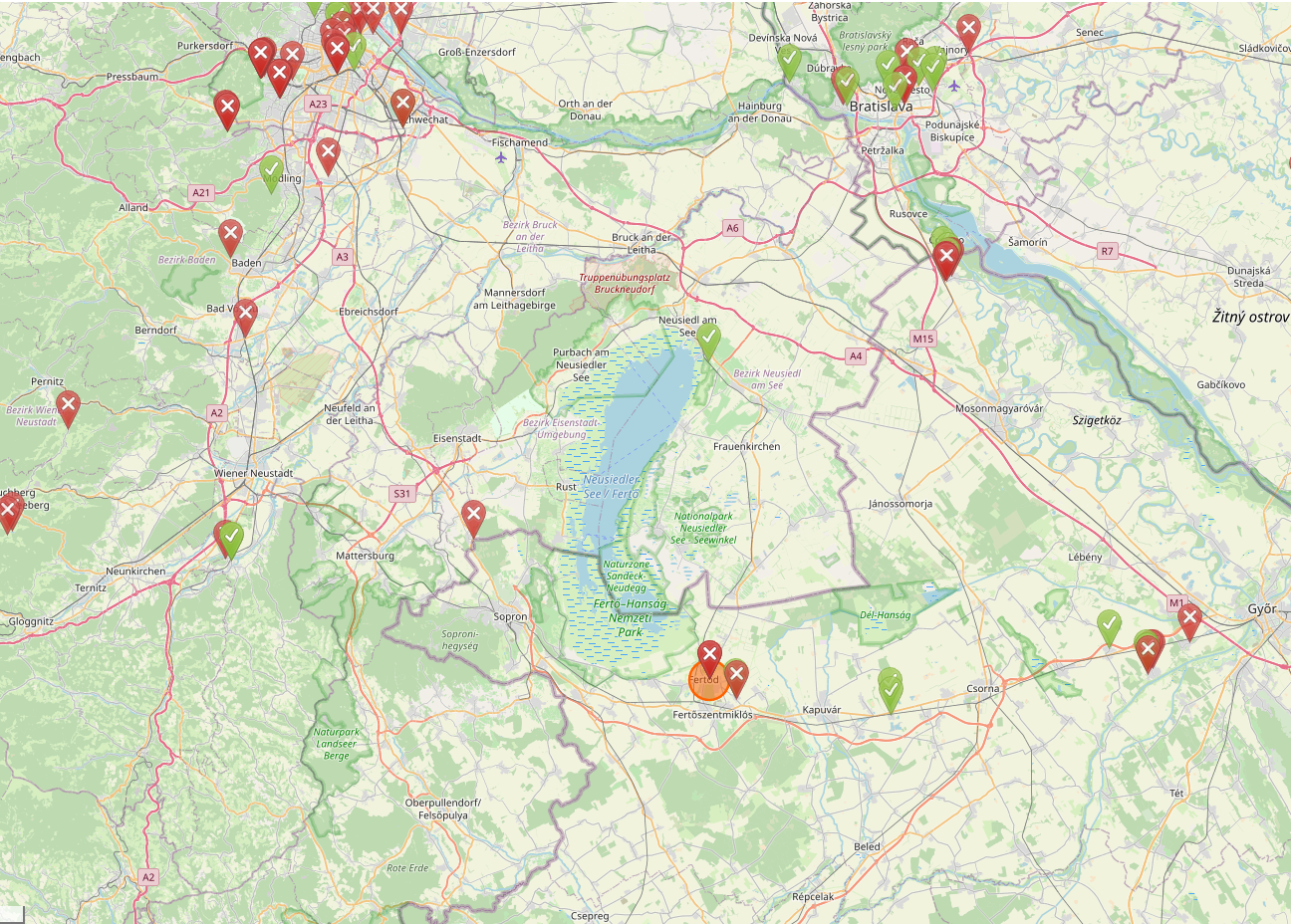
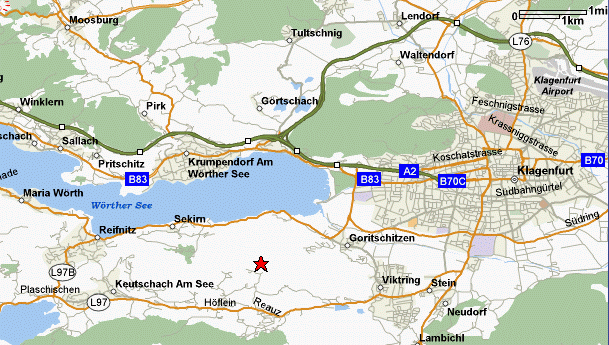
![Mahler's hauschen [composing-hut] in Maiernigg](./viennafiles/mahler-maiernigg-hut.jpg)